2.10 The Binomial Distribution

📊AP Statistics Unit 2 Review
2.10 The Binomial Distribution
📊 AP Statistics
Unit 2 Overview: Probability, Random Variables, and Probability Distributions
2.1
Tabular and Graphical Representations for the Distributions of Two Categorical Variables
2.2
Summary Statistics for Two Categorical Variables
2.3
Estimating Probabilities Using Simulation
2.4
Introduction to Probability
2.5
Mutually Exclusive Events
2.6
Conditional Probability
2.7
Independent Events and Unions of Events
2.8
Introduction to Random Variables and Probability Distributions
2.9
Parameters of Random Variables
2.10
The Binomial Distribution
2.11
The Normal Distribution
2.12
Sampling Distributions and the Central Limit Theorem
A binomial random variable counts the number of successes in a fixed number of independent trials, where each trial ends in success or failure and the probability of success stays the same. In this revised topic, you should be able to recognize a binomial setting, find probabilities, and use the shortcut formulas for the mean and standard deviation.
Why This Matters for the AP Statistics Exam
The binomial distribution is one of the most common discrete models in AP Statistics. On the exam, you may need to recognize when a setting is binomial, compute the probability of a certain number of successes, or calculate the expected number of successes and the standard deviation of that count.
Key Takeaways
- A binomial random variable counts successes, not trials.
- The BINS conditions are Binary outcomes, Independent trials, fixed Number of trials, and Same probability of success.
- Use for the probability of exactly successes.
- For a binomial random variable, the mean is and the standard deviation is .
What Makes a Setting Binomial
A binomial random variable counts the number of successes in a fixed number of independent trials. To recognize a binomial setting, check that all of these are true:
- there is a fixed number of trials,
- each trial is independent
- each trial has only two outcomes: success or failure
- the probability of success is the same on every trial
Many AP Statistics teachers use the acronym BINS:
- Binary
- Independent
- fixed Number of trials
- Same probability of success
Probabilities and Parameters
Once the conditions are met, you can answer two kinds of questions:
- What is the probability of a certain number of successes?
- What is the expected number of successes, and how much does that count typically vary?
The Binomial Probability Formula
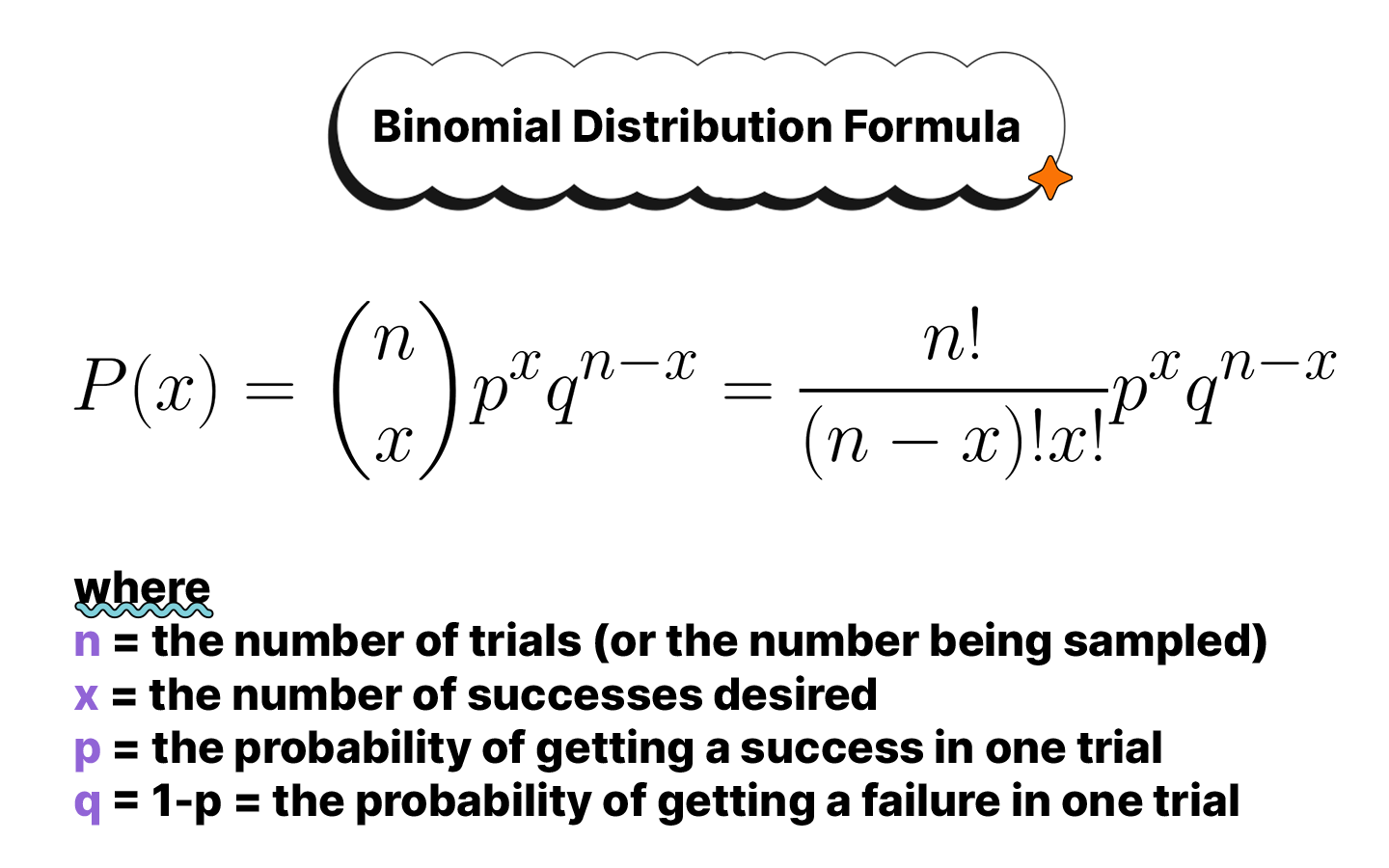
The probability that a binomial random variable has exactly successes in independent trials, with success probability , is:
You can also use calculator functions such as binompdf and binomcdf.
Mean and Standard Deviation of a Binomial Variable
If is binomial with trials and success probability , then:
The mean is the expected number of successes in the long run. The standard deviation tells you how much the count of successes typically varies from that expected value.
How to Use This on the AP Statistics Exam
Problem Solving
- Identify , , and what counts as a success.
- Check BINS before using any formula.
- Write the probability expression or parameter formula clearly.
- Give the answer in context.
Common Trap
Watch the wording. "Exactly 3" means , "at most 3" means , and "at least 3" usually means using a complement.
Practice Example
Suppose 10 people each try a new snack and each person independently likes it with probability . Let be the number who like the snack.
The probability that exactly 3 people like it is:
The parameters are:
That means you expect about 5 of the 10 people to like the snack, and the count typically varies by about 1.58 people from that expected value.
Common Misconceptions
- Misconception: Binomial counts trials, not successes.Actually: Binomial counts successes, not trials.
- Misconception: The formulas work before checking conditions.Actually: They do not.
- Misconception: The standard deviation is .Actually: That is the variance, not the standard deviation.
- Misconception: A success has to be something good.Actually: It does not. "Success" is just the outcome you chose to count.
Related AP Statistics Guides
Practice Questions for 2.10
1 of 10
A psychologist models the number of correct responses in a cognitive test as a binomial random variable with mean and standard deviation . What are the values of the number of trials and the probability of success ?
A.
and
B.
and
C.
and
D.
and
Vocabulary
The following words are mentioned explicitly in the AP® course framework for this topic.Term | Definition |
|---|---|
binomial distribution | A probability distribution that describes the number of successes in a fixed number of independent trials, each with the same probability of success. |
binomial probability function | The formula P(X=x)=C(n,x)p^x(1-p)^(n-x) that calculates the probability of exactly x successes in n independent trials with probability of success p. |
binomial random variable | A random variable that counts the number of successes in a fixed number of repeated independent trials, where each trial has two possible outcomes. |
independent trials | Repeated experiments or observations where the outcome of one trial does not affect the outcome of any other trial. |
mean | The average value of a dataset, represented by μ in the context of a population. |
number of failures | The count of unfavorable outcomes in a sample, denoted as n(1-p̂), used to verify the normality condition. |
number of successes | The count of favorable outcomes in a sample, denoted as np̂, used to verify the normality condition. |
parameter | A numerical summary that describes a characteristic of an entire population. |
probability | The likelihood or chance that a particular outcome or event will occur, expressed as a value between 0 and 1. |
probability distribution | A function that describes the likelihood of all possible values of a random variable. |
probability of success | The constant probability p that an individual trial results in a success in a binomial experiment. |
random number generator | A tool or method used to randomly select items from a population for inclusion in a simple random sample. |
random variable | A variable whose value is determined by the outcome of a random phenomenon and can take on different numerical values with associated probabilities. |
simulation | A method of modeling random events so that simulated outcomes closely match real-world outcomes, used to estimate probabilities. |
standard deviation | A measure of how spread out data values are from the mean, represented by σ in the context of a population. |
Frequently Asked Questions
What is a binomial distribution in AP Stats?
A binomial distribution models the number of successes in a fixed number of independent trials when each trial has two outcomes and the probability of success stays constant.
How do I know if a setting is binomial?
Check for a fixed number of trials, independent trials, two outcomes on each trial, and the same probability of success on every trial.
What is the binomial formula for AP Statistics?
For exactly x successes in n independent trials with success probability p, use P(X=x)=C(n,x)p^x(1-p)^(n-x).
When do I use binompdf vs binomcdf?
Use binompdf for exactly one value, such as P(X=3). Use binomcdf for at most a value, such as P(X≤3). For at least a value, use a complement when it is simpler.
What does success mean in a binomial problem?
Success is just the outcome you choose to count. It does not have to be a good result; it could be a defective item, a correct answer, or a person with a certain trait.
How should I set up a binomial FRQ answer?
Define X, identify n and p, verify the binomial conditions if needed, write the probability expression or calculator command, and interpret the final probability in context.
See Fiveable more often in Google
Mark Fiveable as a preferred source and Google is more likely to show you our guides in Top Stories, with a "preferred" badge in AI Mode and AI Overviews.