AP Psychology EBQ Practice
100 Evidence-Based Questions written in the AP format. Pick one, read the three sources, and write your argument. Fiveable scores each EBQ response part by part on the AP rubric.
Your first scored response is included. A plan unlocks unlimited scoring.
100 questions
sorted by unit
Sleep loss across task complexity, chronic attention lapses, and visual learning
Unit 1: Biological Bases of Behavior
This question has three parts: Part A, Part B, and Part C. Use the three sources provided to answer all parts.
For Part B and Part C, you must cite the source that you used to answer the question. You can do this in two different ways:
• Parenthetical Citation: For example: "...(Source 1)."
• Embedded Citation: For example: "According to Source 1..."
Write the response to each part of the question in complete sentences. Use appropriate psychological terminology.
Using the sources provided, develop and justify an argument about whether sleep deprivation consistently impairs cognitive performance.
Propose a specific and defensible claim based in psychological science that responds to the question: How does sleep affect cognitive functioning?
Support your claim using at least one piece of specific and relevant evidence from one of the sources.
Explain how the evidence from Part B (i) supports your claim using a psychological perspective, theory, concept, or research finding learned in AP Psychology.
Support your claim using an additional piece of specific and relevant evidence from a different source than the one that was used in Part B (i).
Explain how the evidence from Part C (i) supports your claim using a different psychological perspective, theory, concept, or research finding learned in AP Psychology than the one that was used in Part B (ii).
Source 1
Introduction
How does sleep deprivation differentially affect cognitive performance on tasks of varying complexity? This study examines the relationship between sleep loss and task performance through the lens of arousal theory, which suggests that optimal performance depends on matching arousal levels to task demands—with simple tasks requiring higher arousal and complex tasks benefiting from moderate arousal levels.
Participants
Total N: 84
Gender Breakdown: 47 females, 35 males, 2 non-binary
Age Info: Mean age = 20.3 years (SD = 1.8), range 18-25 years
Recruitment: Participants were recruited from undergraduate psychology courses at a large Midwestern university and received course credit for participation. Individuals with sleep disorders, those taking medications affecting alertness, or those who consumed more than 400mg of caffeine daily were excluded.
Method
This between-subjects experiment was conducted in a controlled laboratory setting equipped with individual testing stations. Researchers randomly assigned participants to either the sleep deprivation condition or the control condition to examine how acute sleep loss affects performance on cognitive tasks of differing complexity.
All participants arrived at the laboratory at 8:00 AM for testing. Sleep-deprived participants had been monitored since 8:00 AM the previous day, while control participants arrived after a normal night's sleep. Following informed consent and a brief orientation, participants completed both cognitive tasks in counterbalanced order with a 10-minute break between tasks. The entire testing session lasted approximately 45 minutes.
The Psychomotor Vigilance Task (PVT) served as the simple task measure, requiring participants to press a button as quickly as possible when a visual stimulus appeared at random intervals over a 10-minute period. Performance was operationalized as mean reaction time in milliseconds. The Logical Reasoning Test (LRT) served as the complex task measure, consisting of 30 syllogism problems requiring deductive reasoning, with participants given 20 minutes to complete as many items as possible. Performance was operationalized as the percentage of items answered correctly.
Sleep Deprived (24 hours awake): Participants remained awake in a monitored sleep laboratory for 24 continuous hours prior to testing. Research assistants supervised participants throughout the night, engaging them in low-stimulation activities such as reading, watching documentaries, or playing card games. Caffeine and other stimulants were prohibited.
Control (Normal sleep): Participants maintained their regular sleep schedules the night before testing and were required to sleep at least 7 hours, verified through sleep diary entries and actigraphy wristbands.
Results
Sleep-deprived participants performed significantly worse on the simple Psychomotor Vigilance Task, with a mean reaction time of 412 ms (SD = 58) compared to 298 ms (SD = 41) for control participants, t(82) = 10.47, p < .001, d = 2.28.
On the complex Logical Reasoning Test, sleep-deprived participants scored 67.2% correct (SD = 12.4) while control participants scored 69.8% correct (SD = 11.8), a non-significant difference, t(82) = 0.98, p = .33, d = 0.21.
Independent samples t-tests were conducted for each task. Cohen's d effect sizes indicated a large effect for the PVT (d = 2.28) and a small, non-significant effect for the LRT (d = 0.21). Alpha was set at .05 for all analyses.
Task Performance by Sleep Condition and Task Complexity
A grouped bar graph with two clusters representing the two task types. The left cluster shows Psychomotor Vigilance Task results with reaction time in milliseconds: a tall dark blue bar for Sleep Deprived condition at 412 ms and a shorter light blue bar for Control condition at 298 ms. The right cluster shows Logical Reasoning Test results with percentage correct: a dark blue bar for Sleep Deprived at 67.2% and a light blue bar for Control at 69.8%, appearing nearly equal in height. Error bars represent standard deviations. An asterisk appears above the PVT cluster indicating statistical significance, while 'n.s.' appears above the LRT cluster.
Task Performance by Sleep Condition and Task Complexity
Series | 1 | 2 |
|---|---|---|
Sleep Deprived | 412 | 67.2 |
Control | 298 | 69.8 |
Discussion
These findings support arousal theory's predictions regarding the interaction between arousal levels and task complexity. Sleep deprivation, which reduces arousal, severely impaired performance on the simple vigilance task that requires sustained attention and higher arousal, while leaving complex reasoning relatively intact—possibly because lower arousal levels may actually approach the moderate optimal level needed for complex cognitive processing.
Brennan, K. L., Okonkwo, D. M., & Harrington, S. J. (2021). Differential effects of acute sleep deprivation on simple and complex cognitive task performance: Support for arousal theory. Journal of Experimental Psychology: Applied, 27(3), 418-432.
Source 2
Introduction
How does chronic partial sleep restriction accumulate over time to affect cognitive performance? This experimental study examined the concept of sleep debt by investigating whether consecutive nights of reduced sleep produce cumulative cognitive deficits that compound over time, even when individuals do not perceive significant impairment.
Participants
Total N: 48
Gender Breakdown: 26 males, 22 females
Age Info: Ages 21-38 years (M = 28.4, SD = 4.7)
Recruitment: Participants were recruited through community advertisements and university health center postings; all were screened to confirm regular sleep patterns (7-8 hours nightly), no history of sleep disorders, and no shift work in the past year
Method
This controlled laboratory experiment was conducted in a sleep research facility where participants resided for 16 consecutive days (2 baseline days plus 14 experimental days). The facility controlled for light exposure, caffeine, alcohol, and napping opportunities to isolate the effects of sleep restriction.
After two baseline nights of 8-hour sleep opportunities, participants were randomly assigned to one of three sleep conditions for 14 consecutive nights. Each day at 10:00 AM, 2:00 PM, and 6:00 PM, participants completed a 10-minute Psychomotor Vigilance Task (PVT) and a subjective sleepiness rating. Polysomnography confirmed actual sleep duration each night.
Cognitive performance was measured using lapses on the PVT, operationally defined as reaction times exceeding 500 milliseconds. The daily lapse score was calculated as the average number of lapses across the three testing sessions. Subjective sleepiness was assessed using the Stanford Sleepiness Scale (1 = fully alert to 7 = almost asleep).
8-hour condition: Participants were given 8 hours in bed each night (11:00 PM - 7:00 AM), serving as the control condition
6-hour condition: Participants were restricted to 6 hours in bed each night (1:00 AM - 7:00 AM), representing moderate sleep restriction
4-hour condition: Participants were restricted to 4 hours in bed each night (3:00 AM - 7:00 AM), representing severe sleep restriction
Results
Participants in the 4-hour condition showed a steady linear increase in attention lapses from an average of 2.1 lapses on Day 1 to 24.8 lapses by Day 14, while the 6-hour condition increased from 1.9 lapses to 15.3 lapses over the same period
The 8-hour control group remained stable at approximately 2.0-2.5 lapses throughout the 14 days
By Day 14, performance deficits in the 4-hour and 6-hour conditions matched those previously documented in studies of 24-48 hours of total sleep deprivation
Despite severe cognitive impairment, participants in restricted sleep conditions reported only moderate sleepiness (M = 3.2 on the 7-point scale), indicating poor self-awareness of accumulated sleep debt
A mixed-design ANOVA revealed a significant interaction between sleep condition and day, F(26, 585) = 14.72, p < .001, η²p = .40. Post-hoc comparisons confirmed that both the 4-hour and 6-hour conditions differed significantly from the 8-hour condition by Day 3 (p < .01) and continued to diverge thereafter.
Cumulative Attention Lapses Across 14 Days of Sleep Restriction
A line graph displaying three distinct lines tracking average daily PVT lapses over 14 days. The x-axis shows Day (1-14) and the y-axis shows Average Number of Lapses (0-30). The 8-hour condition line (blue) remains flat near the bottom at approximately 2-2.5 lapses throughout. The 6-hour condition line (orange) shows gradual upward trajectory from about 1.9 on Day 1 to 15.3 on Day 14. The 4-hour condition line (red) shows steep upward trajectory from about 2.1 on Day 1 to 24.8 on Day 14. Error bars are shown at each data point.
Cumulative Attention Lapses Across 14 Days of Sleep Restriction
Series | 1 | 2 | 3 | 4 | 5 | 6 | 7 | 8 | 9 | 10 | 11 | 12 | 13 | 14 |
|---|---|---|---|---|---|---|---|---|---|---|---|---|---|---|
8-hour condition | 2 | 2.1 | 2.3 | 2.1 | 2.4 | 2.2 | 2.5 | 2.3 | 2.2 | 2.4 | 2.3 | 2.5 | 2.4 | 2.5 |
6-hour condition | 1.9 | 3.1 | 4.5 | 5.8 | 7.2 | 8.4 | 9.6 | 10.5 | 11.4 | 12.3 | 13.1 | 14 | 14.7 | 15.3 |
4-hour condition | 2.1 | 4.8 | 7.2 | 9.5 | 11.8 | 14 | 16.1 | 18 | 19.8 | 21.3 | 22.6 | 23.7 | 24.3 | 24.8 |
Discussion
These findings demonstrate that sleep debt accumulates in a dose-dependent manner, with cognitive impairment building steadily even when individuals perceive themselves as only mildly sleepy. The dissociation between objective performance deficits and subjective awareness of impairment has critical implications for understanding why sleep-deprived individuals often fail to recognize their compromised cognitive state.
Morrison, K. L., Tanaka, R., & Blackwood, S. E. (2021). Chronic sleep restriction and the accumulation of neurocognitive deficits: A controlled laboratory study. Sleep Medicine Reviews, 58(3), 234-251.
Source 3
Introduction
What role do specific sleep stages play in the consolidation of procedural memory? This experiment investigated whether REM sleep, compared to slow-wave sleep (SWS), is differentially important for strengthening newly acquired motor and perceptual skills, addressing fundamental questions about sleep-dependent memory consolidation mechanisms.
Participants
Total N: 63
Gender Breakdown: 34 females, 29 males
Age Info: Mean age = 20.4 years (SD = 1.8), range 18-25 years
Recruitment: Undergraduate students recruited through the university psychology research participation pool who reported normal sleep patterns and no history of sleep disorders
Method
Participants spent two consecutive nights in a sleep laboratory equipped with polysomnography (PSG) monitoring systems to track sleep stages via EEG, EOG, and EMG recordings. Each participant was randomly assigned to one of three experimental conditions involving targeted sleep stage disruption.
On the first evening, all participants completed training on a visual texture discrimination task, which required identifying the orientation of a target array embedded in a background of horizontal lines presented briefly (16 ms) before a mask. Baseline performance thresholds were established as the minimum stimulus-to-mask interval (SOA) at which participants achieved 80% accuracy. Participants then slept overnight in the laboratory while undergoing their assigned sleep manipulation. The following morning, after a standardized wake period of 90 minutes, participants completed the texture discrimination task again under identical conditions.
The dependent variable was improvement in visual texture discrimination, operationally defined as the decrease in stimulus-to-mask onset asynchrony (SOA in milliseconds) needed to maintain 80% accuracy from pre-sleep baseline to post-sleep testing. Greater decreases indicated stronger procedural memory consolidation.
REM Deprived: Participants were awakened by a tone each time PSG indicated entry into REM sleep and kept awake for 3 minutes before being allowed to return to sleep (n = 21)
SWS Deprived: Participants were awakened each time PSG indicated entry into slow-wave (N3) sleep and kept awake for 3 minutes before being allowed to return to sleep (n = 21)
Control: Participants were awakened an equivalent number of times during Stage N2 (light sleep) to control for disruption effects without targeting memory-critical stages (n = 21)
Results
The REM Deprived group showed virtually no improvement on the texture discrimination task, with a mean SOA decrease of only 1.2 ms (SD = 4.8) from baseline to retest
The SWS Deprived group demonstrated significant improvement with a mean SOA decrease of 18.7 ms (SD = 6.2), comparable to the Control group's improvement of 19.4 ms (SD = 5.9)
A one-way ANOVA revealed a significant main effect of sleep condition on task improvement, F(2, 60) = 72.14, p < .001, η² = .71
Post-hoc Tukey HSD tests confirmed that the REM Deprived group improved significantly less than both the SWS Deprived group (p < .001) and the Control group (p < .001), while SWS Deprived and Control groups did not differ significantly from each other (p = .89).
Improvement in Visual Texture Discrimination Task by Sleep Deprivation Condition
A bar graph with three vertical bars representing the three experimental conditions. The x-axis shows the three groups: REM Deprived, SWS Deprived, and Control. The y-axis shows 'Improvement in SOA Threshold (ms)' ranging from 0 to 25 milliseconds. The REM Deprived bar is very short at 1.2 ms, while the SWS Deprived bar reaches 18.7 ms and the Control bar reaches 19.4 ms. Error bars showing standard error are included on each bar. The REM Deprived bar is distinctly shorter than the other two nearly equal bars.
Improvement in Visual Texture Discrimination Task by Sleep Deprivation Condition
Series | 1 | 2 | 3 |
|---|---|---|---|
Mean Improvement | 1.2 | 18.7 | 19.4 |
Discussion
These findings demonstrate that REM sleep plays a critical and selective role in procedural memory consolidation, as only disruption of REM sleep—not slow-wave sleep—prevented overnight improvement on the perceptual skill task. This supports the hypothesis that REM sleep provides unique neurobiological conditions, potentially involving acetylcholine-mediated plasticity, necessary for stabilizing procedural memories.
Nakamura, T., Westbrook, R. F., & Chen, L. M. (2021). Selective REM sleep deprivation impairs consolidation of visual procedural learning in young adults. Journal of Sleep Research, 30(4), 287-298.
What the EBQ asks
The Evidence-Based Question is FRQ 2 on the AP Psychology exam. You get three summarized studies and build an argument: a claim, then evidence from two different sources, each tied to a psychological concept.
- 45 min
- 15 reading, 30 writing
- 7 points
- across parts A to C
- 16.65%
- of your exam score
Part A: Claim
A specific, defensible position that answers the question
1 pt
Part B: First source
Cited evidence, how it supports the claim, and a psychological concept
3 pts
Part C: Second source
The same, from a different source and with a different concept
3 pts
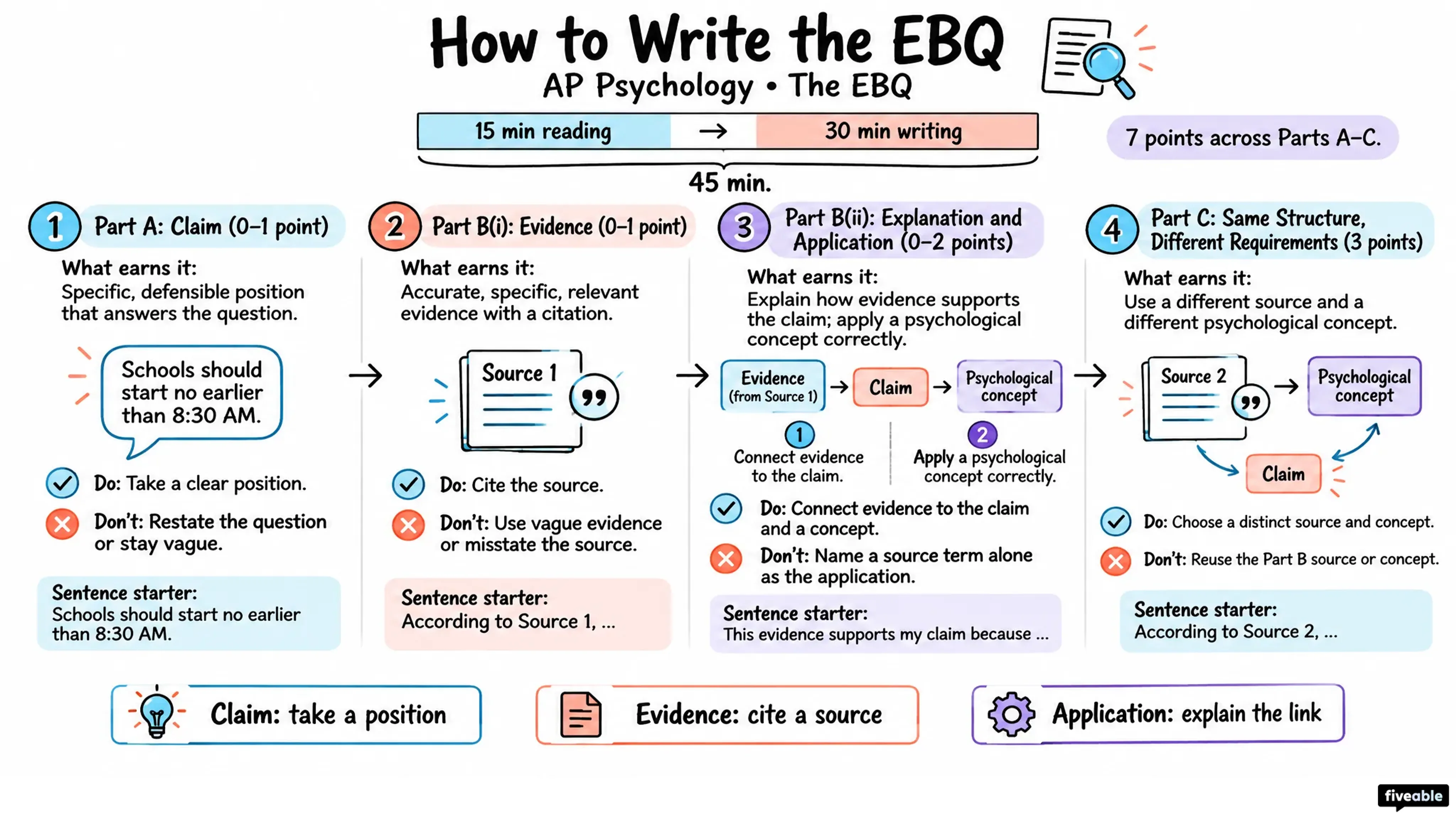
EBQ skill sheet
Every rubric point on one page: what earns it, what to do and what to avoid. Tap the sheet to see it full size.
How EBQ practice works
Each question follows the exam’s format, from the full prompt to a score on every part.
Read the question and sources
The prompt and all three source summaries, laid out the way the exam shows them.
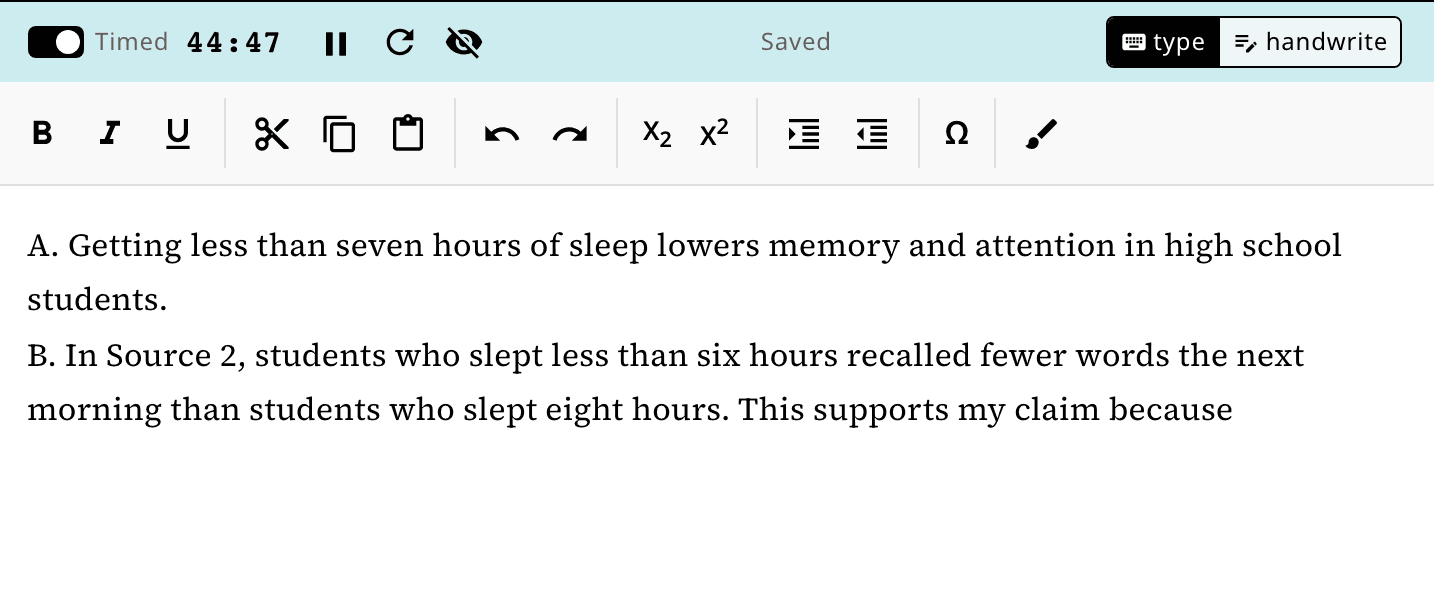
Write on a 45-minute timer
The time to plan for on exam day. Pause it or turn it off, and your response saves as you go.
Submit for a score out of 7
Your response is scored against the scoring guidelines written for that question. Your first score is included.
Feedback on every part
A summary at the top tells you what to work on next. Below it, each part shows whether you earned the point and what the scoring guidelines were looking for.
Detailed Feedback
Part A: 1/1 point
Earned the point. You proposed a specific and defensible claim that identifies public group pressure and feeling connected to the group as factors that influence conformity.
Part B(i): 1/1 point
Earned the point. You explicitly cited Source 2 and provided specific, relevant evidence about Japanese participants conforming more with in-group members, which supports your claim.
Part C(i): 0/1 point
Did not earn the point. While you mentioned Source 3, you only provided a general summary of the study's topic rather than citing a specific finding, data point, or result from the source.
What 518 scored EBQs show
Patterns from the practice EBQs students have turned in on Fiveable. Students lose the most points on Part C: second source.
A: Claim
78%
B: First source
76%
C: Second source
68%
36%
of responses earned all 7 points
5.2 of 7
average score
+1.3 points
average gain when students rewrote the same EBQ after feedback
518 practice responses from 240 students, scored on Fiveable through October 26, 2026.
Questions about the EBQ
How many responses can I get scored?
You can read every question without a plan. Your first scored response is included. A plan unlocks unlimited scoring.
What do the sources look like?
Three summaries of published studies, each with its methods, participants, and results. You don’t need to know the studies ahead of time.
How is the EBQ different from the AAQ?
The EBQ asks you to build an argument from three sources. The AAQ asks about one study and its research methods, and the exam gives it 25 minutes.
Are these real College Board questions?
No. We wrote them in the AP format, with the same three parts, and wrote scoring guidelines for each one.
Can I write my answer by hand?
Yes. Switch the editor to handwrite, write on paper, and add a photo of your page.
More AP Psychology practice
AAQ practice
Article Analysis Questions with the full study summary and all six parts.
See the EBQ rubric points students miss most, from responses scored on Fiveable.
Write your first EBQ
Pick one from the list, or let us choose for you.
Teaching AP Psychology? Assign these EBQs to your class