Systems & Center of Mass
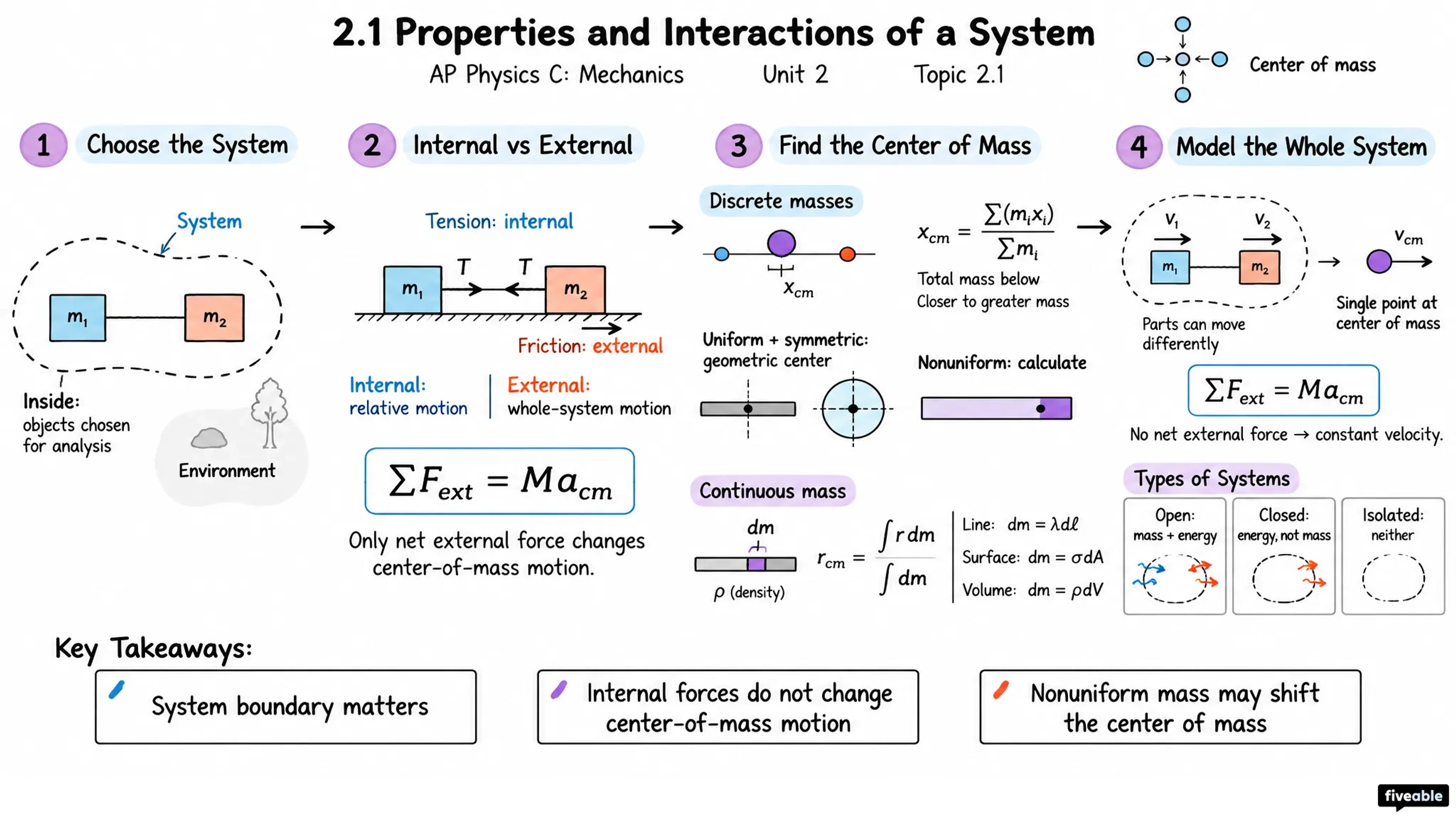
System Definition: An object or collection of objects chosen for analysis, treated as distinct from its environment; a system may be a single object (often modeled as a point particle with no internal structure), and forces are classified as internal (between parts of the system) or external (from the environment).
- Treat as single object at center of mass when internal structure is not important
- Internal structure affects analysis; external changes may alter substructure
Center of Mass Location:
- Discrete: $\vec{x}_{\mathrm{cm}}=\frac{\sum m_{i} \vec{x}_{i}}{\sum m_{i}}$
- Continuous: $\vec{r}_{\mathrm{cm}}=\frac{\int \vec{r} \, dm}{\int dm}$
- On lines of symmetry for uniform distributions
Linear Mass Density: $\lambda=\frac{d}{d\ell}m(\ell)$; Total mass: $M=\int \rho(r) \, dV$