AP Physics C: E&M Representations FRQ Practice
20 Translation Between Representations questions written in the AP format. Pick one, read the full question, and write your response. Fiveable scores each Representations FRQ response part by part on the AP rubric.
Your first scored response is included. A plan unlocks unlimited scoring.
20 questions
sorted by unit
Electric field and flux in charged spherical shell
Unit 8: Electric Charges, Fields, and Gauss's Law
A thin, nonconducting spherical shell of inner radius and outer radius is centered at the origin, as shown in Figure 1. The material of the shell has a uniform volume charge density throughout the region . A point charge is fixed at the center of the shell. The space inside and outside the shell is vacuum with permittivity . Neglect gravitational interactions unless explicitly stated.
Figure 1. Thin nonconducting spherical shell (inner radius a = 0.10 m, outer radius b = 0.20 m) with a central point charge q = −2.0 μC, showing three spherical Gaussian surfaces at r = 0.05 m, 0.15 m, and 0.30 m.
Figure 2. Bar chart of electric-field magnitude |E| at three radii (0.05 m, 0.15 m, 0.30 m). The r = 0.30 m bar is provided as the reference; students complete the other bars.
In Figure 2, draw bars to represent at and relative to the bar shown at . If , write a "0" in that column. The electric field magnitude at a distance r from the center is |E(r)|. The partially completed bar chart in Figure 2 shows a bar that represents |E| at r = 0.30 m.
Derive an expression for the electric field (including sign/direction using the radial unit vector ) for the region in terms of , , , , , and physical constants, as appropriate. Begin your derivation by writing a fundamental physics principle or an equation from the reference information.
Figure 3. Axes for electric flux Φ_E through a spherical Gaussian surface versus radius r for 0 ≤ r ≤ 0.35 m; sketch must show sign and slope changes at r = a and r = b.
On the axes shown in Figure 3, sketch a graph of the electric flux through a spherical Gaussian surface of radius , for . Your graph must indicate the sign of and any changes in curvature or slope at and .
Indicate whether the magnitude of the particle's initial acceleration is greater than, less than, or equal to . Briefly justify your answer by comparing the magnitudes of the electric and gravitational forces at using and . A small test particle of mass and charge is released from rest at and moves radially under the influence of the electric force from the charge distribution and the gravitational force from Earth. Take downward. At the release point, the radial direction is horizontal, so the gravitational force is perpendicular to the radial electric force. Use the electric field at due to the total enclosed charge at that radius.
What the Representations FRQ asks
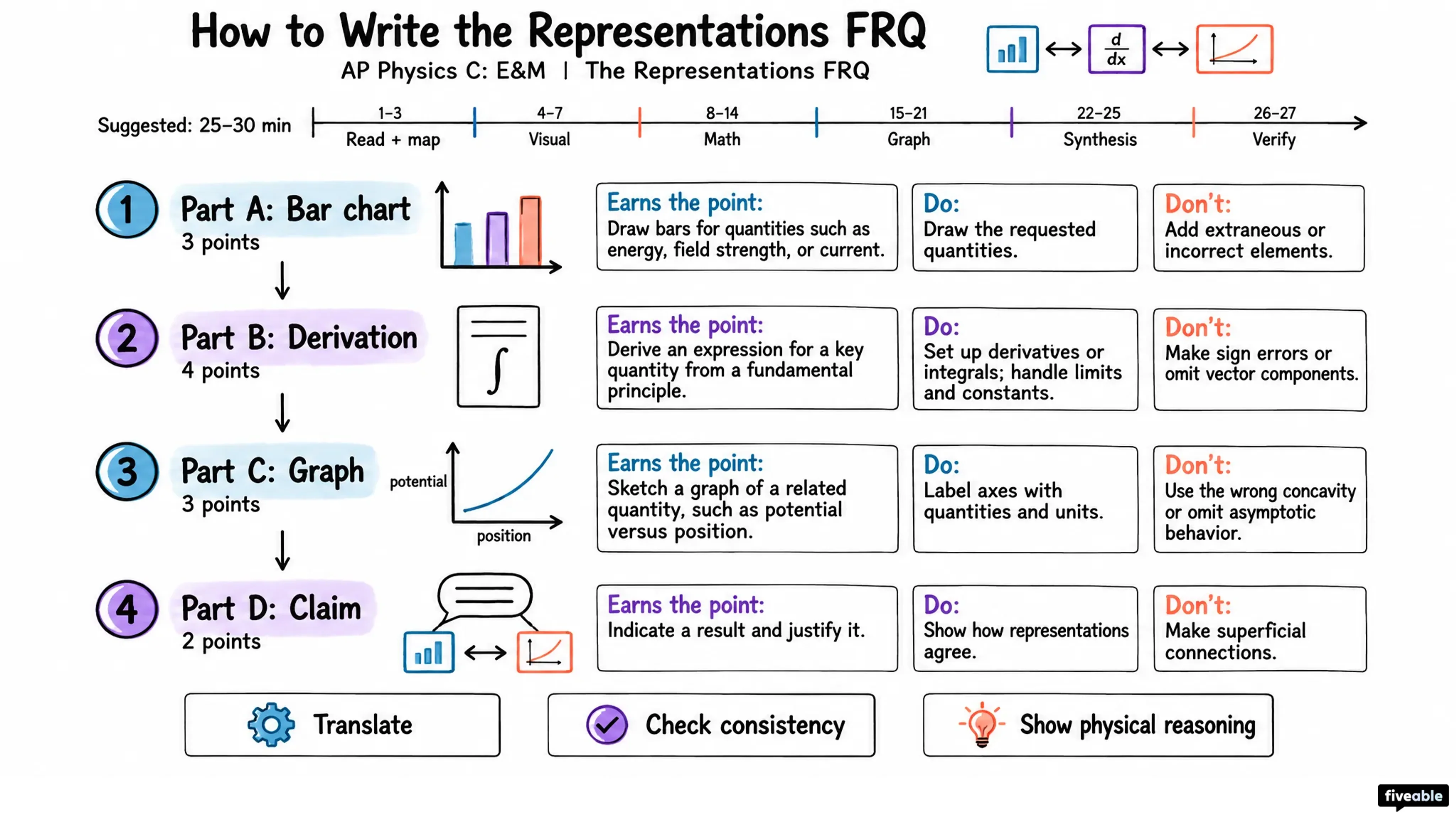
The Translation Between Representations (TBR) question is FRQ 2 on the AP Physics C: E&M exam. You represent one electricity and magnetism scenario as a bar chart, a derived equation, and a sketched graph, then justify a claim that ties them together.
- 25–30 min
- suggested on the exam
- 12 points
- across parts A to D
- 95 min
- for all four FRQs
Part A: Bar chart
Draw bars for quantities such as energy, field strength, or current
3 pts
Part B: Derivation
Derive an expression for a key quantity, starting from a fundamental principle
4 pts
Part C: Graph
Sketch a graph of a related quantity, such as potential versus position
3 pts
Part D: Claim
Indicate a result, often whether two parts agree, and justify it
2 pts
Representations FRQ skill sheet
Every rubric point on one page: what earns it, what to do and what to avoid. Tap the sheet to see it full size.
How Representations FRQ practice works
Each question follows the exam’s format, from the full prompt to a score on every part.
Read the full question
The scenario, its figures, and parts A through D, laid out the way the exam shows them.
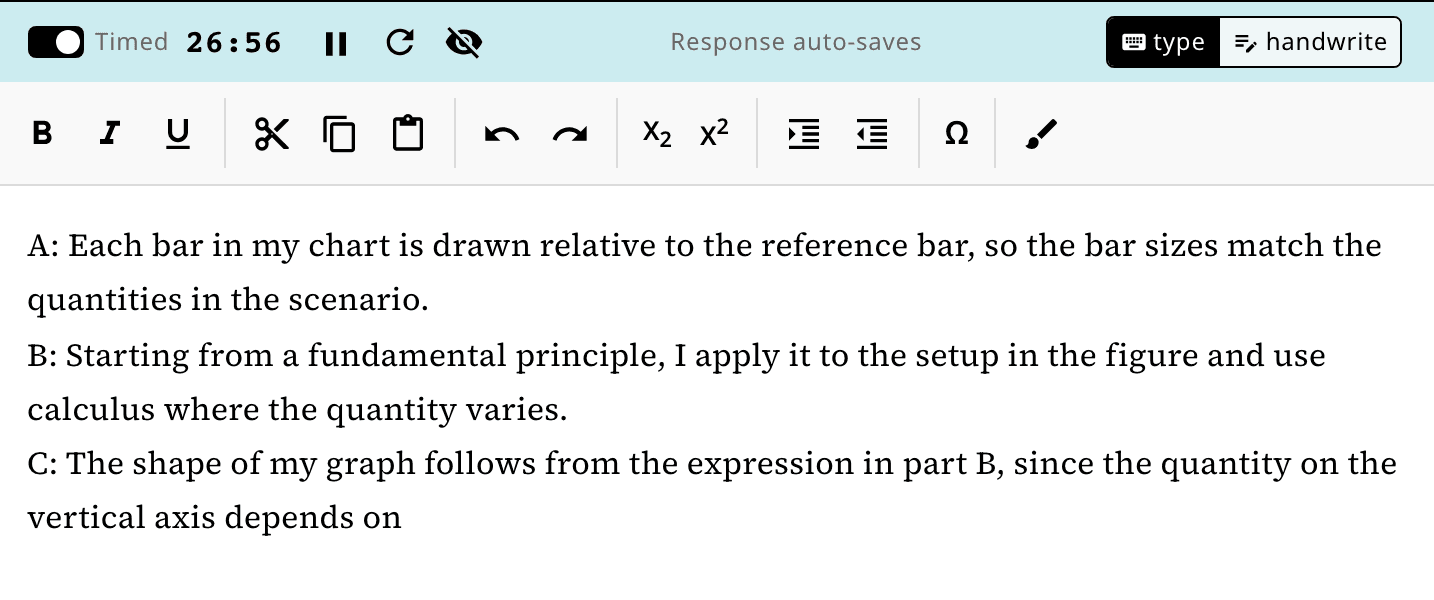
Write on a 27-minute timer
Inside the 25 to 30 minutes the exam suggests for this question. Pause it or turn it off, and your response saves as you go.
Submit for a score out of 12
Your response is scored against the scoring guidelines written for that question. Your first score is included.
Feedback on every part
A summary at the top tells you what to work on next. Below it, each part shows whether you earned the point and what the scoring guidelines were looking for.
Detailed Feedback
Part A: 1/1 point
Earned the point. You correctly described drawing a downward gravitational force (Fg) for both objects.
Part A: 1/1 point
Earned the point. You correctly identified that the electric force points to the right (+x) at point A and to the left (-x) at point B, radially away from the positive rod.
Part D: 0/1 point
Did not earn the point. You stated that the electric flux is the same in both cases. In a dielectric medium, the electric flux through the surface depends on the permittivity of the medium, so the flux is different in Medium 1 than in Medium 2.
Questions about the Representations FRQ
How many responses can I get scored?
You can read every question without a plan. Your first scored response is included. A plan unlocks unlimited scoring.
What representations does the TBR ask for?
A bar chart for quantities such as energy, field strength, or current, a derivation, a graph of a related quantity, and a justified claim, often about whether your representations agree.
How is the TBR different from the Mathematical Routines question?
Both include derivations. The TBR is built around linking a bar chart, an equation, and a graph of the same scenario, and it is worth 12 points instead of 10.
How do I draw the bar chart or graph?
Use the drawing tool to draw on the question’s figure or on a blank graph. Your drawing is scored with the rest of your response. You can also switch to handwrite and add a photo of your page.
Are these real College Board questions?
No. We wrote them in the AP format, with the same four parts, and wrote scoring guidelines for each one.
More AP Physics C: E&M practice
Mathematical Routines FRQ practice
Mathematical Routines questions with the full scenario, figures, and both parts.
Experimental Design FRQ practice
Experimental Design questions with the lab setup, the data table, and all four parts.
Qualitative/Quantitative FRQ practice
Qualitative/Quantitative Translation questions with the full scenario and all three parts.
AP Physics C: E&M FRQs
Every FRQ type for AP Physics C: E&M, with practice for each.
Write your first Representations FRQ
Pick one from the list, or let us choose for you.
Teaching AP Physics C: E&M? Assign these Representations FRQs to your class