AP Physics C: E&M Qualitative/Quantitative FRQ Practice
102 Qualitative/Quantitative Translation questions written in the AP format. Pick one, read the full question, and write your response. Fiveable scores each Qualitative/Quantitative FRQ response part by part on the AP rubric.
Your first scored response is included. A plan unlocks unlimited scoring.
New to the Qualitative/Quantitative FRQ? Read the exam guide
102 questions
sorted by unit
Electric force from semicircular charge distribution
Unit 8: Electric Charges, Fields, and Gauss's Law
A thin, non-conducting rod is bent into a semicircle of radius . The rod carries a total positive charge that is uniformly distributed along its length. A small sphere with positive charge is fixed at point P, which is the center of curvature of the semicircle, as shown in Figure 1. The surroundings are a vacuum.
Figure 1. Semicircular rod with distributed charge
Let be the magnitude of the electric force exerted on the sphere at point P by the semicircular rod. Let be the magnitude of the electric force that would be exerted on the sphere if the entire charge of the rod were concentrated at a single point located at the vertex of the semicircle (the point on the rod on the axis of symmetry, distance from P).
Indicate whether is greater than, less than, or equal to by writing one of the following.
Justify your answer using qualitative reasoning beyond referencing equations.
Derive an expression for the magnitude of the electric force exerted on the sphere at point P by the semicircular rod. Express your answer in terms of , , , and physical constants, as appropriate. Begin your derivation by writing a fundamental physics principle or an equation from the reference information.
Figure 2. Quarter-circle rod with distributed charge
Indicate whether is greater than, less than, or equal to by writing one of the following. The semicircular rod is now replaced by a quarter-circle rod of the same radius , as shown in Figure 2. The new rod carries the same total positive charge uniformly distributed along its length. Let be the magnitude of the electric force exerted on the sphere at point P by this quarter-circle rod.
Briefly justify your answer by referencing your derivation in part B.
What the Qualitative/Quantitative FRQ asks
The Qualitative/Quantitative Translation (QQT) question is FRQ 4 on the AP Physics C: E&M exam. You compare two quantities and justify the comparison in words, derive an expression for one of them, then use that expression to reason about a new case.
- 15–20 min
- suggested on the exam
- 8 points
- across parts A to C
- 95 min
- for all four FRQs
Part A: Qualitative reasoning
Compare two quantities and justify the comparison in words
3 pts
Part B: Derivation
Derive an expression for one of the quantities
3 pts
Part C: Connection
Use your derivation to compare a new case and justify it
2 pts
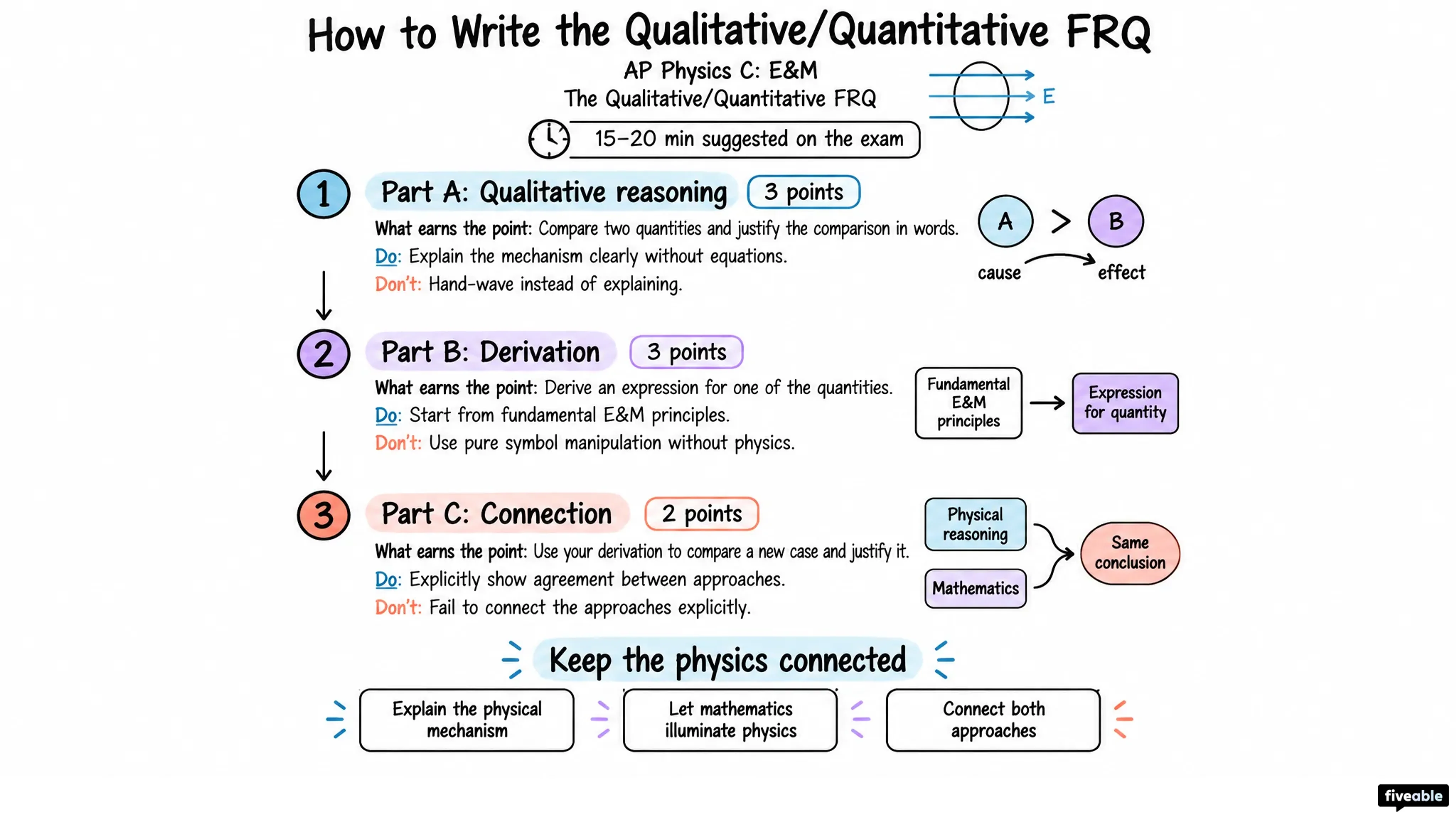
Qualitative/Quantitative FRQ skill sheet
Every rubric point on one page: what earns it, what to do and what to avoid. Tap the sheet to see it full size.
How Qualitative/Quantitative FRQ practice works
Each question follows the exam’s format, from the full prompt to a score on every part.
Read the full question
The scenarios, their figures, and parts A through C, laid out the way the exam shows them.
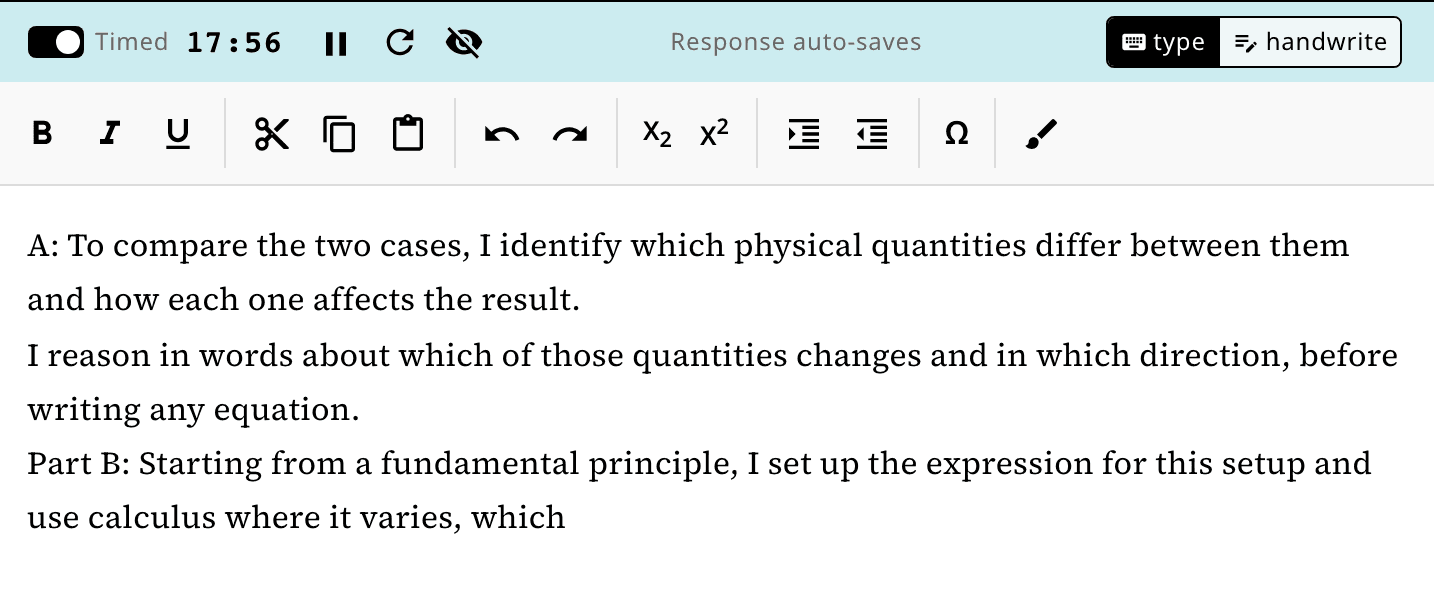
Write on an 18-minute timer
Inside the 15 to 20 minutes the exam suggests for this question. Pause it or turn it off, and your response saves as you go.
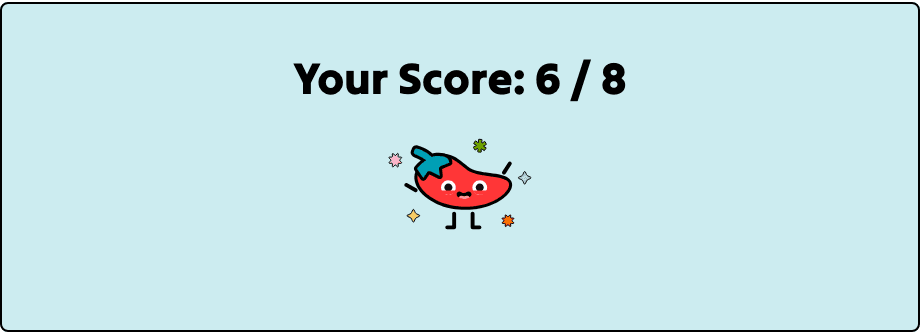
Submit for a score out of 8
Your response is scored against the scoring guidelines written for that question. Your first score is included.
Feedback on every part
A summary at the top tells you what to work on next. Below it, each part shows whether you earned the point and what the scoring guidelines were looking for.
Detailed Feedback
Part A: 1/1 point
Earned the point. You correctly indicated that F_semi < F_point.
Part A: 1/1 point
Earned the point. You correctly noted that the forces from different pieces of charge point in different directions, showing an understanding of the vector nature of the force.
Part C: 0/1 point
Did not earn the point. You indicated F_new = F_semi, but the correct answer is F_new > F_semi.
Questions about the Qualitative/Quantitative FRQ
How many responses can I get scored?
You can read every question without a plan. Your first scored response is included. A plan unlocks unlimited scoring.
What does qualitative/quantitative translation mean?
You reason about the physics in words, then with an equation, and connect the two. Part A asks for a justified comparison, part B for a derivation, and part C for a prediction that uses your derivation.
How is the QQT different from the Translation Between Representations (TBR) question?
The QQT is shorter, at 8 points and 15 to 20 minutes, and centers on comparisons you justify in words. The TBR is worth 12 points and also asks for a bar chart and a graph.
Can I write my answer by hand?
Yes. Switch the editor to handwrite, write on paper, and add a photo of your page.
Are these real College Board questions?
No. We wrote them in the AP format, with the same three parts, and wrote scoring guidelines for each one.
More AP Physics C: E&M practice
Mathematical Routines FRQ practice
Mathematical Routines questions with the full scenario, figures, and both parts.
Representations FRQ practice
Translation Between Representations questions with the full scenario and all four parts.
Experimental Design FRQ practice
Experimental Design questions with the lab setup, the data table, and all four parts.
AP Physics C: E&M FRQs
Every FRQ type for AP Physics C: E&M, with practice for each.
Write your first Qualitative/Quantitative FRQ
Pick one from the list, or let us choose for you.
Teaching AP Physics C: E&M? Assign these Qualitative/Quantitative FRQs to your class