AP Physics C: E&M Mathematical Routines FRQ Practice
61 Mathematical Routines questions written in the AP format. Pick one, read the full question, and write your response. Fiveable scores each Mathematical Routines FRQ response part by part on the AP rubric.
Your first scored response is included. A plan unlocks unlimited scoring.
61 questions
sorted by unit
Uniformly charged insulating sphere in dielectric medium
Unit 8: Electric Charges, Fields, and Gauss's Law
A solid insulating sphere of radius is centered at the origin and has a uniform volume charge density . The sphere is embedded in a homogeneous, linear dielectric material with permittivity . A point particle of mass and charge is located on the positive -axis at , as shown in Figure 1. The sphere and the particle are stationary and the dielectric fills all space.
Figure 1. Uniformly charged insulating sphere at the origin and a point particle on the +x-axis; concentric spherical Gaussian surface of radius r.
Figure 2. Axes for a student sketch of electric-field magnitude E versus radial distance r from the center of the sphere.
Using Gauss’s law, derive an expression for the magnitude of the electric field produced by the uniformly charged insulating sphere for the region . Express your answer in terms of , , , and physical constants, as appropriate.
Derive an expression for the magnitude of the electric field produced by the sphere for the region . Express your answer in terms of , , , , and physical constants, as appropriate. Begin your derivation by writing a fundamental physics principle or an equation from the reference information.
On the axes shown in Figure 2, sketch a graph of the magnitude of the electric field produced by the sphere, , as a function of from to .
Figure 3. Gaussian surface of radius r = 0.20 m centered at the origin encloses the insulating sphere but not the point particle at x = 0.30 m.
Derive an expression for the electric flux through this Gaussian surface. Express your answer in terms of , , and physical constants, as appropriate. Begin your derivation by writing a fundamental physics principle or an equation from the reference information. Consider the spherical Gaussian surface of radius centered at the origin, as shown in Figure 3. The point particle at lies outside this Gaussian surface.
What the Mathematical Routines FRQ asks
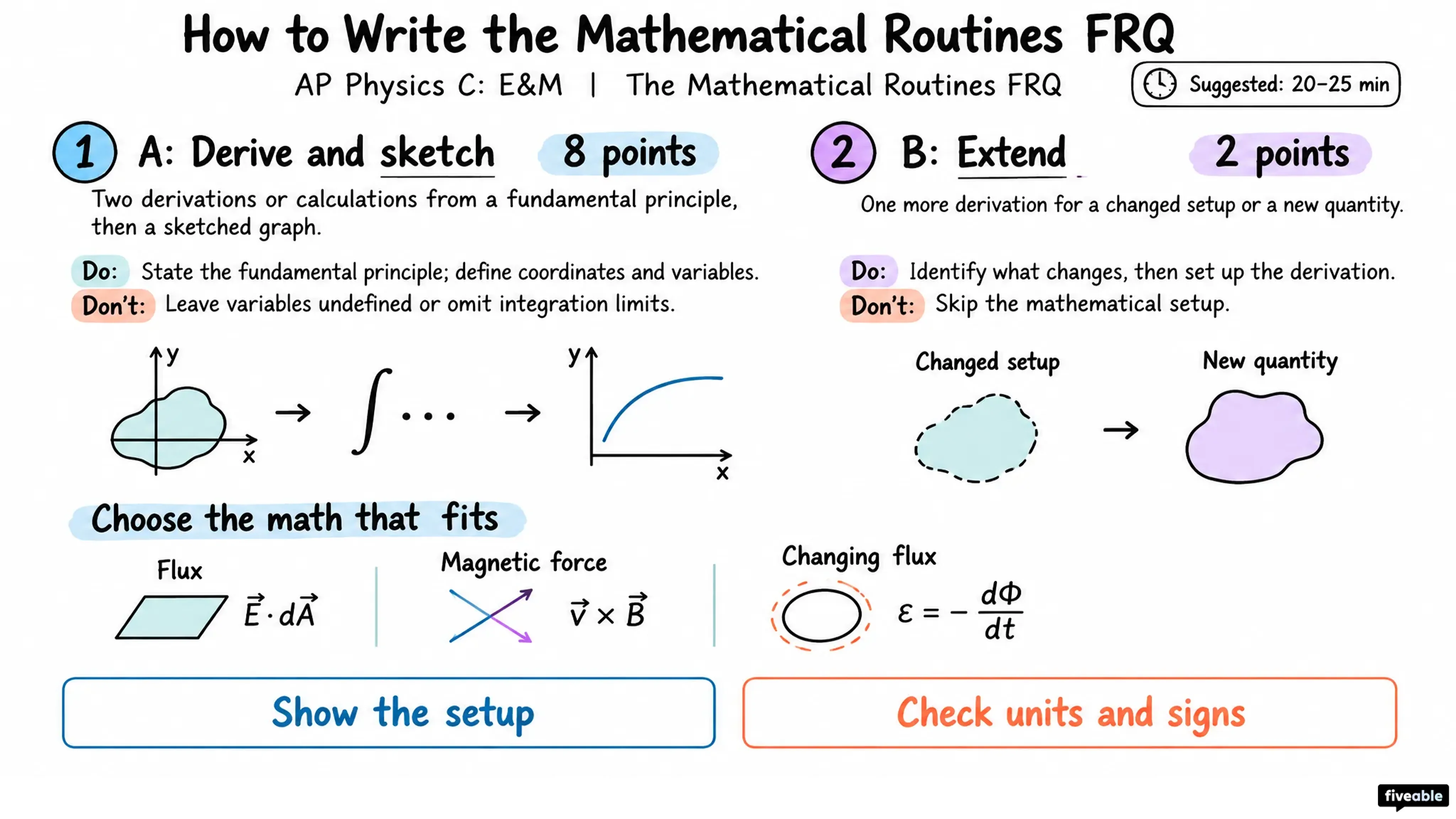
The Mathematical Routines question is FRQ 1 on the AP Physics C: E&M exam. You use calculus to derive expressions, calculate values, and sketch a graph for an electricity and magnetism scenario, then extend the analysis in a short second part.
- 20–25 min
- suggested on the exam
- 10 points
- across parts A and B
- 95 min
- for all four FRQs
Part A: Derive and sketch
Two derivations or calculations from a fundamental principle, then a sketched graph
8 pts
Part B: Extend
One more derivation for a changed setup or a new quantity
2 pts
Mathematical Routines FRQ skill sheet
Every rubric point on one page: what earns it, what to do and what to avoid. Tap the sheet to see it full size.
How Mathematical Routines FRQ practice works
Each question follows the exam’s format, from the full prompt to a score on every part.
Read the full question
The scenario, its figures, and parts A and B, laid out the way the exam shows them.
Write on a 23-minute timer
Inside the 20 to 25 minutes the exam suggests for this question. Pause it or turn it off, and your response saves as you go.
Submit for a score out of 10
Your response is scored against the scoring guidelines written for that question. Your first score is included.
Feedback on every part
A summary at the top tells you what to work on next. Below it, each part shows whether you earned the point and what the scoring guidelines were looking for.
Detailed Feedback
Part A(i): 0/1 point
Did not earn the point. No response was provided for this part.
Part B: 1/1 point
Earned the point. You correctly started your derivation with the fundamental equation for capacitance, C = Q/V.
Part B: 1/1 point
Earned the point. You correctly indicated that the insertion of the dielectric modifies the electric field and voltage by a factor of κ (E_new = E_old/κ and V_new = Ed/κ).
Questions about the Mathematical Routines FRQ
How many responses can I get scored?
You can read every question without a plan. Your first scored response is included. A plan unlocks unlimited scoring.
How do I type equations and integrals?
Type them in plain text, like E = kq/r^2. The editor has subscript and superscript buttons and a special characters menu with symbols such as ε, μ, Φ, and ∫. You can also switch to handwrite and add a photo of your page.
How do I answer the part that asks for a graph?
Use the drawing tool to sketch on a blank graph or on the question’s figure. Your drawing is scored with the rest of your response.
Can I use a calculator and the equation sheet?
Yes. The writing screen has a scientific and a graphing calculator and the AP Physics C: E&M equation sheet.
Is the split between parts A and B always 8 and 2?
No. Most of our questions give part A 8 points and part B 2. Some give part A 7 and part B 3. Every question is worth 10.
Are these real College Board questions?
No. We wrote them in the AP format, with the same parts and point values, and wrote scoring guidelines for each one.
More AP Physics C: E&M practice
Representations FRQ practice
Translation Between Representations questions with the full scenario and all four parts.
Experimental Design FRQ practice
Experimental Design questions with the lab setup, the data table, and all four parts.
Qualitative/Quantitative FRQ practice
Qualitative/Quantitative Translation questions with the full scenario and all three parts.
AP Physics C: E&M FRQs
Every FRQ type for AP Physics C: E&M, with practice for each.
Write your first Mathematical Routines FRQ
Pick one from the list, or let us choose for you.
Teaching AP Physics C: E&M? Assign these Mathematical Routines FRQs to your class