AP Physics C: E&M Unit 9 Cheatsheet: Electric Potential

AP Physics C: E&M Unit 9 Cheatsheet: Electric Potential

Start with the first 3 sections of the Unit 9 one-page cheatsheet below. The full sheet is a PDF you can print.

Electric Potential Energy: Definition & Formula

Electric potential energy is the work required by an external force to bring charged objects from infinity to their current positions.

Two-point-charge system:

$$U_E = k\frac{q_1 q_2}{r} = \frac{1}{4\pi\varepsilon_0}\frac{q_1 q_2}{r}$$

  • k = Coulomb constant
  • r = separation distance
  • Positive when charges repel (same sign)
  • Negative when charges attract (opposite sign)

Multi-charge systems: Sum potential energies of all pairwise interactions.

Key distinction: Potential energy belongs to the system, not to individual charges.
Potential Difference & Energy Change

Potential difference between two points:

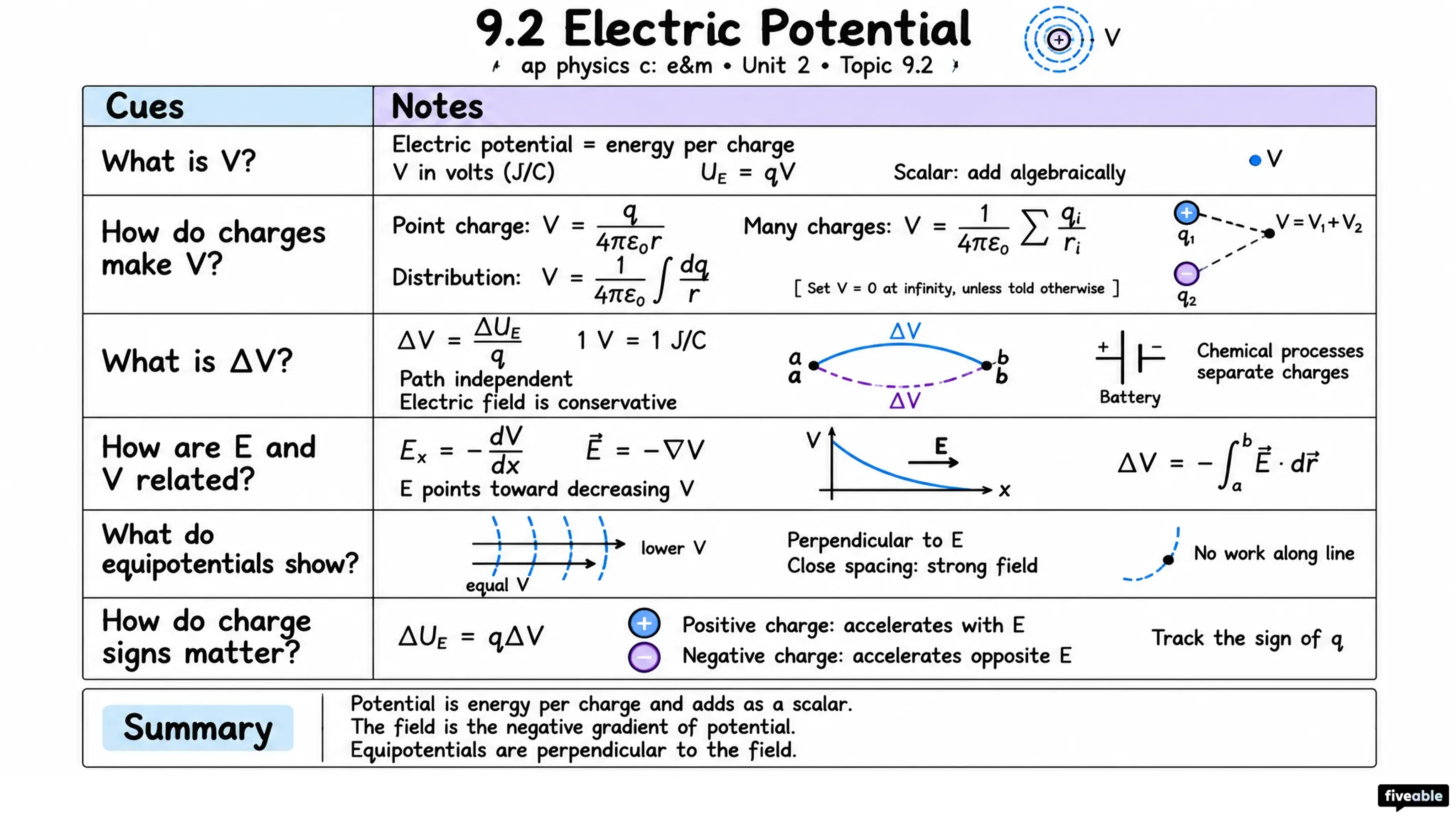
$$\Delta V = V_b - V_a = -\int_a^b \vec{E} \cdot d\vec{r}$$

Change in potential energy:

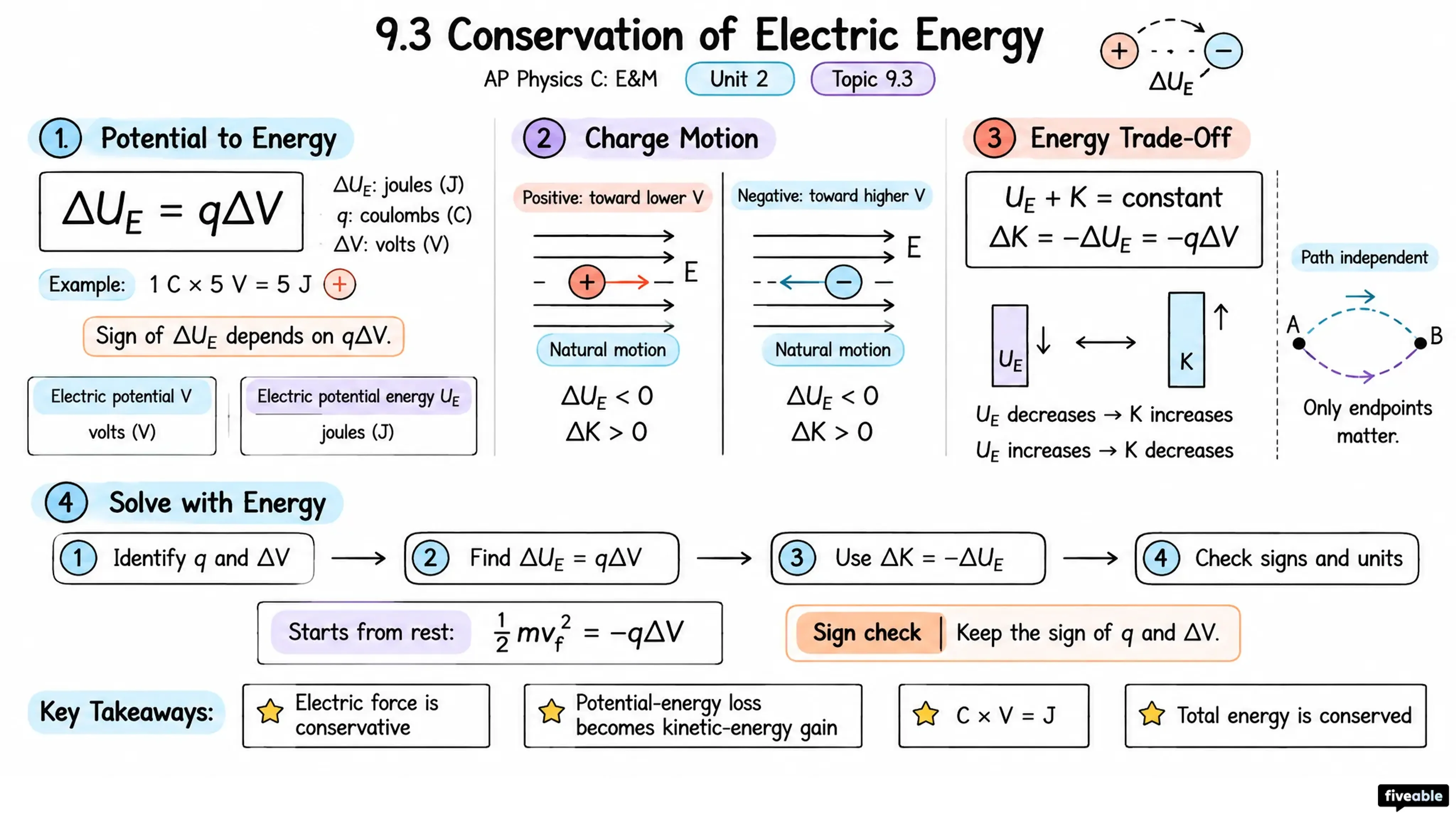
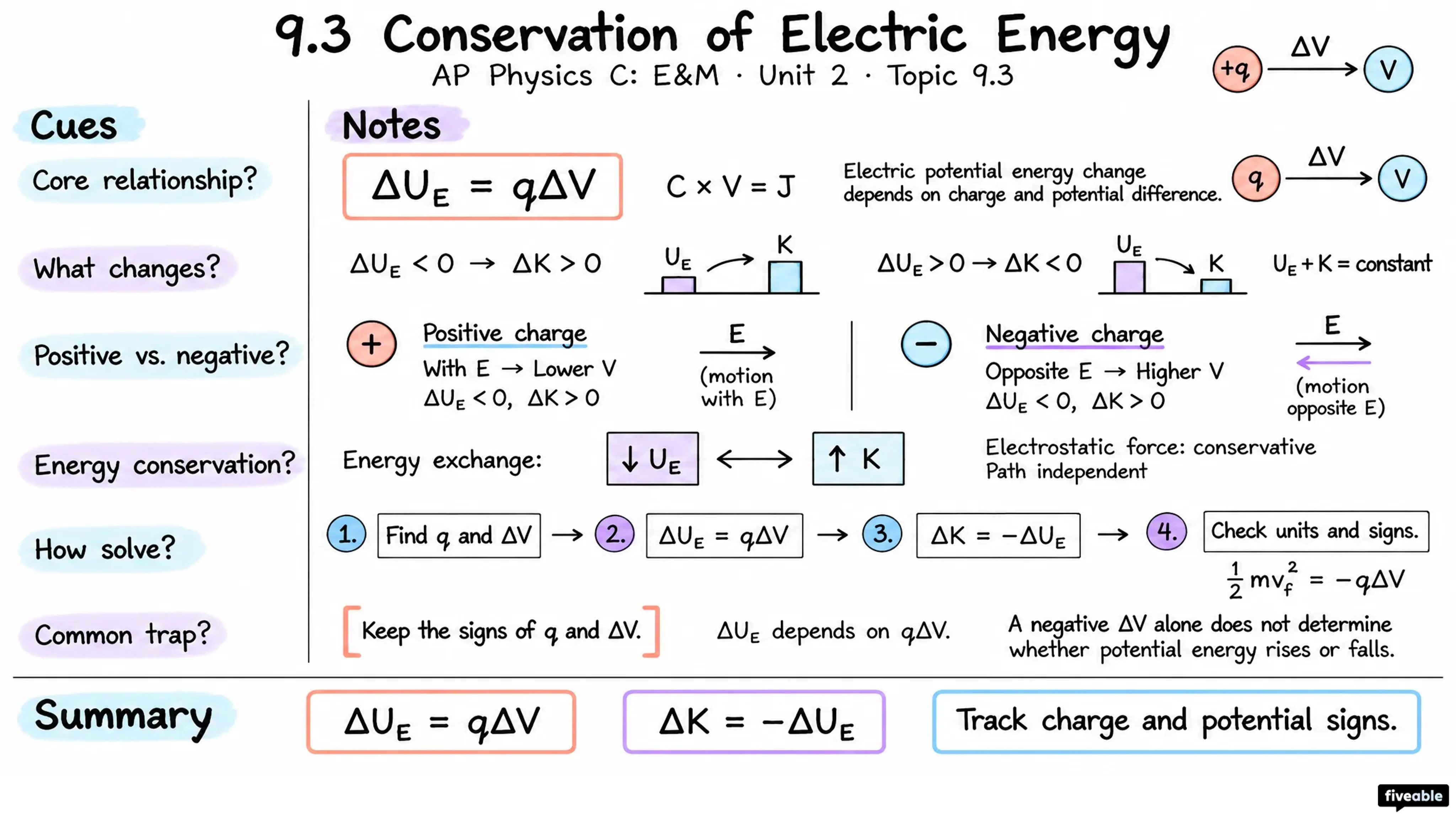
$$\Delta U_E = q\Delta V$$

  • If a positive charge moves to lower electric potential, ΔU = qΔV < 0, so the system loses electric potential energy.
  • If a positive charge moves to higher electric potential, ΔU_E is positive (the system gains electric potential energy).

Conservation of energy: If only conservative (e.g., electrostatic) forces do work, mechanical energy is conserved and ΔK = -ΔU = -qΔV; if an external agent or nonconservative force also acts, include its work: W_ext = ΔK + ΔU.

Potential difference can arise from charge separation (batteries) or external fields.

Comparing Scenarios: Potential & Field

When comparing two configurations:

  • Same charge, different r: V ∝ 1/r; smaller r → larger |V|
  • Same r, different q: V ∝ q; double charge → double potential
  • Field vs. potential: E ∝ 1/r²; V ∝ 1/r (different dependencies)

Multi-charge systems:

  • Potentials add as scalars (easier than vector addition of fields)
  • Opposite charges can cancel V at a point even if E ≠ 0
  • Same charges: V always has same sign

Equipotential spacing:

  • Closer spacing near strong sources (small r)
  • Wider spacing far from sources (large r)

Use superposition to find net V; use field definition to find E from V.

The rest of the Unit 9 sheet

6 more sections are on the one-page PDF:

  • Electric Potential: Point Charges & Superposition

  • Electric Field & Potential Relationship

  • Calculus-Required Charge Distributions

  • Constructing & Interpreting Field & Potential Maps

  • Problem-Solving: Potential Energy & Motion

  • Common Confusions & Checks

Made by you

Visual Cheatsheets

Pick a Unit 9 topic and a format: flowchart, comparison chart, vocab sheet, Cornell notes and more. Ready in about a minute.

Printable PDF · from the Fiveable shop

AP Physics C: Electricity and Magnetism Unit 9 Cheatsheet

1 page · Electric Potential · PDF

Visual Cheatsheets

One topic, the format you pick, ready in about a minute

Format

Topic

Takes 30–60 seconds

Preview: Standard

Unit 9: Electric Potential, topic by topic

Each topic has a full study guide. See the whole unit.