AP Physics C: E&M Unit 12 Cheatsheet: Magnetic Fields and Electromagnetism

AP Physics C: E&M Unit 12 Cheatsheet: Magnetic Fields and Electromagnetism

Start with the first 3 sections of the Unit 12 one-page cheatsheet below. The full sheet is a PDF you can print.

Magnetic Field Properties & Sources

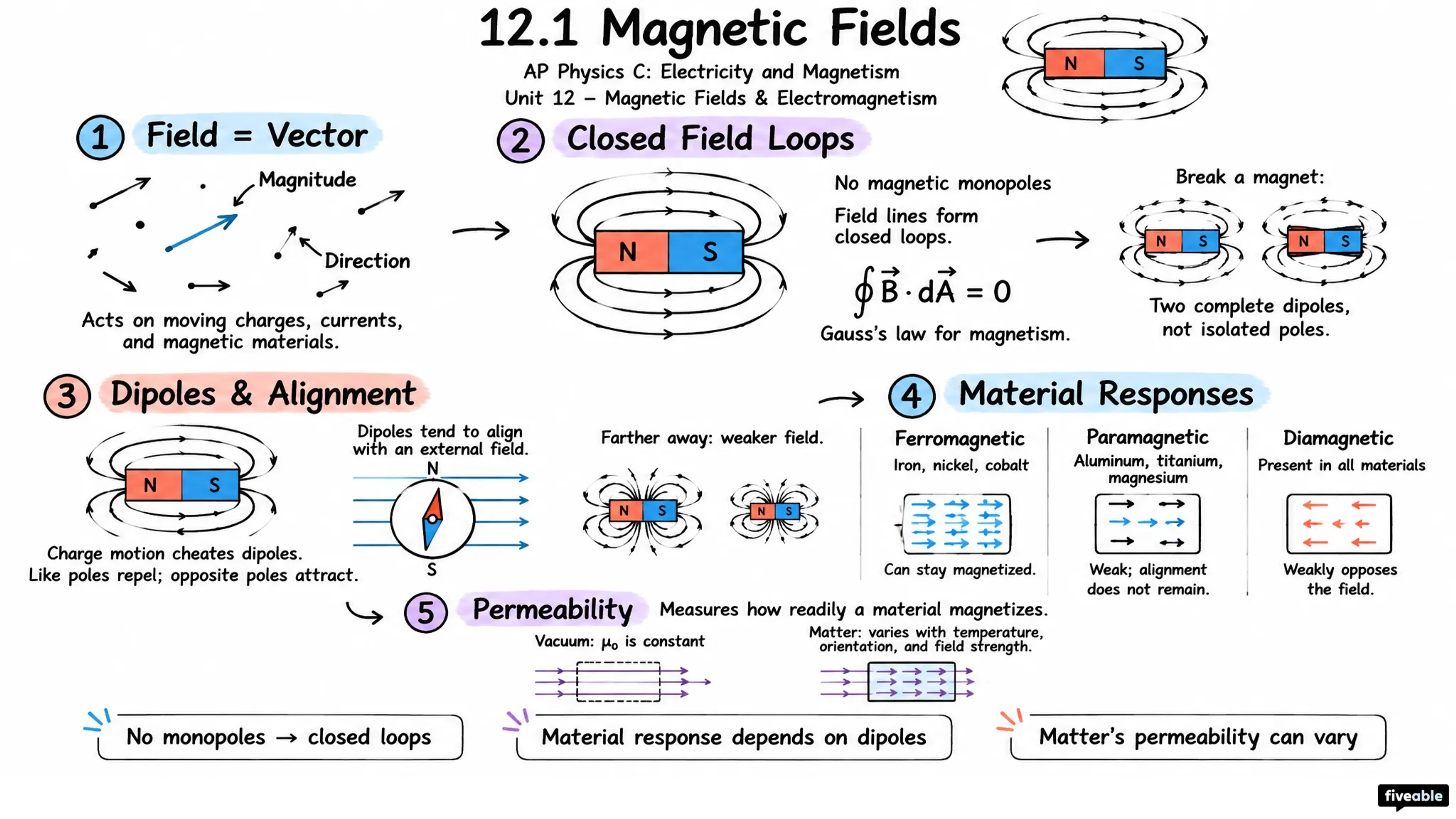
What is a magnetic field?

  • Vector field that exerts force on moving charges, currents, and magnetic materials
  • No magnetic monopoles have been observed; magnetic fields are produced by moving charges/currents (including magnetic dipoles) and by changing electric fields.
  • Field lines form closed loops (Gauss's law for magnetism: ∮ B · dA = 0)
  • External field points away from north pole, returns to south pole

Magnetic dipoles & alignment

  • Arise from current loops (charges moving in closed paths) or from intrinsic magnetic moments of particles (e.g., electron spin, which is not literal rotation)
  • Same polarity repels; opposite polarity attracts
  • Compass needle aligns with external field
  • Breaking a magnet creates two new dipoles (no isolated poles)
  • Field magnitude decreases with distance
Magnetic Field Geometry & Visualization

Field line patterns

  • Always form closed loops (no beginning or end)
  • Density indicates field strength
  • Direction: away from north pole, into south pole (external)
  • Inside a bar magnet: south to north

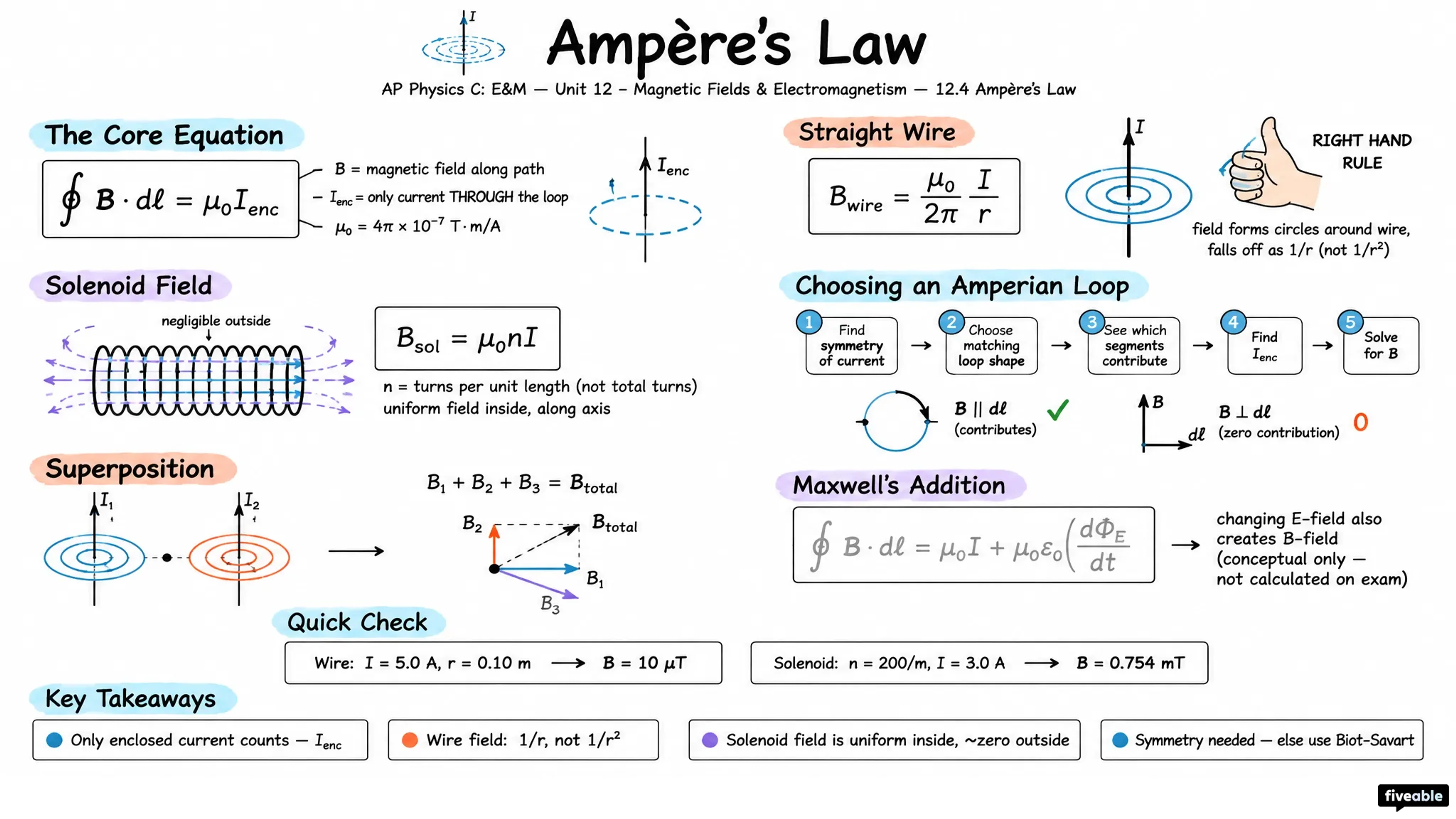
Concentric circles around wire

  • Field vectors tangent to circles centered on wire
  • Perpendicular to wire and to radial direction
  • Right-hand rule: thumb along current, fingers curl in field direction

Solenoid field

  • Uniform inside (parallel lines)
  • Negligible outside (assumed)
  • Strength depends on turns per unit length (n) and current (I)

Key Distinctions & Common Errors

Magnetic field vs. force

  • Field B exists independently; force requires moving charge or current
  • Stationary charge feels no magnetic force

Biot-Savart vs. Ampère

  • Biot-Savart: Integrates over current elements; works for any geometry
  • Ampère: Uses symmetry; faster for symmetric cases (wire, solenoid, slab)

Closed loops requirement

  • Magnetic field lines never start or end (unlike electric field)
  • Consequence: no magnetic monopoles
  • Breaking magnet creates two dipoles, not isolated poles

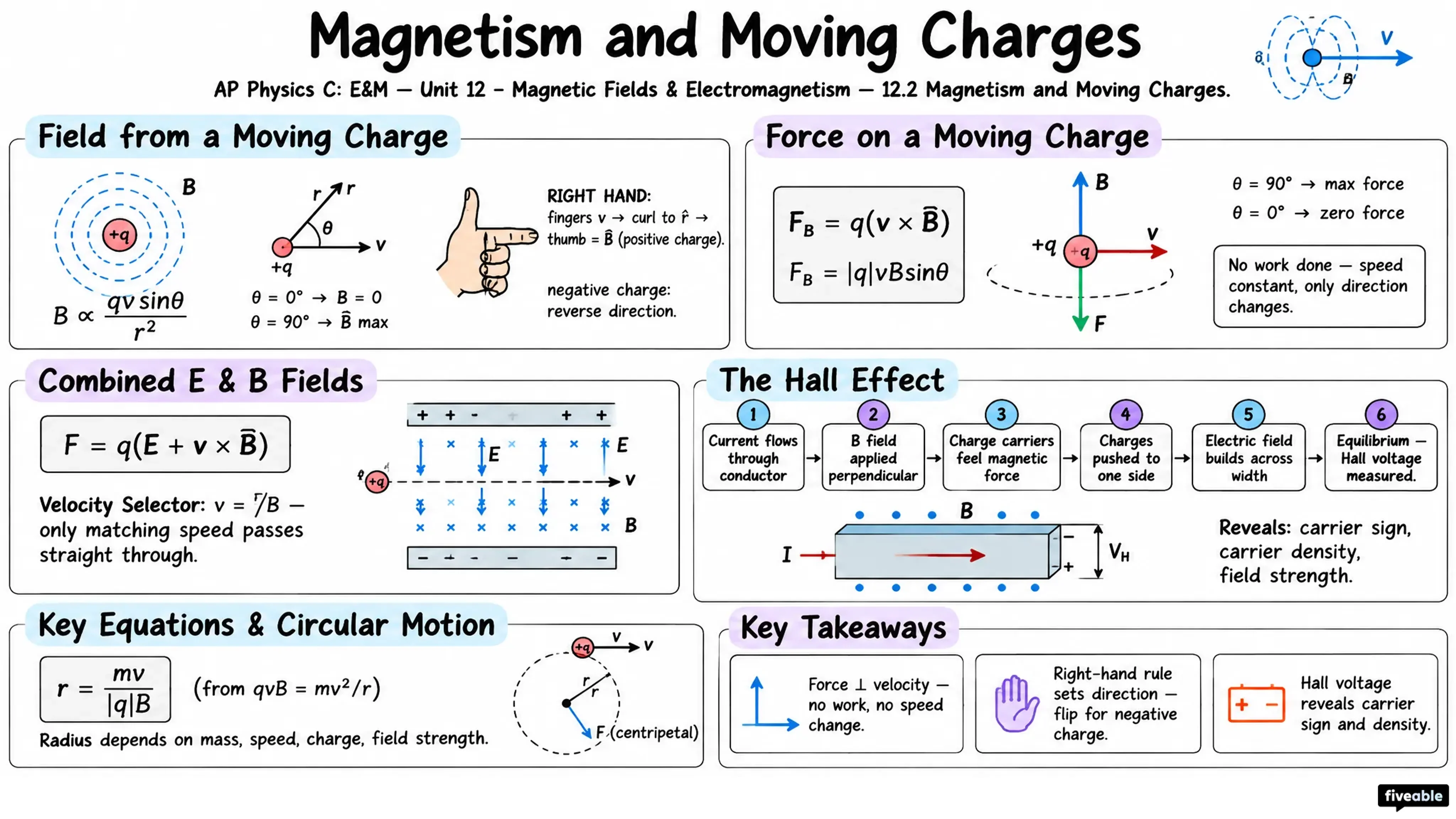
Right-hand rule variants

  • Current/velocity → field: thumb along current, fingers curl
  • Cross product v × B: fingers point along v, curl toward B, thumb shows result

The rest of the Unit 12 sheet

6 more sections are on the one-page PDF:

  • Magnetic Materials & Permeability

  • Ampère's Law & Symmetric Fields

  • Quantitative Relationships & Scaling

  • Moving Charges & Magnetic Force

  • Biot-Savart Law & Current-Carrying Wires

  • Problem-Solving Strategy

Made by you

Visual Cheatsheets

Pick a Unit 12 topic and a format: flowchart, comparison chart, vocab sheet, Cornell notes and more. Ready in about a minute.

Printable PDF · from the Fiveable shop

AP Physics C: Electricity and Magnetism Unit 12 Cheatsheet

1 page · Magnetic Fields and Electromagnetism · PDF

Visual Cheatsheets

One topic, the format you pick, ready in about a minute

Format

Topic

Takes 30–60 seconds

Preview: Standard

Unit 12: Magnetic Fields & Electromagnetism, topic by topic

Each topic has a full study guide. See the whole unit.