← back to ap physics c: e&m

ap physics c: e&m unit 12 study guides

magnetic fields & electromagnetism

unit 12 review

Magnetic fields and electromagnetism form the foundation of modern technology. From electric motors to MRI machines, these principles govern the interaction between electricity and magnetism, enabling countless applications in our daily lives. Understanding magnetic fields, forces on charges and currents, and electromagnetic induction is crucial for grasping the behavior of electromagnetic systems. These concepts explain phenomena like Earth's magnetic field and provide the basis for generating and transforming electrical energy.

Key Concepts and Definitions

  • Magnetic field B\vec{B} represents the region around a magnet or current-carrying wire where magnetic forces can be detected
  • Magnetic flux ΦB\Phi_B measures the amount of magnetic field passing through a surface (units: webers, Wb)
  • Magnetic permeability μ\mu describes a material's ability to support the formation of a magnetic field within itself
    • Vacuum permeability: μ0=4π×107 Tm/A\mu_0 = 4\pi \times 10^{-7} \text{ T}\cdot\text{m/A}
    • Relative permeability: μr=μ/μ0\mu_r = \mu / \mu_0
  • Magnetic dipole moment μ\vec{\mu} quantifies the torque experienced by a current loop or bar magnet when placed in an external magnetic field
  • Faraday's law states that a changing magnetic flux through a loop induces an electromotive force (emf) in the loop
  • Lenz's law predicts the direction of induced current in a loop based on the change in magnetic flux

Magnetic Field Basics

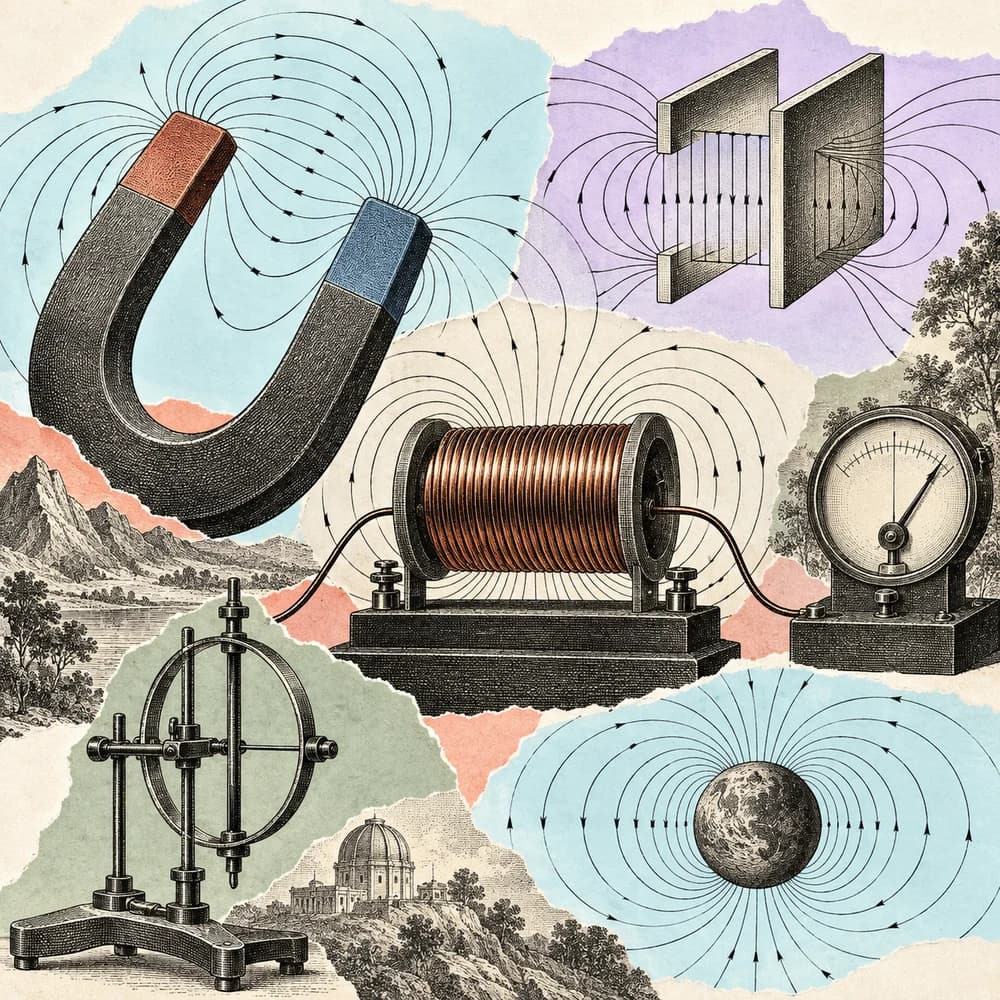
  • Magnetic fields are represented by field lines, which form closed loops and never cross each other
  • The direction of a magnetic field line at any point is tangent to the field line and points from the north pole to the south pole
  • Magnetic field strength decreases with distance from the source (magnet or current-carrying wire)
  • Magnetic fields can be uniform (constant strength and direction) or non-uniform (varying strength and/or direction)
  • The Earth's magnetic field is approximately a dipole field, with north and south magnetic poles near the geographic poles
  • Magnetic fields are measured in teslas (T) or gauss (G), where 1 T = 10,000 G

Sources of Magnetic Fields

  • Permanent magnets produce magnetic fields due to the alignment of magnetic domains within the material (ferromagnetic materials like iron, nickel, and cobalt)
  • Current-carrying wires generate magnetic fields in accordance with the Biot-Savart law
    • The direction of the magnetic field is determined by the right-hand rule
  • Solenoids (tightly wound coils of wire) produce strong, uniform magnetic fields inside the coil when current flows through the wire
    • The magnetic field strength inside a solenoid is given by B=μ0nIB = \mu_0 n I, where nn is the number of turns per unit length and II is the current
  • Electromagnets are temporary magnets created by passing current through a coil of wire, often wrapped around a ferromagnetic core (soft iron)
  • Superconductors can generate strong magnetic fields due to their ability to carry high currents with zero resistance

Magnetic Forces on Moving Charges

  • A charged particle moving in a magnetic field experiences a force perpendicular to both the particle's velocity and the magnetic field (Lorentz force)
    • The magnitude of the force is given by F=qvBsinθF = qvB\sin\theta, where qq is the charge, vv is the velocity, BB is the magnetic field strength, and θ\theta is the angle between v\vec{v} and B\vec{B}
  • The direction of the magnetic force on a moving charge is determined by the right-hand rule
  • Charged particles moving parallel to a magnetic field experience no force
  • Charged particles moving perpendicular to a magnetic field experience maximum force and follow a circular path
    • The radius of the circular path is given by r=mv/qBr = mv/qB, where mm is the mass of the particle
  • Magnetic fields can be used to filter or separate charged particles based on their charge-to-mass ratio (mass spectrometry)

Magnetic Forces on Current-Carrying Wires

  • A current-carrying wire in a magnetic field experiences a force due to the interaction between the magnetic field and the moving charges (electrons) in the wire
  • The force on a current-carrying wire is given by F=IL×B\vec{F} = I\vec{L} \times \vec{B}, where II is the current, L\vec{L} is the length vector of the wire, and B\vec{B} is the magnetic field
  • The direction of the force is determined by the right-hand rule (curl the fingers of the right hand from L\vec{L} to B\vec{B}, and the thumb points in the direction of F\vec{F})
  • Parallel current-carrying wires experience attractive forces if the currents flow in the same direction and repulsive forces if the currents flow in opposite directions
  • The force between two parallel current-carrying wires is given by F=μ0I1I2L/2πdF = \mu_0 I_1 I_2 L / 2\pi d, where I1I_1 and I2I_2 are the currents, LL is the length of the wires, and dd is the distance between them
  • Magnetic forces on current-carrying wires are the basis for electric motors and loudspeakers

Electromagnetic Induction

  • Faraday's law of induction states that a changing magnetic flux through a loop induces an electromotive force (emf) in the loop
    • The induced emf is given by E=dΦB/dt\mathcal{E} = -d\Phi_B/dt, where ΦB\Phi_B is the magnetic flux
  • Lenz's law predicts the direction of the induced current, which opposes the change in magnetic flux that produced it
  • Motional emf is induced when a conductor moves through a magnetic field
    • The magnitude of the motional emf is given by E=BLv\mathcal{E} = BLv, where BB is the magnetic field strength, LL is the length of the conductor, and vv is the velocity of the conductor perpendicular to the field
  • Transformers use electromagnetic induction to change the voltage and current levels in AC circuits
    • The voltage ratio between the primary and secondary coils is equal to the ratio of the number of turns in each coil
  • Eddy currents are induced currents in bulk conductors that create magnetic fields opposing the change in the original magnetic field (used in braking systems)

Applications and Real-World Examples

  • Magnetic Resonance Imaging (MRI) uses strong magnetic fields and radio waves to create detailed images of the body's internal structures
  • Particle accelerators (cyclotrons, synchrotrons) use magnetic fields to guide and accelerate charged particles for research in physics and medicine
  • Maglev trains use powerful electromagnets to levitate and propel the train, reducing friction and allowing for high-speed travel
  • Electric generators convert mechanical energy into electrical energy through electromagnetic induction (wind turbines, hydroelectric power plants)
  • Electromagnetic braking systems in vehicles use eddy currents to slow down the vehicle without physical contact between the brake pads and rotors
  • Hall effect sensors measure magnetic fields and are used in various applications (brushless DC motors, proximity sensors, current sensors)

Problem-Solving Strategies

  • Identify the type of problem (magnetic field, force, induction) and the relevant given information
  • Draw a clear diagram showing the magnetic field, current, or moving charge, and label all known quantities
  • Determine the appropriate equation or principle to apply based on the problem type and given information
  • Use the right-hand rules to determine the directions of magnetic fields, forces, and induced currents
  • Solve the equation for the desired quantity, paying attention to units and significant figures
  • Check the reasonableness of the answer by considering the magnitude and direction of the result, and compare it to known values or physical intuition
  • Practice solving a variety of problems to develop a strong understanding of the concepts and problem-solving techniques
  • When faced with a complex problem, break it down into smaller, manageable steps and solve each step systematically

Frequently Asked Questions

What topics are covered in AP Physics C: Electricity and Magnetism Unit 12?

Unit 12 focuses on Magnetic Fields and Electromagnetism as laid out in the College Board CED and summarized at (https://library.fiveable.me/ap-physics-e-m/unit-12). It includes Topics 12.1–12.4: 12.1 Magnetic Fields (field properties, field lines, magnetization, permeability). 12.2 Magnetism and Moving Charges (magnetic fields from moving charges, Lorentz force, Hall effect). 12.3 Magnetic Fields of Current-Carrying Wires and the Biot–Savart Law (field patterns, Biot–Savart law, fields of loops and wires, forces between currents). 12.4 Ampère's Law (Ampèrian loops, B around long wires, solenoids, superposition, Maxwell’s addition conceptually). The emphasis is conceptual, using right-hand rules, and a few symmetric quantitative applications. For a concise review, Fiveable offers a study guide, cheatsheet, cram videos, and practice questions at the unit link above.

How much of the AP Physics C: E&M exam does Unit 12 typically comprise?

You’ll see Unit 12 (Magnetic Fields and Electromagnetism) make up roughly 10%–20% of the AP Physics C: E&M exam — that range comes from the College Board’s recommended exam weighting. Expect about one-tenth to one-fifth of the exam content to focus on magnetic fields, moving charges, the Biot–Savart law, and Ampère’s law. In classroom pacing this unit usually takes around 10–14 periods, so it’s a medium-weight unit: important but not the largest. For focused review and practice problems tied to these topics, check the Fiveable unit guide (https://library.fiveable.me/ap-physics-e-m/unit-12).

What's the hardest part of Unit 12 in AP Physics C: Electricity and Magnetism?

A lot of students find applying the Biot–Savart Law and Ampère's Law with vector calculus the toughest part — especially setting up and evaluating the integrals. Common struggles: writing and evaluating line integrals for magnetic fields from current distributions, keeping vector directions straight (cross products), and using the right-hand rule consistently for forces on moving charges. Choosing the simplest symmetry for Ampère’s Law and translating word problems into integral expressions also trips people up. Practice that forces you to parametrize current elements, sketch fields, and solve integrals helps most. For worked examples and targeted practice, see the Fiveable Unit 12 guide (https://library.fiveable.me/ap-physics-e-m/unit-12).

How long should I study Unit 12 to master magnetic fields and electromagnetism?

Plan on about 2–4 weeks (roughly the CED’s ~10–14 class periods) to learn Unit 12; start with the unit guide (https://library.fiveable.me/ap-physics-e-m/unit-12). If you’re comfortable with vector calculus, aim for 3–6 focused hours per week. If vector calculus feels weak, budget 6–10+ hours per week. A good breakdown: 2–3 days reviewing theory (12.1–12.4) and derivations, 2–3 days doing problem sets (Biot–Savart, Ampère’s law, magnetic forces), plus weekly mixed practice and FRQ-style problems. Add extra time for 3D integrals and mastering right-hand-rule applications. Track progress by timing problems and noting repeated misses; if you still miss several problem types, add another week of targeted practice. Use the practice bank for drills (https://library.fiveable.me/practice/physics-e-m).

What calculus is needed specifically for Unit 12 in AP Physics C: Electricity and Magnetism?

You’ll need comfort with vector algebra (especially the cross product), single-variable calculus (derivatives and definite/indefinite integrals), and basic line integrals; see the Fiveable Unit 12 guide (https://library.fiveable.me/ap-physics-e-m/unit-12). Practically, you’ll use derivatives to relate quantities in circular motion (for example r = mv/qB), apply the cross product in the magnetic force law F = q(v × B), and evaluate integrals in the Biot–Savart law (dB integrals over current elements) and Ampère’s law (∮B·dℓ). Useful skills: parametrizing current elements, doing trig substitutions, and exploiting symmetry to simplify integrals. You won’t need advanced vector calculus (full Maxwell curl/divergence proofs) for the AP exam. For practice problems and walkthroughs, check the practice set (https://library.fiveable.me/practice/physics-e-m).

Where can I find Unit 12 FRQ practice for AP Physics C: Electricity and Magnetism (recent years)?

Try the College Board’s free-response question archive at https://apcentral.collegeboard.org/courses/ap-physics-c-electricity-and-magnetism/exam-questions for recent AP Physics C: E&M FRQs. The site has downloadable past FRQs, scoring guidelines, and sample responses — you can filter by year to grab the latest exams. Because exams don’t always label questions by unit, read the stems and scoring notes to pick out Unit 12 topics (magnetic fields, moving charges, Biot–Savart/Ampère’s law). For step-by-step walkthroughs and unit-targeted practice, check Fiveable’s Unit 12 study guide and practice pool at https://library.fiveable.me/ap-physics-e-m/unit-12 and https://library.fiveable.me/practice/physics-e-m.

What common mistakes do students make on Unit 12 questions in AP Physics C: E&M?

You’ll see a lot of the same pitfalls. Students mix up directions and signs for magnetic forces and fields, misapply the right-hand rule, or forget to treat quantities as vectors (cross products matter). Others treat magnetic fields like scalars, drop factors of µ0 or 2π in Biot–Savart/Ampère problems, or misuse Ampère’s Law where symmetry isn’t enough. Common extras: confusing velocity vs. current direction for force on charges, skipping units (tesla, ampere, meter), and plugging numbers too early instead of doing symbol-first work. See the Unit 12 study guide (https://library.fiveable.me/ap-physics-e-m/unit-12) for focused review. To improve, sketch right-hand-rule diagrams, track vector signs carefully, do derivations in symbols, and practice multiple Biot–Savart/Ampère examples. Fiveable also offers cram videos and practice questions to drill these skills.

How should I structure a study plan for Unit 12 (magnetic fields & electromagnetism) before the exam?

Start with Fiveable’s Unit 12 study guide at https://library.fiveable.me/ap-physics-e-m/unit-12 to get a roadmap of topics and formulas. Aim for 10–14 days (or 4–6 if you’re short on time) using this pattern: Days 1–2: read the overview and memorize key formulas (magnetic force, Biot–Savart, Ampère’s law, fields of wires/loops). Days 3–6: work derivations and conceptual questions (force on moving charge, right-hand rule, flux changes). Days 7–10: drill 20–30 mixed problems, including Biot–Savart integrals and Ampère’s cases. Day 11: do timed FRQ-style problems. Days 12–14: review mistakes, make a one-page cheatsheet, and finish with a full mixed practice set. Track weak spots and re-drill them. For extra practice, use Fiveable’s 1000+ practice questions at https://library.fiveable.me/practice/physics-e-m and the cheatsheets/cram videos for quick reviews.