AP Physics 2 Qualitative/Quantitative FRQ Practice
98 Qualitative/Quantitative Translation questions written in the AP format. Pick one, read the full question, and write your response. Fiveable scores each Qualitative/Quantitative FRQ response part by part on the AP rubric.
Your first scored response is included. A plan unlocks unlimited scoring.
New to the Qualitative/Quantitative FRQ? Read the exam guide
98 questions
sorted by unit
Monatomic ideal gas heating in rigid container
Unit 9: Thermodynamics
A rigid, sealed container holds of a monatomic ideal gas, as shown in Figure 1. The gas is initially in thermal equilibrium at temperature and pressure . The gas is then heated slowly while the container remains rigid, until the gas reaches a higher temperature . Assume the ideal gas model applies throughout, and the gas remains in equilibrium during the heating.
Figure 1. Rigid sealed container (constant volume) of monatomic ideal gas heated from initial state (P₁, T₁) to a higher-temperature final state (P₂, T₂).
A student claims that when the temperature of the gas increases from to in the rigid container, the pressure of the gas on the container walls increases because the gas particles move faster and collide with the walls more frequently and with greater momentum change per collision.
Indicate whether the student's claim is correct or incorrect. Without manipulating equations, justify your answer by referring to the atomic motion of the gas particles and how that motion relates to both temperature and the pressure exerted on the container walls.
Derive an expression for the thermal energy transferred to the gas, , during the heating from to in the rigid container. Express your answer in terms of , , , and physical constants, as appropriate. Begin your derivation by writing a fundamental physics principle or an equation from the reference information.
Indicate whether the expression you derived in part B is or is not consistent with your answer from part A. Briefly justify your answer by explaining how increasing affects the thermal energy added and the resulting change in the gas behavior in a constant-volume process.
What the Qualitative/Quantitative FRQ asks
The Qualitative/Quantitative Translation (QQT) question is FRQ 4 on the AP Physics 2 exam. You decide whether a claim about a scenario is correct and justify it without equations, derive an expression, then check whether the expression agrees.
- 15–20 min
- suggested on the exam
- 8 points
- across parts A to C
- 95 min
- for all four FRQs
Part A: Claim and reasoning
Whether a claim is correct, justified without equations
3 pts
Part B: Derivation
An expression derived from a physics principle
4 pts
Part C: Consistency
Whether your expression is consistent with a claim
1 pt
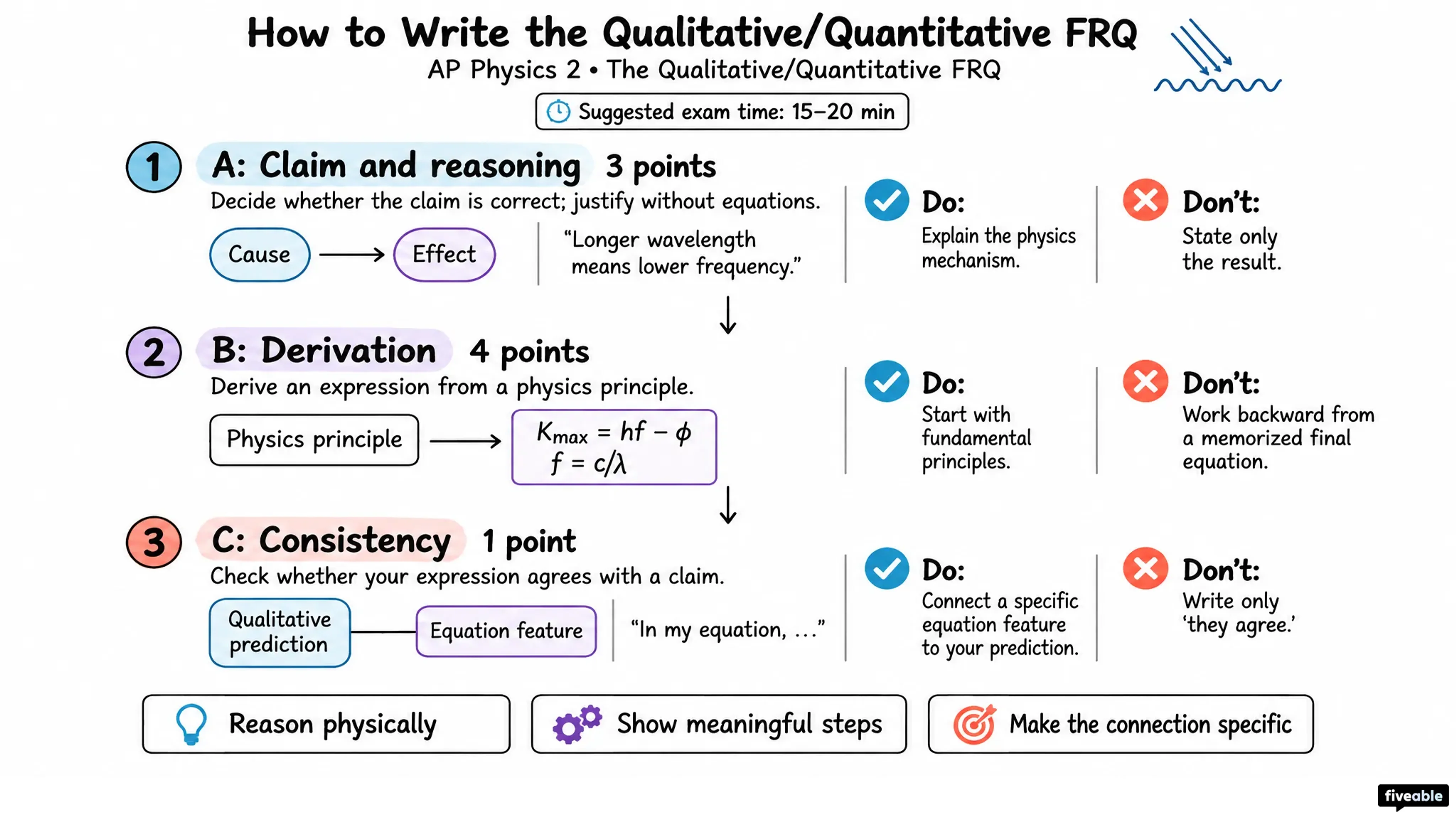
Qualitative/Quantitative FRQ skill sheet
Every rubric point on one page: what earns it, what to do and what to avoid. Tap the sheet to see it full size.
How Qualitative/Quantitative FRQ practice works
Each question follows the exam’s format, from the full prompt to a score on every part.
Read the full question
The scenario, its figures, and all three parts, A through C, laid out the way the exam shows them.
Write on an 18-minute timer
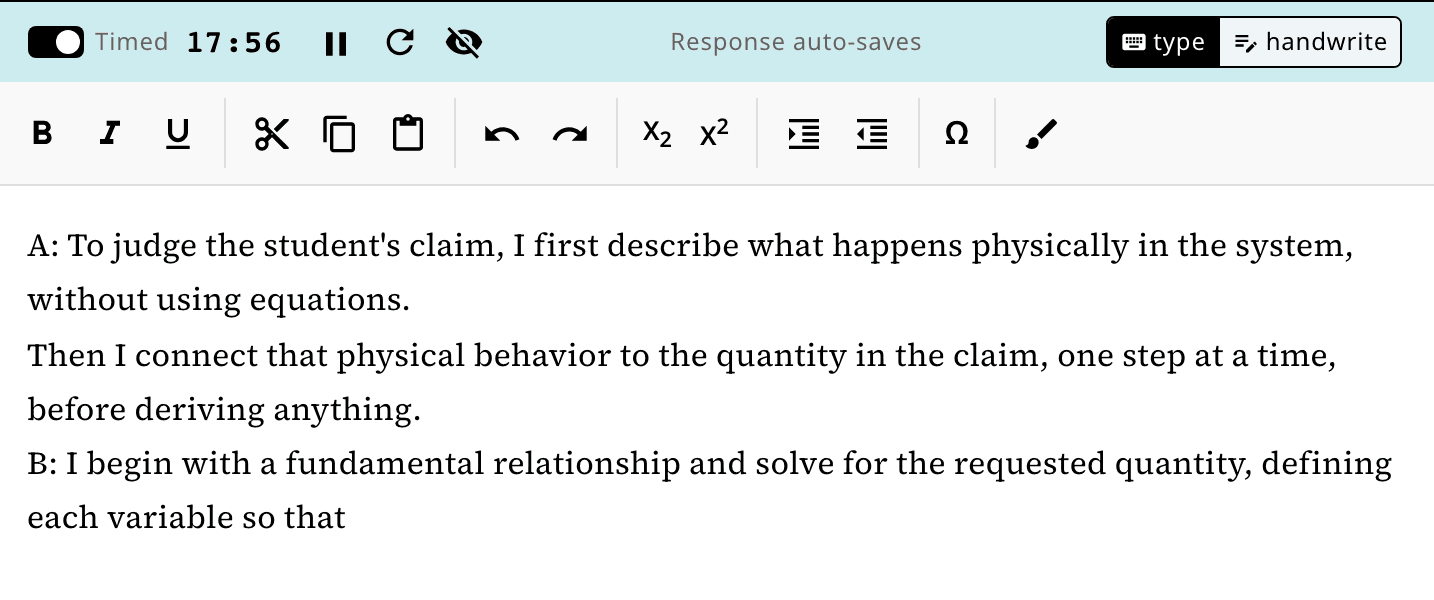
Inside the 15 to 20 minutes the exam suggests for this question. Pause it or turn it off, and your response saves as you go.
Submit for a score out of 8
Your response is scored against the scoring guidelines written for that question. Your first score is included.
Feedback on every part
A summary at the top tells you what to work on next. Below it, each part shows whether you earned the point and what the scoring guidelines were looking for.
Detailed Feedback
Part A: 1/1 point
Earned the point. You correctly indicated that the student's claim is incorrect.
Part A: 1/1 point
Earned the point. You correctly stated the law of reflection, noting that the angle of incidence equals the angle of reflection.
Part A: 0/1 point
Did not earn the point. While you stated the general law of reflection, you needed to apply it specifically to the scenario by stating that since the incident angle is 40°, the reflected angle must also be exactly 40° (and therefore not greater than 40°).
Questions about the Qualitative/Quantitative FRQ
How many responses can I get scored?
You can read every question without a plan. Your first scored response is included. A plan unlocks unlimited scoring.
Can I use equations in part A?
No. Part A asks you to justify the claim without manipulating equations, by describing what happens physically. Part B is where you derive.
How is the QQT different from the Mathematical Routines question?
The QQT starts with reasoning in words, then checks it against a derivation, and is worth 8 points. The Mathematical Routines question adds a diagram and is worth 10.
How do I type equations and symbols?
Use the subscript, superscript, and special-character buttons in the editor toolbar. Or write your derivation on paper, switch to handwrite, and add a photo.
Are these real College Board questions?
No. We wrote them in the AP format, with the same three parts, and wrote scoring guidelines for each one.
More AP Physics 2 practice
Mathematical Routines FRQ practice
Mathematical Routines questions with the full scenario, figures, and both parts.
Representations FRQ practice
Translation Between Representations questions with the full scenario and all four parts.
Experimental Design FRQ practice
Experimental Design and Analysis questions with the full lab setup and data table.
Write your first Qualitative/Quantitative FRQ
Pick one from the list, or let us choose for you.
Teaching AP Physics 2? Assign these Qualitative/Quantitative FRQs to your class