AP Physics 2 Mathematical Routines FRQ Practice
58 Mathematical Routines questions written in the AP format. Pick one, read the full question, and write your response. Fiveable scores each Mathematical Routines FRQ response part by part on the AP rubric.
Your first scored response is included. A plan unlocks unlimited scoring.
58 questions
sorted by unit
Thermal conduction through aluminum wall
Unit 9: Thermodynamics
A rigid, sealed container of volume holds of a monatomic ideal gas. The gas is initially at temperature and pressure . A thin rectangular aluminum wall of thickness and area separates the gas from a large thermal reservoir at constant temperature , as shown in Figure 1. The gas and reservoir exchange energy only by thermal conduction through the wall. The aluminum has thermal conductivity . Assume the wall has negligible heat capacity, the gas remains uniform in temperature, and the gas remains ideal throughout.
Figure 1. Rigid sealed container of monatomic ideal gas separated from a 500 K thermal reservoir by a thin aluminum wall; heat is conducted from reservoir to gas through the wall.
Figure 2. Molecular-speed distributions at initial state (300 K) and at a later, higher-temperature state; student indicates how the distribution changes.
Figure 3. Direction of the net force on the wall due to gas-molecule collisions at the later time; student indicates direction only.
Complete the following tasks in Figures 2 and 3.
In Figure 2, indicate how the distribution of molecular speeds of the gas at a later time compares to the distribution at .
In Figure 3, indicate the direction of the net force exerted on the wall by the gas due to molecular collisions at the later time.
The gas is heated by conduction until it reaches thermal equilibrium with the reservoir at .
Derive an expression for the final pressure of the gas in terms of , , and . Begin your derivation by writing a fundamental physics principle or an equation from the reference information.
Figure 4. Gas temperature versus time as it warms by conduction toward the 500 K reservoir; t1 marks a specific instant used for the instantaneous conduction rate.
Calculate the magnitude of the instantaneous rate at which energy is transferred by conduction into the gas at time (see Figure 4). At a particular time , the gas temperature is . The reservoir remains at . Assume heat transfer is only by conduction through the wall and use the conduction model for the instantaneous rate of energy transfer.
Then calculate the time interval required for of energy to be transferred into the gas if that rate were constant over the interval.
What the Mathematical Routines FRQ asks
The Mathematical Routines question is FRQ 1 on the AP Physics 2 exam. You analyze one physical scenario by completing a diagram and deriving an expression, then indicate an answer in part B and justify it.
- 20–25 min
- suggested on the exam
- 10 points
- across parts A and B
- 95 min
- for all four FRQs
Part A: Analysis
Complete a diagram, then derive an expression
7 pts
Part B: Claim
Indicate an answer, such as whether a claim is correct, and justify it
3 pts
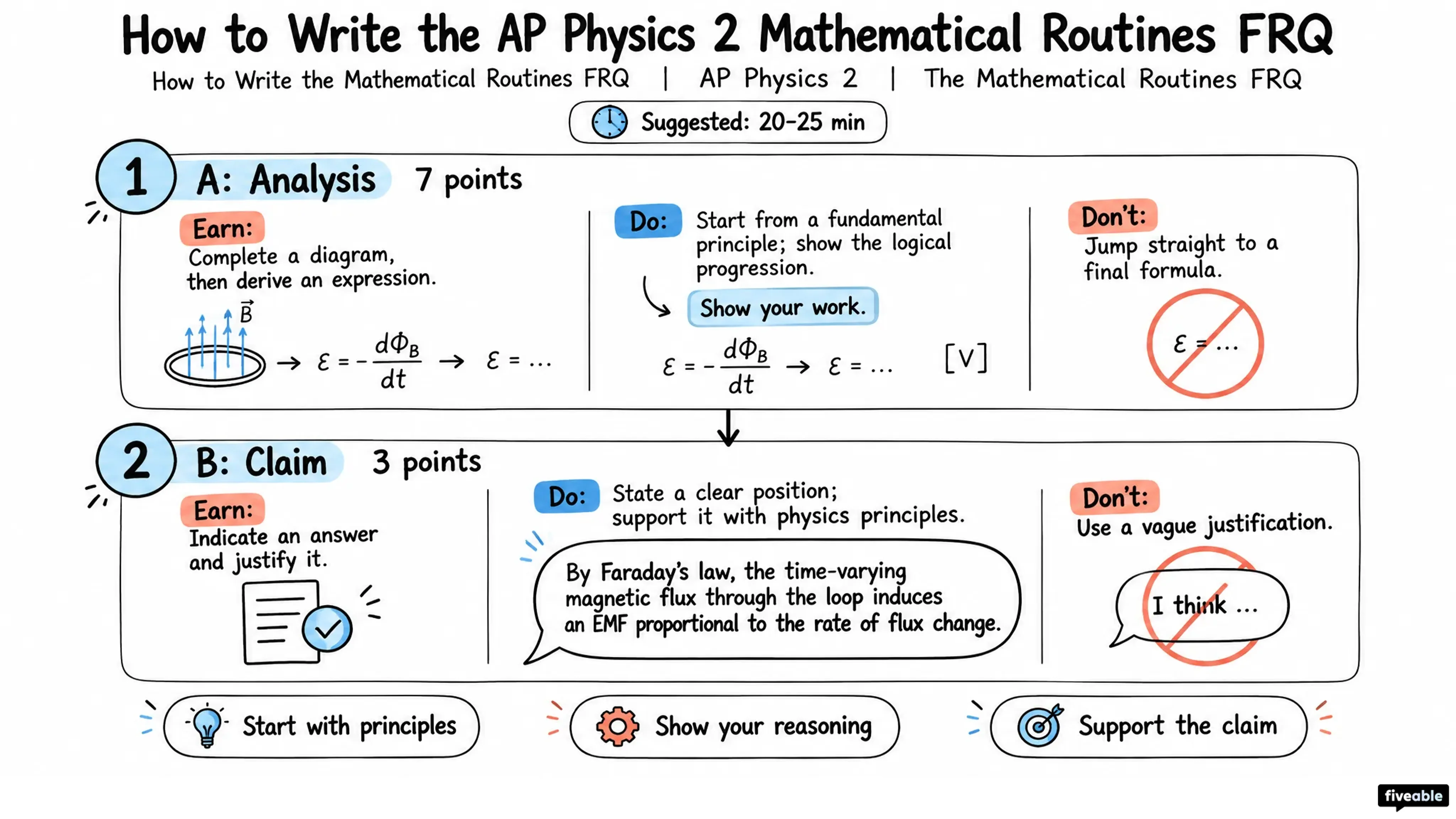
Mathematical Routines FRQ skill sheet
Every rubric point on one page: what earns it, what to do and what to avoid. Tap the sheet to see it full size.
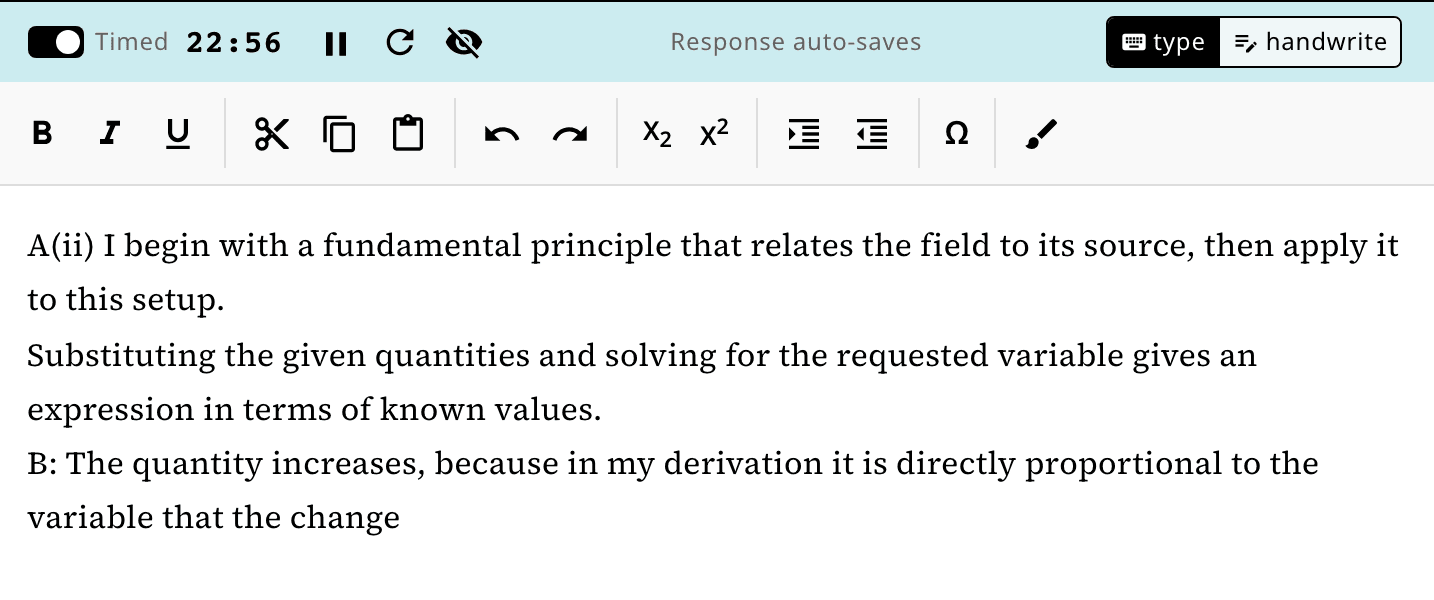
How Mathematical Routines FRQ practice works
Each question follows the exam’s format, from the full prompt to a score on every part.
Read the full question
The scenario, its figures, and parts A and B, laid out the way the exam shows them.
Write on a 23-minute timer
Inside the 20 to 25 minutes the exam suggests for this question. Pause it or turn it off, and your response saves as you go.
Submit for a score out of 10
Your response is scored against the scoring guidelines written for that question. Your first score is included.
Feedback on every part
A summary at the top tells you what to work on next. Below it, each part shows whether you earned the point and what the scoring guidelines were looking for.
Detailed Feedback
Part A-i-1: 0/1 point
Did not earn the point. You mentioned that the arrows will have a greater magnitude, but you needed to describe how the distribution of speeds changes. At a higher temperature, the distribution broadens, meaning there is a wider spread of speeds with more fast molecules, but still some slow ones.
Part A-i-2: 1/1 point
Earned the point. You correctly indicated that the net force on the wall is a vector pointing to the right.
Part A-ii-1: 1/1 point
Earned the point. You successfully started your derivation by applying the ideal gas law.
Questions about the Mathematical Routines FRQ
How many responses can I get scored?
You can read every question without a plan. Your first scored response is included. A plan unlocks unlimited scoring.
How do I complete the diagram in part A?
Open the drawing tool in the editor and draw it there. You can also switch to handwrite and add a photo of your page.
How do I type equations and symbols?
Use the subscript, superscript, and special-character buttons in the editor toolbar. Or write your derivations on paper, switch to handwrite, and add a photo.
How is the Mathematical Routines question different from the Qualitative/Quantitative Translation (QQT) question?
Both ask for a derivation. The Mathematical Routines question also asks for a diagram and is worth 10 points. The QQT starts with reasoning in words and is worth 8 points.
Are these real College Board questions?
No. We wrote them in the AP format, with the same parts and points, and wrote scoring guidelines for each one.
More AP Physics 2 practice
Representations FRQ practice
Translation Between Representations questions with the full scenario and all four parts.
Experimental Design FRQ practice
Experimental Design and Analysis questions with the full lab setup and data table.
Qualitative/Quantitative FRQ practice
Qualitative/Quantitative Translation questions with the full scenario and all three parts.
Write your first Mathematical Routines FRQ
Pick one from the list, or let us choose for you.
Teaching AP Physics 2? Assign these Mathematical Routines FRQs to your class