AP Microeconomics Question 3 Short FRQ Practice
109 short FRQs written in the AP format for FRQ 3. Pick one, read the full question, and write your response.
Your first scored response is included. A plan unlocks unlimited scoring.
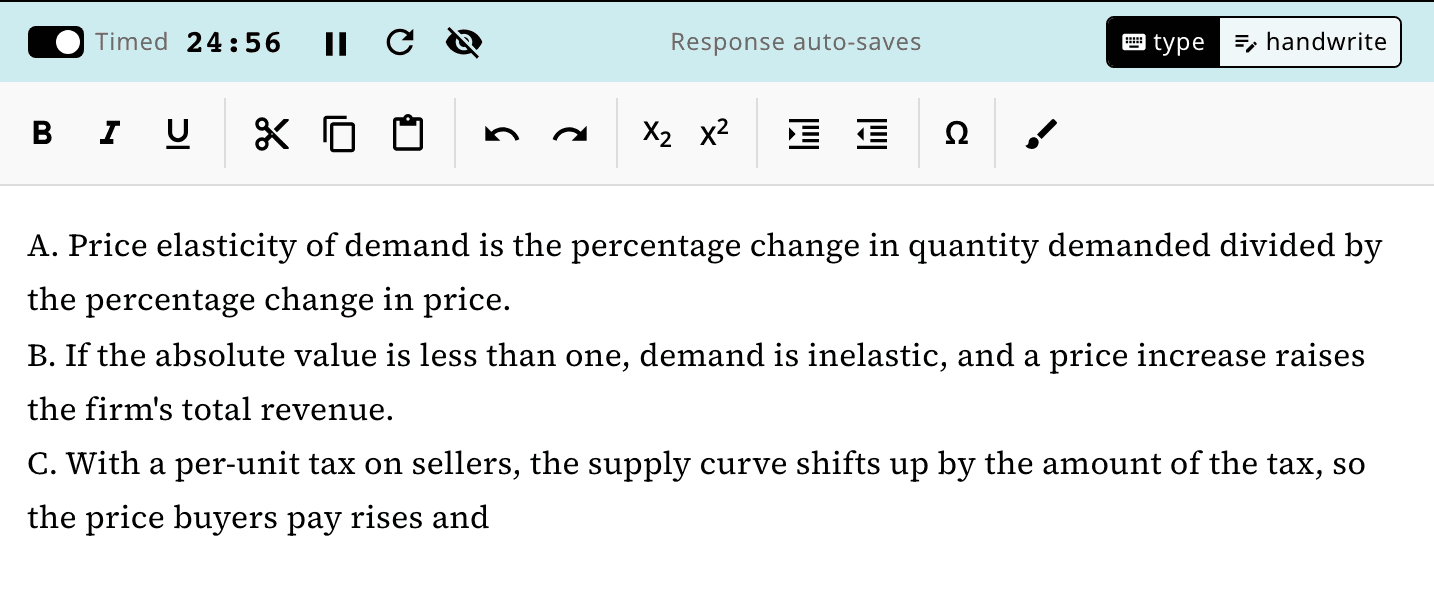
109 questions
sorted by unit
Wheat and corn output in Countries A and B with one-for-one trade
Unit 1: Basic Economic Concepts
Country A and Country B produce two goods, Wheat and Corn, using equal amounts of resources. The table below shows the maximum daily output of each good for each country if they devote all their resources to the production of that good. Assume constant opportunity costs for both countries.
Maximum Daily Output
Country | Wheat (bushels) | Corn (bushels) |
|---|---|---|
Country A | 60 | 30 |
Country B | 20 | 40 |
Which country has the absolute advantage in the production of Wheat? Explain.
Calculate the opportunity cost of producing one bushel of Corn in Country A. Show your work.
Which country has the comparative advantage in the production of Corn? Explain using numbers.
Assume the countries agree to trade 1 bushel of Corn for 1 bushel of Wheat. Would this trade be beneficial for Country A? Explain.
Suppose Country A decides to produce 40 bushels of Wheat. Calculate the maximum number of bushels of Corn it can produce with the remaining resources. Show your work.
What the Question 3 Short FRQ asks
FRQ 3 is the second short question on the AP Microeconomics exam. Like FRQ 2, it focuses on one model and asks you to calculate, identify, and explain one result at a time.
- 12-15 min
- suggested writing time
- 5 points
- usually across parts A to E
- 25%
- of your FRQ section score
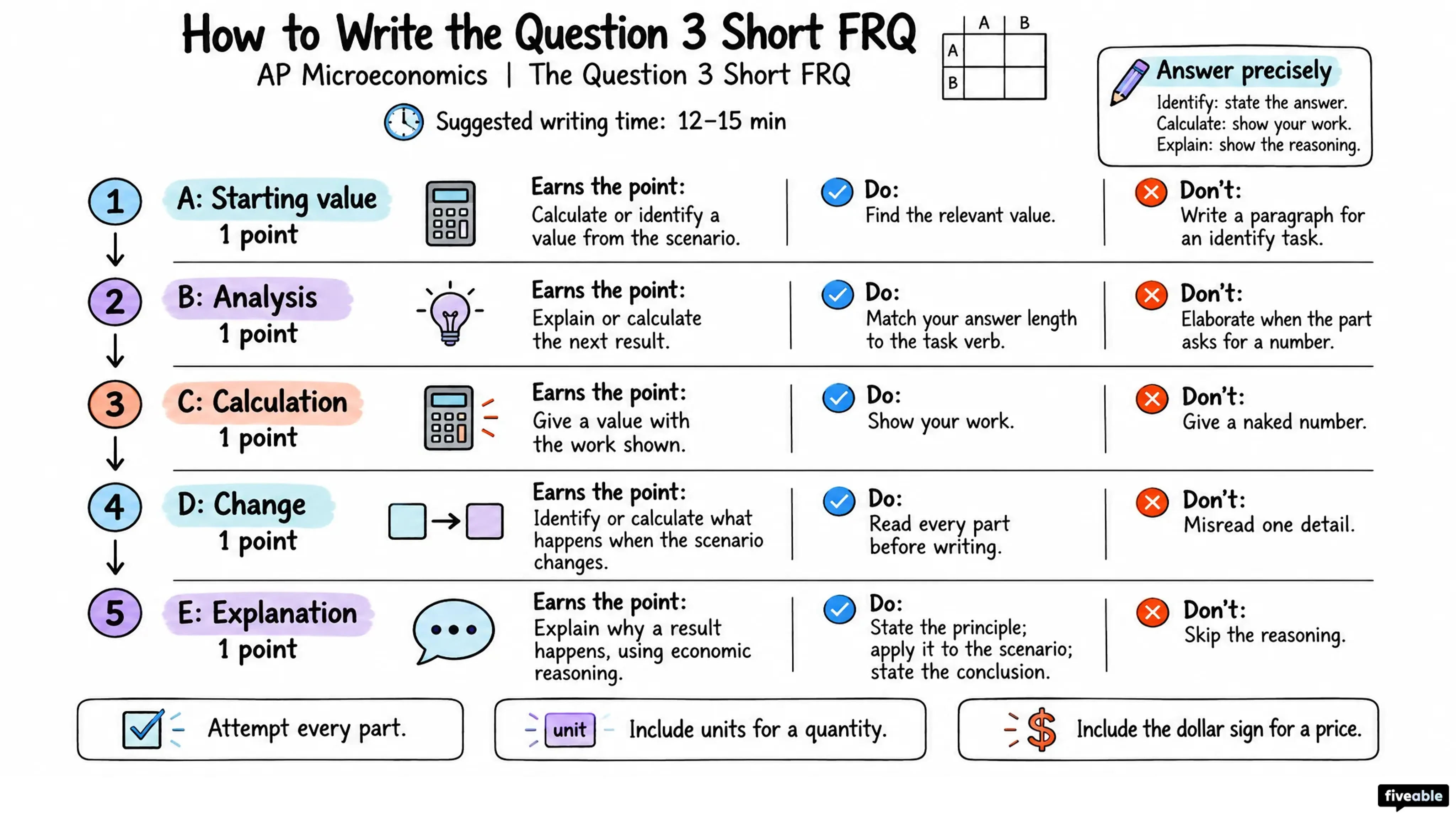
Part A: Starting value
Calculate or identify a value from the scenario
1 pt
Part B: Analysis
Explain or calculate the next result
1 pt
Part C: Calculation
A value with the work shown
1 pt
Part D: Change
Identify or calculate what happens when the scenario changes
1 pt
Part E: Explanation
Explain why a result happens, using economic reasoning
1 pt
Question 3 Short FRQ skill sheet
Every rubric point on one page: what earns it, what to do and what to avoid. Tap the sheet to see it full size.
How Question 3 Short FRQ practice works
Each question follows the exam’s format, from the full prompt to a score on every part.
Read the full question
The scenario, any data or tables, and every part, laid out the way the exam shows them.
Write on a 12-minute timer
The time to plan for on exam day. Pause it or turn it off, and your response saves as you go.
Submit for a score out of 5
Your response is scored against the scoring guidelines written for that question. Your first score is included.
Feedback on every part
A summary at the top tells you what to work on next. Below it, each part shows whether you earned the point and what the scoring guidelines were looking for.
Detailed Feedback
Part A: 1/1 point
Earned the point. You correctly identified the equilibrium price as $50 and the equilibrium quantity as 60 solar panels, and you explained that this occurs where quantity demanded equals quantity supplied.
Part B: 0/1 point
Did not earn the point. Your calculation is incorrect. You calculated the absolute changes (10 solar panels and $10) and concluded the elasticity is 1, but price elasticity of supply requires calculating PERCENTAGE changes, not absolute changes. The correct calculation is: PES = (% change in Qs)/(% change in P) = [(70-60)/60]/[(60-50)/50] = (10/60)/(10/50) = 0.167/0.20 ≈ 0.83. You needed to divide each change by its original value to get the percentage changes.
Part C(i): 1/1 point
Earned the point. You correctly identified that 50 solar panels will be sold after the tax is imposed. Note: The question asks about a $20 per-unit tax (not 60 and producers receive $40, creating the $20 tax wedge.
Questions about the Question 3 Short FRQ
How many responses can I get scored?
You can read every question without a plan. Your first scored response is included. A plan unlocks unlimited scoring.
What does FRQ 3 usually cover?
One model, such as costs and profit, elasticity, a price control, an externality, or game theory. Most parts ask for one result each.
How is FRQ 3 different from FRQ 2?
On the exam both short questions are worth 5 points, with about 12 to 15 minutes suggested for each. Most of our FRQ 3 questions have five 1-point parts, and our FRQ 2 questions end with a 3-point part C.
Is every FRQ 3 split the same way?
Most have five parts worth 1 point each. Some have four parts, with one of them worth 2 points.
Do I need to show my work?
Yes, on any part that says calculate. Write the setup first, then the numbers. A four-function calculator is built into the writing screen.
More AP Microeconomics practice
Question 2 Short FRQ practice
Short FRQs for question 2, with the full scenario and every part.
AP Microeconomics FRQs
Every FRQ type for AP Microeconomics, with practice for each.
Write your first Question 3 Short FRQ
Pick one from the list, or let us choose for you.
Teaching AP Microeconomics? Assign these Question 3 Short FRQs to your class