AP Macroeconomics Question 3 Short FRQ Practice
117 short FRQs written in the AP format for FRQ 3. Pick one, read the full question, and write your response.
Your first scored response is included. A plan unlocks unlimited scoring.
117 questions
sorted by unit
Ashla and Bogan’s radios and televisions trade
Unit 1: Basic Economic Concepts
Ashla and Bogan are two countries that produce only two goods: radios and televisions. The table below shows the maximum daily output of each good for each country using equal amounts of resources. Assume that both countries have constant opportunity costs in the production of both goods.
Resources are fully employed.
Opportunity costs are constant.
Maximum Daily Output
Country | Radios | Televisions |
|---|---|---|
Ashla | 20 | 10 |
Bogan | 30 | 60 |
Calculate the opportunity cost of producing one television in Ashla. Show your work.
Which country has the comparative advantage in the production of radios? Explain.
Draw a correctly labeled graph of the production possibilities curve for Bogan, with radios on the horizontal axis and televisions on the vertical axis. Plot the numerical values of the intercepts.
Assume the two countries specialize and trade. Would a term of trade of 1 radio for 1 television be mutually beneficial? Explain.
What the Question 3 Short FRQ asks
FRQ 3 is the second short question on the AP Macroeconomics exam. Like FRQ 2, it centers on one topic and asks for calculations, short explanations, and sometimes a graph.
- 12 min
- suggested writing time
- 5 points
- usually across parts A to D
- 25%
- of your FRQ section score
Part A: Graph or calculation
A labeled graph or a value from the data, with the work shown
1 pt
Part B: Next step
A calculation or a short answer that follows from part A
1 pt
Part C: Change
Show a change on your graph or explain its effect
2 pts
Part D: Explanation
Explain why a result happens, through cause and effect
1 pt
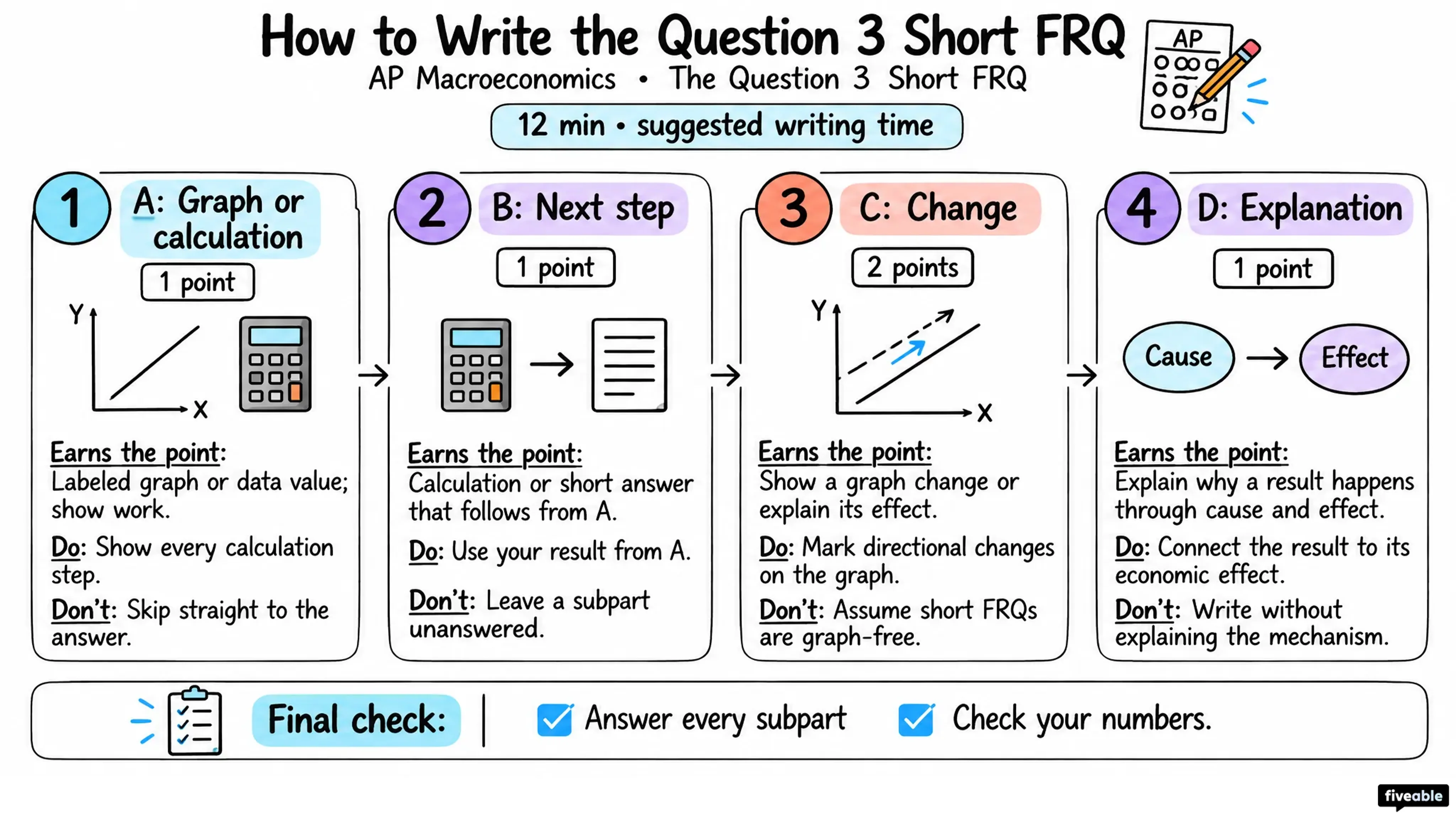
Question 3 Short FRQ skill sheet
Every rubric point on one page: what earns it, what to do and what to avoid. Tap the sheet to see it full size.
How Question 3 Short FRQ practice works
Each question follows the exam’s format, from the full prompt to a score on every part.
Read the full question
The scenario, any data, and every part, laid out the way the exam shows them.
Write on a 12-minute timer
The time to plan for on exam day. Pause it or turn it off, and your response saves as you go.
Submit for a score out of 5
Your response is scored against the scoring guidelines written for that question. Your first score is included.
Feedback on every part
A summary at the top tells you what to work on next. Below it, each part shows whether you earned the point and what the scoring guidelines were looking for.
Detailed Feedback
Part A: 0/1 point
Did not earn the point. Your graph shows a downward-sloping curve with point A marked, but the axes are not labeled. To earn this point, you needed to label the vertical axis as inflation rate (or π) and the horizontal axis as unemployment rate (or U). The curve itself also needs to be labeled as SRPC.
Part C: 1/1 point
Earned the point. You correctly calculated the tax multiplier as -3 and applied it to the $20 billion tax decrease to get a maximum change in GDP of $60 billion. Note: The answer should be $60 billion (not million), but your calculation method was correct and you showed your work clearly.
Part D: 1/1 point
Earned the point. You correctly explained that government borrowing increases the demand for loanable funds, which raises real interest rates and crowds out private investment spending. You also connected this to decreased economic growth in the long run by noting that investment in technology or human capital drives long-run growth.
Questions about the Question 3 Short FRQ
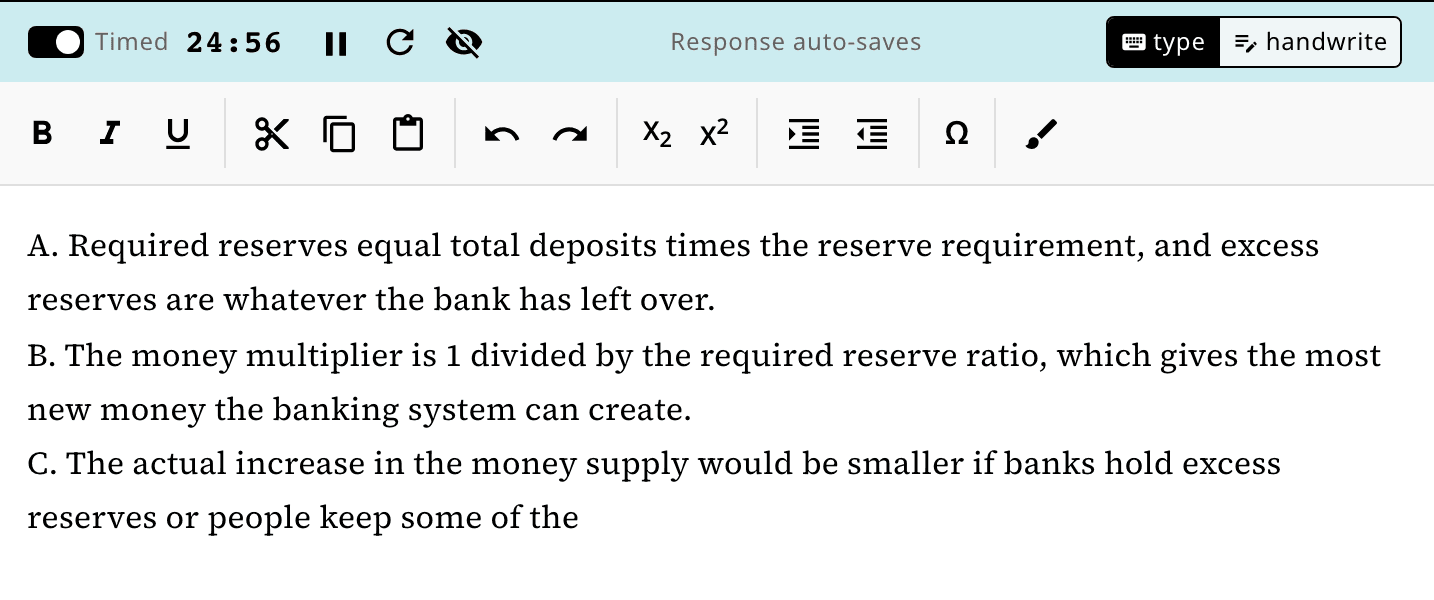
How many responses can I get scored?
You can read every question without a plan. Your first scored response is included. A plan unlocks unlimited scoring.
What does FRQ 3 usually cover?
One topic, like output gaps and fiscal policy, banking and the money supply, the Phillips curve, or comparative advantage.
How is FRQ 3 different from FRQ 2?
On the exam they’re the same kind of question: 5 points each, with about 12 minutes suggested for each. Practicing both gives you more questions in the same format.
Is every short FRQ split the same way?
No. Most have four parts with one part worth 2 points, and which part that is changes by question. The table shows the most common split.
How do I draw a graph or show my work?
Type your work with the formula first, then the numbers. When a part asks for a graph, open the drawing tool and sketch it on a grid with axes, or switch the editor to handwrite and add a photo of your page. A four-function calculator is built in.
More AP Macroeconomics practice
Question 2 Short FRQ practice
Short FRQs for question 2, with the full scenario and every part.
AP Macroeconomics FRQs
Every FRQ type for AP Macroeconomics, with practice for each.
Write your first Question 3 Short FRQ
Pick one from the list, or let us choose for you.
Teaching AP Macroeconomics? Assign these Question 3 Short FRQs to your class