AP Macroeconomics Long FRQ Practice
106 long FRQs written in the AP format. Pick one, read the full question, and write your response. Fiveable scores each Long FRQ response part by part on the AP rubric.
Your first scored response is included. A plan unlocks unlimited scoring.
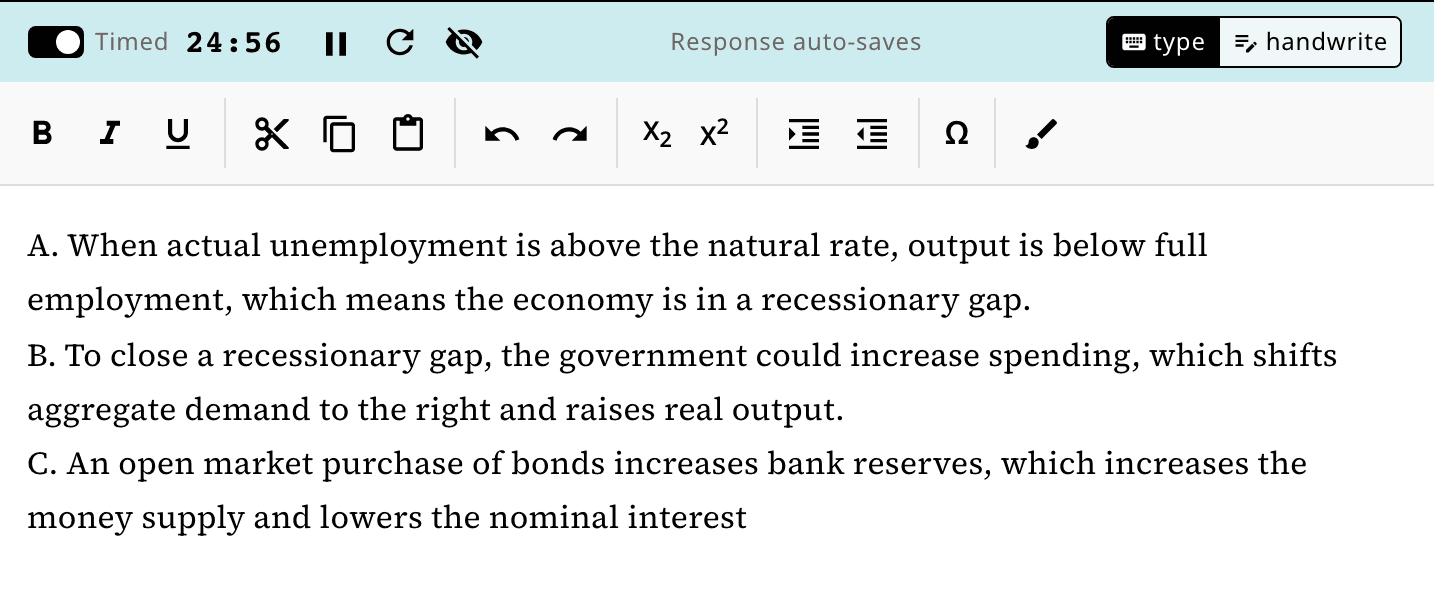
106 questions
sorted by unit
Production possibilities curve technology shift effects
Unit 1: Basic Economic Concepts
Assume that the economy of Artland produces two goods: radios and televisions. The resources in Artland are not equally suitable for the production of both goods, resulting in increasing opportunity costs.
Artland is currently operating at full employment.
The market for radios in Artland is competitive.
Draw a correctly labeled graph of the production possibilities curve (PPC) for Artland in the space provided for Figure 1, with radios on the horizontal axis and televisions on the vertical axis. Label a point A that represents full employment and efficient production. Label a point B that represents inefficient production.
Assume that Artland develops a new technology that improves the production of radios but has no effect on the production of televisions. On your graph in part A (Figure 1), show the effect of this new technology.
Table 1: Production Data
Country | Radios Produced per Worker per Day | Televisions Produced per Worker per Day |
|---|---|---|
Artland | 20 | 10 |
Rayland | 15 | 5 |
Artland decides to trade with a neighboring country, Rayland. Assume for the following parts that opportunity costs are constant. The table below (Table 1) shows the maximum daily output of radios or televisions for a single worker in each country.
Using the data in Table 1, calculate the opportunity cost of producing one television in Artland. Show your work.
Using the data in Table 1, calculate the opportunity cost of producing one television in Rayland. Show your work.
Which country has the comparative advantage in the production of televisions? Explain.
Identify one specific numerical value for the terms of trade (in terms of radios) that would be beneficial for both countries to exchange one television.
Draw a correctly labeled graph of the market for radios in Artland in the space provided for Figure 2. Show the equilibrium price and quantity, the price ceiling labeled , the quantity demanded labeled , and the quantity supplied labeled . Assume the government of Artland imposes a binding price ceiling in the market for radios.
What the Long FRQ asks
The long FRQ is FRQ 1 on the AP Macroeconomics exam. It follows one economy through a policy or a shock, with graphs to draw, values to calculate, and effects to explain.
- 25 min
- suggested writing time
- 10 points
- usually across parts A to F
- 50%
- of your FRQ section score
Part A: Starting graph
A correctly labeled graph showing where the economy starts
2 pts
Part B: Next step
A calculation, a policy action, or a change shown on your graph
2 pts
Part C: Graph or calculation
A second graph, a calculation, or an identified effect
2 pts
Part D: Related market
A second graph or market and what changes there
2 pts
Part E: Explanation
Explain a result through its chain of cause and effect
1 pt
Part F: Extension
Explain a further effect, often on exchange rates or in the long run
1 pt
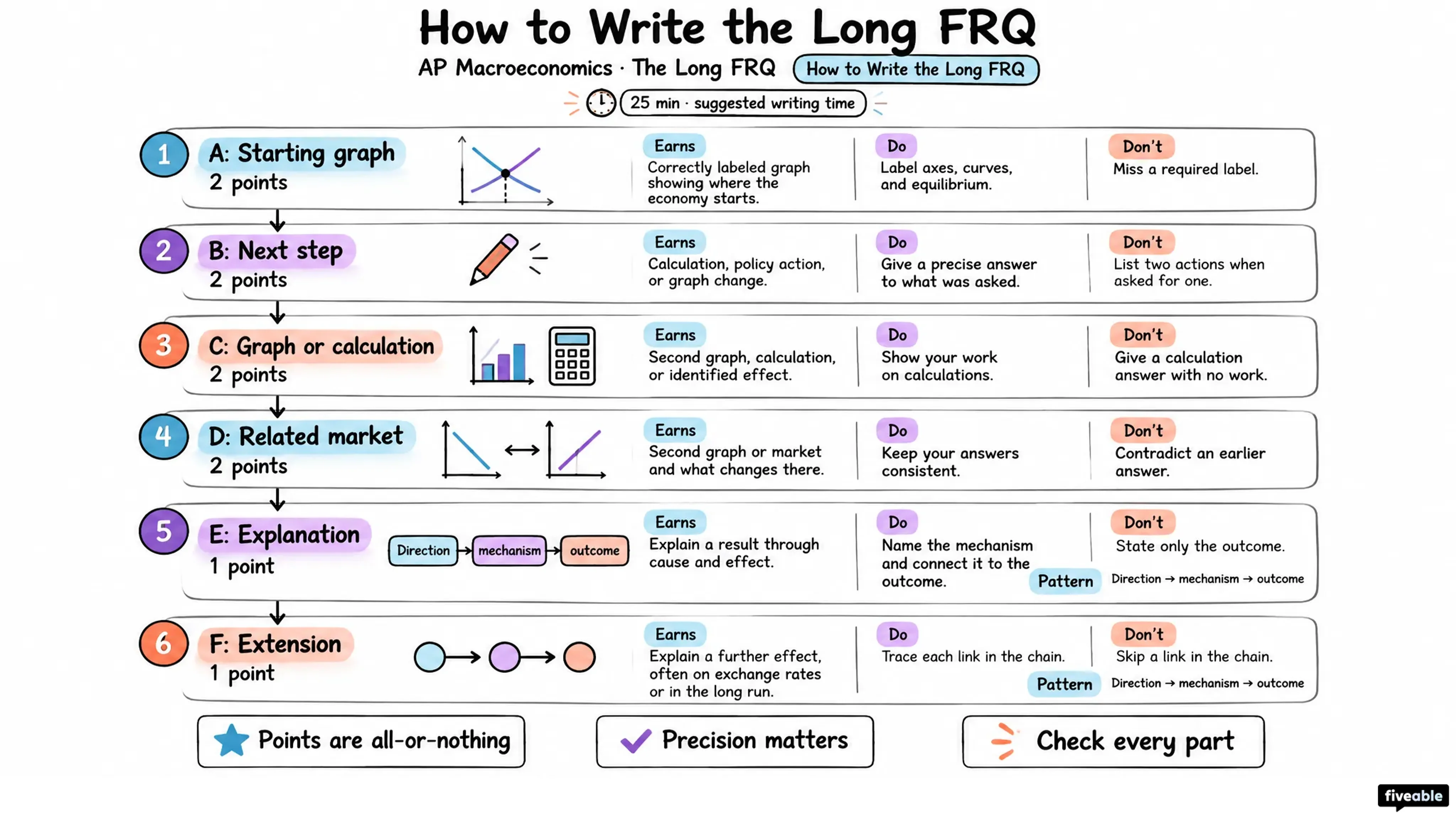
Long FRQ skill sheet
Every rubric point on one page: what earns it, what to do and what to avoid. Tap the sheet to see it full size.
How Long FRQ practice works
Each question follows the exam’s format, from the full prompt to a score on every part.
Read the full question
The scenario, any data, and every part, laid out the way the exam shows them.
Write on a 25-minute timer
The time to plan for on exam day. Pause it or turn it off, and your response saves as you go.
Submit for a score out of 10
Your response is scored against the scoring guidelines written for that question. Your first score is included.
Feedback on every part
A summary at the top tells you what to work on next. Below it, each part shows whether you earned the point and what the scoring guidelines were looking for.
Detailed Feedback
Part A: 1/1 point
Earned the point. Your graph has the vertical axis labeled 'PL' (Price Level) and the horizontal axis labeled 'GDP' (Real GDP). You drew a downward-sloping AD curve, an upward-sloping SRAS curve, and a vertical LRAS curve. All the required elements are present and correctly labeled.
Part A: 1/1 point
Earned the point. You correctly showed the current equilibrium at the intersection of AD and SRAS, labeled as Y₁ and PL₁, positioned to the left of the vertical LRAS curve. You also labeled the full-employment output as Yf at the LRAS position on the horizontal axis.
Part D: 0/1 point
Did not earn the point. While you labeled part D in your written response, your graph does not show the required rightward shift of the AD curve or a new equilibrium labeled E₂. To earn this point, you needed to draw a second AD curve (AD₂) shifted to the right of the original AD, and mark the new equilibrium E₂ at the intersection of AD₂ and SRAS, showing a higher real output and higher price level.
Questions about the Long FRQ
How many responses can I get scored?
You can read every question without a plan. Your first scored response is included. A plan unlocks unlimited scoring.
How do I draw graphs?
When a part asks for a graph, open the drawing tool and sketch it on a grid with axes. You can also switch the editor to handwrite, draw on paper, and add a photo of your page.
Is every long FRQ split the same way?
No. Most have five or six parts, and the points per part change from question to question. The table shows the most common split.
How is the long FRQ different from FRQs 2 and 3?
The long FRQ is worth 10 points and links several graphs and markets into one scenario. FRQs 2 and 3 are worth 5 points each and usually focus on one topic.
Can I use a calculator?
Yes. A four-function calculator is built into the writing screen, the same kind the exam allows.
More AP Macroeconomics practice
Question 2 Short FRQ practice
Short FRQs for question 2, with the full scenario and every part.
Question 3 Short FRQ practice
Short FRQs for question 3, with the full scenario and every part.
AP Macroeconomics FRQs
Every FRQ type for AP Macroeconomics, with practice for each.
See the Long FRQ rubric points students miss most, from responses scored on Fiveable.
Write your first Long FRQ
Pick one from the list, or let us choose for you.
Teaching AP Macroeconomics? Assign these Long FRQs to your class