AP Macroeconomics Unit 3 Cheatsheet: National Income and Price Determination

AP Macroeconomics Unit 3 Cheatsheet: National Income and Price Determination

Start with the first 3 sections of the Unit 3 one-page cheatsheet below. The full sheet is a PDF you can print.

Aggregate Demand (AD) Curve

Definition: Relationship between price level and quantity of goods/services demanded (C + I + G + NX).

Why negative slope?

  • Real wealth effect: Higher price level → lower purchasing power → less consumption
  • Interest rate effect: Higher price level → higher interest rates → less investment
  • Exchange rate effect: Higher price level → higher interest rates → stronger currency → fewer net exports

AD Shifts (not price-level changes):

  • Change in C, I, G, or NX (autonomous)
  • Consumer/business confidence
  • Tax changes
  • Foreign income

Short-Run Aggregate Supply (SRAS)

Definition: Relationship between price level and quantity supplied in the short run.

Upward-sloping because: Sticky wages and prices. When price level rises, real wages fall → firms hire more → output increases.

SRAS Shifts (cost changes):

  • Input prices (wages, oil)
  • Inflationary expectations
  • Productivity changes
  • Supply shocks

Short-run inflation-unemployment trade-off: An increase in AD raises output and the price level (i.e., higher inflation), lowering unemployment below its natural rate — this inverse inflation-rate/unemployment-rate relationship is the short-run Phillips Curve, the mirror image of movement along SRAS.

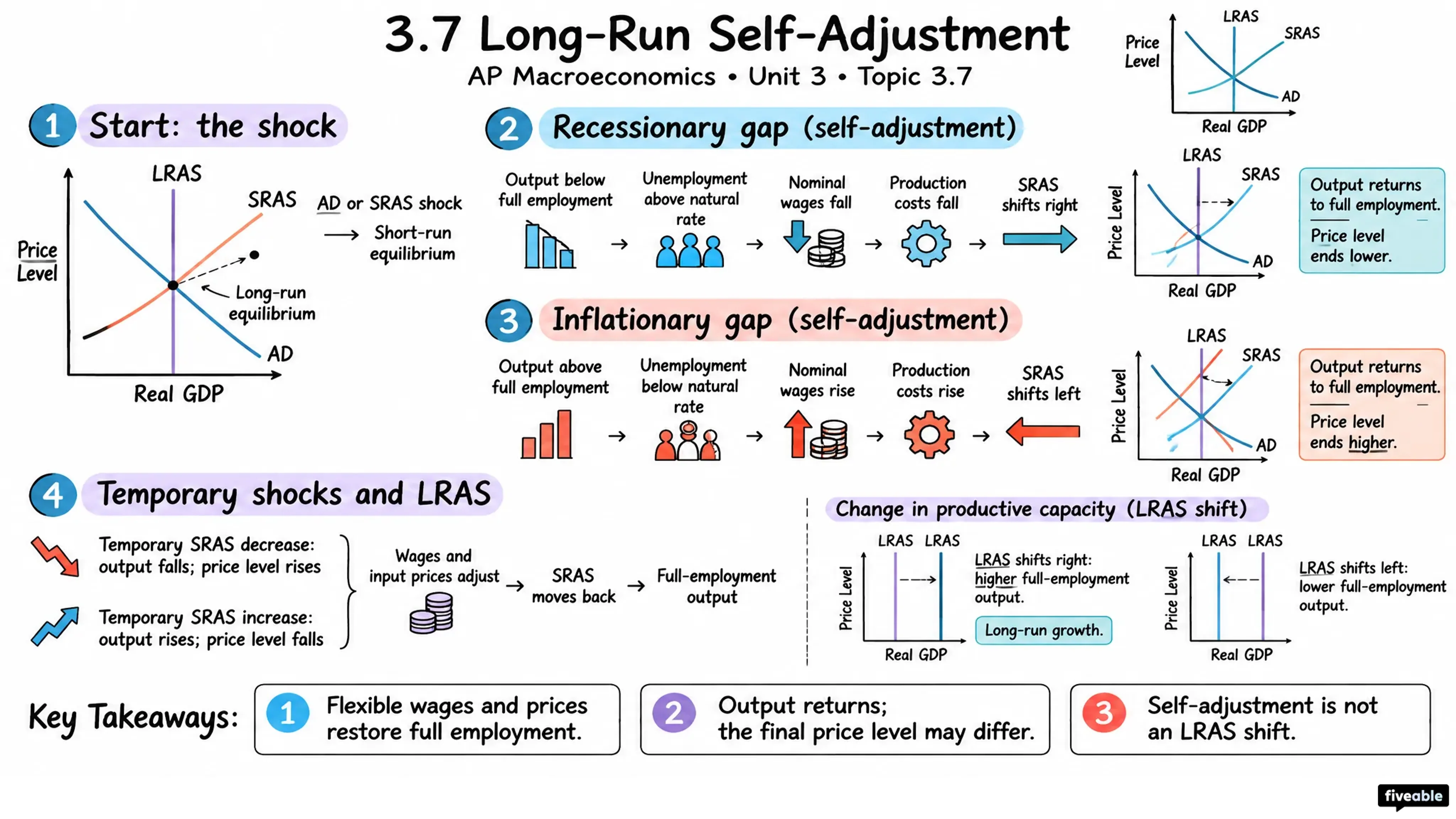
Long-Run Self-Adjustment

How the economy returns to full employment:

After negative AD shock (recession): Unemployment rises → wages fall → SRAS shifts right → output and employment recover → price level falls.

After positive AD shock (overheating): Unemployment falls below natural rate → wages rise → SRAS shifts left → output falls back to full employment → price level rises.

Key: In long run, flexible wages/prices restore full employment. No long-run inflation-unemployment trade-off.

LRAS shifts: Indicate changes in full-employment output and economic growth (capital, labor, technology, institutions).

The rest of the Unit 3 sheet

6 more sections are on the one-page PDF:

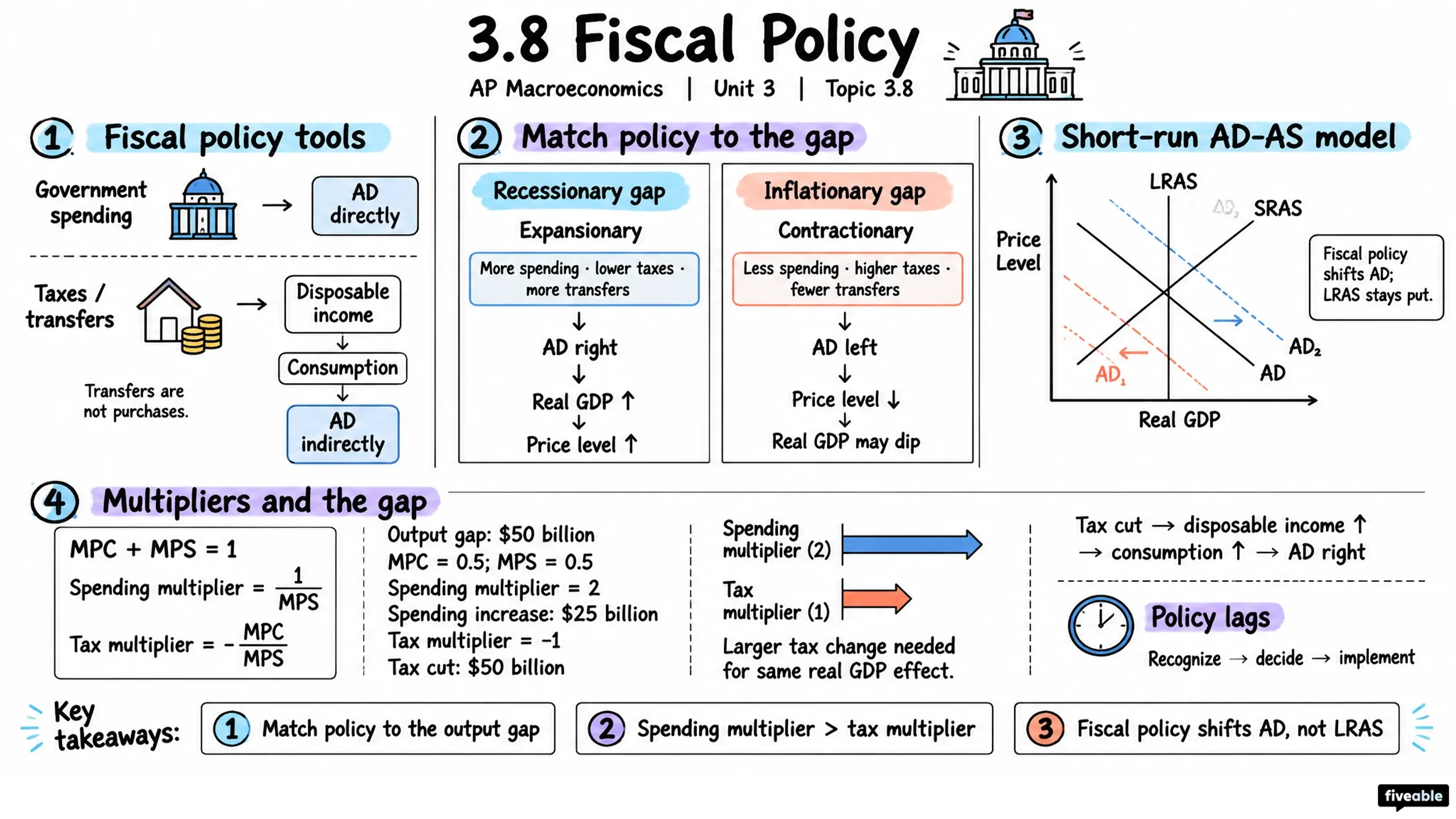
  • Multipliers & MPC/MPS

  • Fiscal Policy Tools & Effects

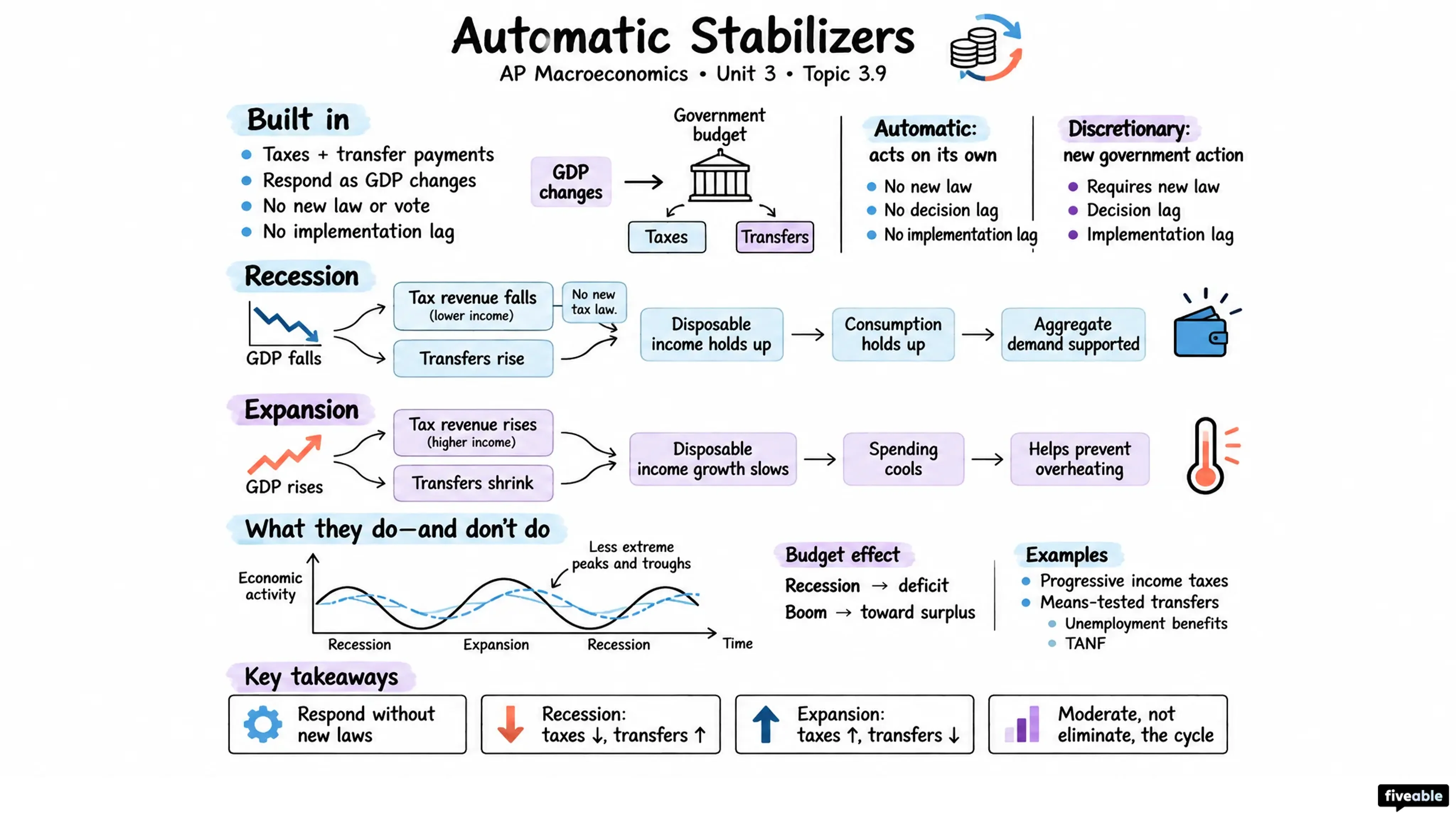
  • Automatic Stabilizers

  • Long-Run Aggregate Supply (LRAS) & Equilibrium

  • AD & SRAS Shocks (Short Run)

  • Test-Solving Checklist

Made by you

Visual Cheatsheets

Pick a Unit 3 topic and a format: flowchart, comparison chart, vocab sheet, Cornell notes and more. Ready in about a minute.

Printable PDF · from the Fiveable shop

AP Macroeconomics Unit 3 Cheatsheet

1 page · National Income and Price Determination · PDF

Visual Cheatsheets

One topic, the format you pick, ready in about a minute

Format

Topic

Takes 30–60 seconds

Preview: Standard

Unit 3: National Income and Price Determination, topic by topic

Each topic has a full study guide. See the whole unit.