AP Human Geography Two-Stimulus FRQ Practice
41 two-stimulus FRQs written in the AP format. Pick one, read the question and both sources, and write your response. Fiveable scores each Two-Stimulus FRQ response part by part on the AP rubric.
Your first scored response is included. A plan unlocks unlimited scoring.
41 questions
sorted by unit
Population density patterns across geographic regions
Unit 1: Thinking Geographically
Respond to parts A, B, C, D, E, F, and G.
Identify the type of map shown in Map 1.
Describe the spatial pattern of high population density shown on Map 1.
Compare the way population density is represented on Map 1 with how it is represented in the data table. (Response must include both stimuli in the comparison.)
Describe one way geographers could use the data in the table to define a formal region.
Explain how the concept of environmental determinism could be used to interpret global population distribution.
Explain how governments might use population density data to make local policy decisions.
Using the data table, explain the degree to which national-level data reveals the actual distribution of a country's population.
What the Two-Stimulus FRQ asks
The two-stimulus FRQ is FRQ 3 on the AP Human Geography exam. You get two sources, like a map and a data table, and answer seven 1-point parts, including one that compares them.
- 25 min
- suggested time per question
- 7 points
- across parts A to G
- 50%
- of your exam score, across all 3 FRQs
Part A: Identify
Identify a feature or value shown in one source
1 pt
Part B: Description
Describe a pattern shown in a source
1 pt
Part C: Comparison
Compare the two sources, using both
1 pt
Part D: Explanation
Explain how or why something happens, with cause and effect
1 pt
Part E: Second explanation
Explain a related cause, effect, or consequence
1 pt
Part F: Third explanation
Explain another process or impact tied to the topic
1 pt
Part G: Final explanation
Explain a further effect, or the degree to which an idea holds
1 pt
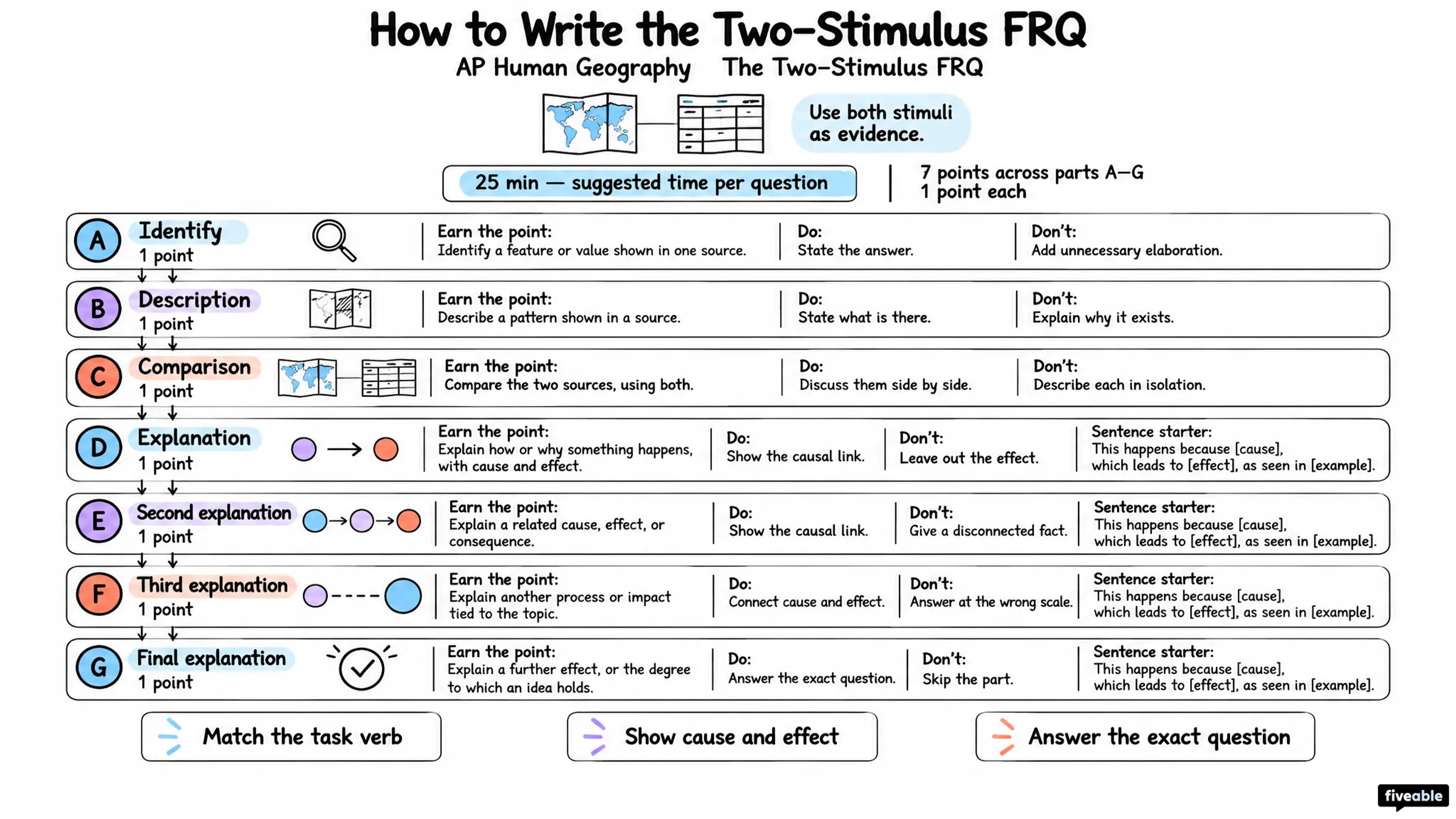
Two-Stimulus FRQ skill sheet
Every rubric point on one page: what earns it, what to do and what to avoid. Tap the sheet to see it full size.
How Two-Stimulus FRQ practice works
Each question follows the exam’s format, from the full prompt to a score on every part.
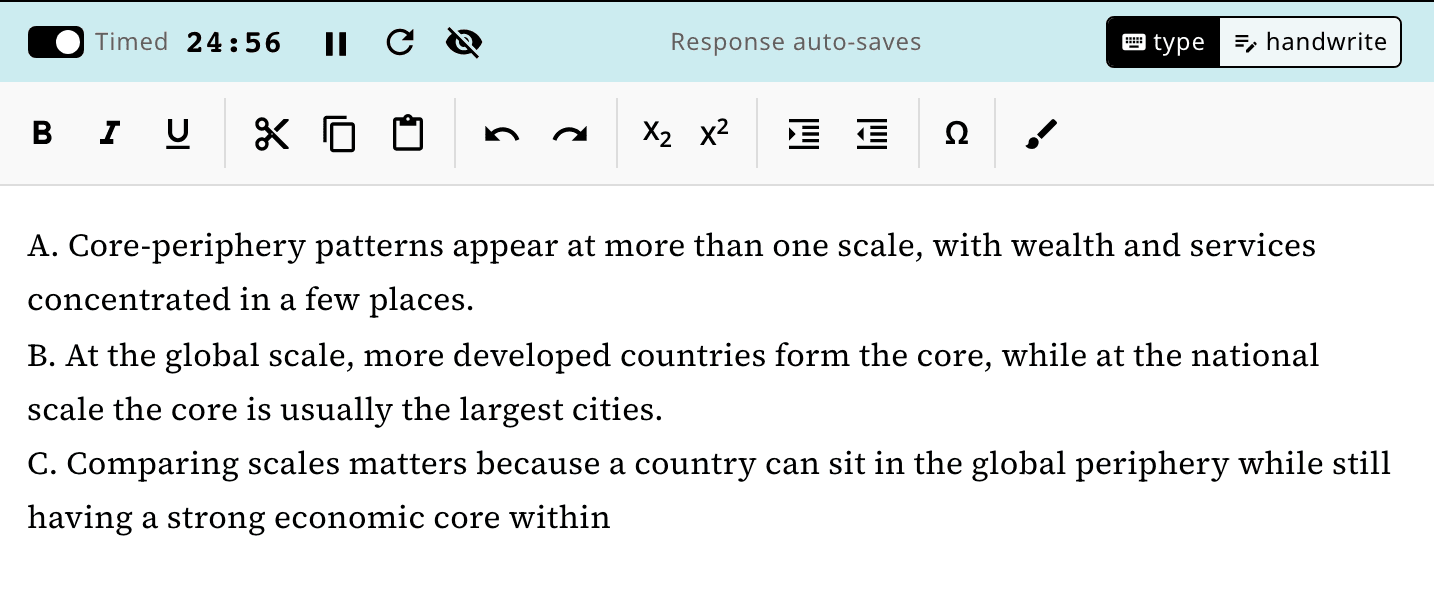
Read the question and both stimuli
Both sources and all seven parts, A through G, laid out the way the exam shows them.
Write on a 25-minute timer
The time to plan for on exam day. Pause it or turn it off, and your response saves as you go.
Submit for a score out of 7
Your response is scored against the scoring guidelines written for that question. Your first score is included.
Feedback on every part
A summary at the top tells you what to work on next. Below it, each part shows whether you earned the point and what the scoring guidelines were looking for.
Detailed Feedback
Part A: 0/1 point
Did not earn the point. You identified Latin America, but that region is not shown on the map as a predominantly low-life-expectancy region. To earn this point, you needed to name a low-life-expectancy world region such as sub-Saharan Africa or a valid subdivision like Central or West Africa.
Part E: 1/1 point
Earned the point. You explained that an aging population creates more dependency on younger workers because many older people are retired and no longer in the workforce. That clearly connects aging to a workforce economic consequence.
Part F: 1/1 point
Earned the point. You addressed both public health and economic opportunity by explaining that healthier, safer countries with more jobs attract immigrants. That is a valid push-pull explanation of international migration. To make this even stronger, you could also mention that poor health conditions and fewer jobs push people out of other countries.
What 243 scored Two-Stimulus FRQs show
Patterns from the practice Two-Stimulus FRQs students have turned in on Fiveable. Students lose the most points on Part G: final explanation.
A: Identify
84%
D: Explanation
79%
F: Third explanation
76%
E: Second explanation
70%
B: Description
69%
C: Comparison
68%
G: Final explanation
58%
24%
of responses earned all 7 points
5 of 7
average score
+1.2 points
average gain when students rewrote the same Two-Stimulus FRQ after feedback
243 practice responses from 153 students, scored on Fiveable through October 26, 2026.
Questions about the Two-Stimulus FRQ
How many responses can I get scored?
You can read every question without a plan. Your first scored response is included. A plan unlocks unlimited scoring.
What do the two stimuli look like?
Two sources on one topic, like a map and a data table, or two maps of related patterns. They’re meant to be read together.
Do I have to use both stimuli?
For the comparison in part C, yes. That answer has to draw on both sources. For the other parts, read each one to see which source it points to.
How is FRQ 3 different from FRQs 1 and 2?
FRQ 1 has no stimulus, and FRQ 2 has one. FRQ 3 adds a second source and asks you to connect the two.
Can I write my answer by hand?
Yes. You can type, or switch the editor to handwrite, write on paper, and add a photo of your page. The exam itself is typed, so typing is good practice.
More AP Human Geography practice
No-Stimulus FRQ practice
No-stimulus FRQs with the full scenario and all seven parts.
One-Stimulus FRQ practice
One-stimulus FRQs with the full source and all seven parts.
AP Human Geography FRQs
Every FRQ type for AP Human Geography, with practice for each.
See the Two-Stimulus FRQ rubric points students miss most, from responses scored on Fiveable.
Write your first Two-Stimulus FRQ
Pick one from the list, or let us choose for you.
Teaching AP Human Geography? Assign these Two-Stimulus FRQs to your class