AP Human Geography One-Stimulus FRQ Practice
326 one-stimulus FRQs written in the AP format. Pick one, read the question and its source, and write your response.
Your first scored response is included. A plan unlocks unlimited scoring.
326 questions
sorted by unit
Rural population density patterns and environmental influences
Unit 1: Thinking Geographically
Population Density of China
Respond to parts A, B, C, D, E, F, and G.
Identify the type of thematic map shown in the stimulus.
Describe the spatial pattern of the highest rural population density shown on the map.
Explain ONE way the physical environment influences the spatial pattern of population density shown on the map.
Describe ONE method of geographic data collection a government would use to gather the population data shown on the map.
Explain how a geographer could use the rural density data shown on the map to define a formal region.
Explain what a local scale of analysis might reveal about population density that is hidden by the national scale of the map.
Explain a limitation of the map in illustrating the overall population distribution of China.
What the One-Stimulus FRQ asks
The one-stimulus FRQ is FRQ 2 on the AP Human Geography exam. You get one map, chart, data table, or image and answer seven 1-point parts, many of them anchored in that source.
- 25 min
- suggested time per question
- 7 points
- across parts A to G
- 50%
- of your exam score, across all 3 FRQs
Part A: Identify
Identify a pattern or value shown in the stimulus
1 pt
Part B: Description
Describe what the stimulus shows or a related process
1 pt
Part C: Concept
Describe, define, or explain a related concept
1 pt
Part D: Explanation
Explain how or why something happens, with cause and effect
1 pt
Part E: Second explanation
Explain a related cause, effect, or consequence
1 pt
Part F: Third explanation
Explain another process or impact tied to the topic
1 pt
Part G: Limitation
Explain a limitation, or the degree to which an idea holds
1 pt
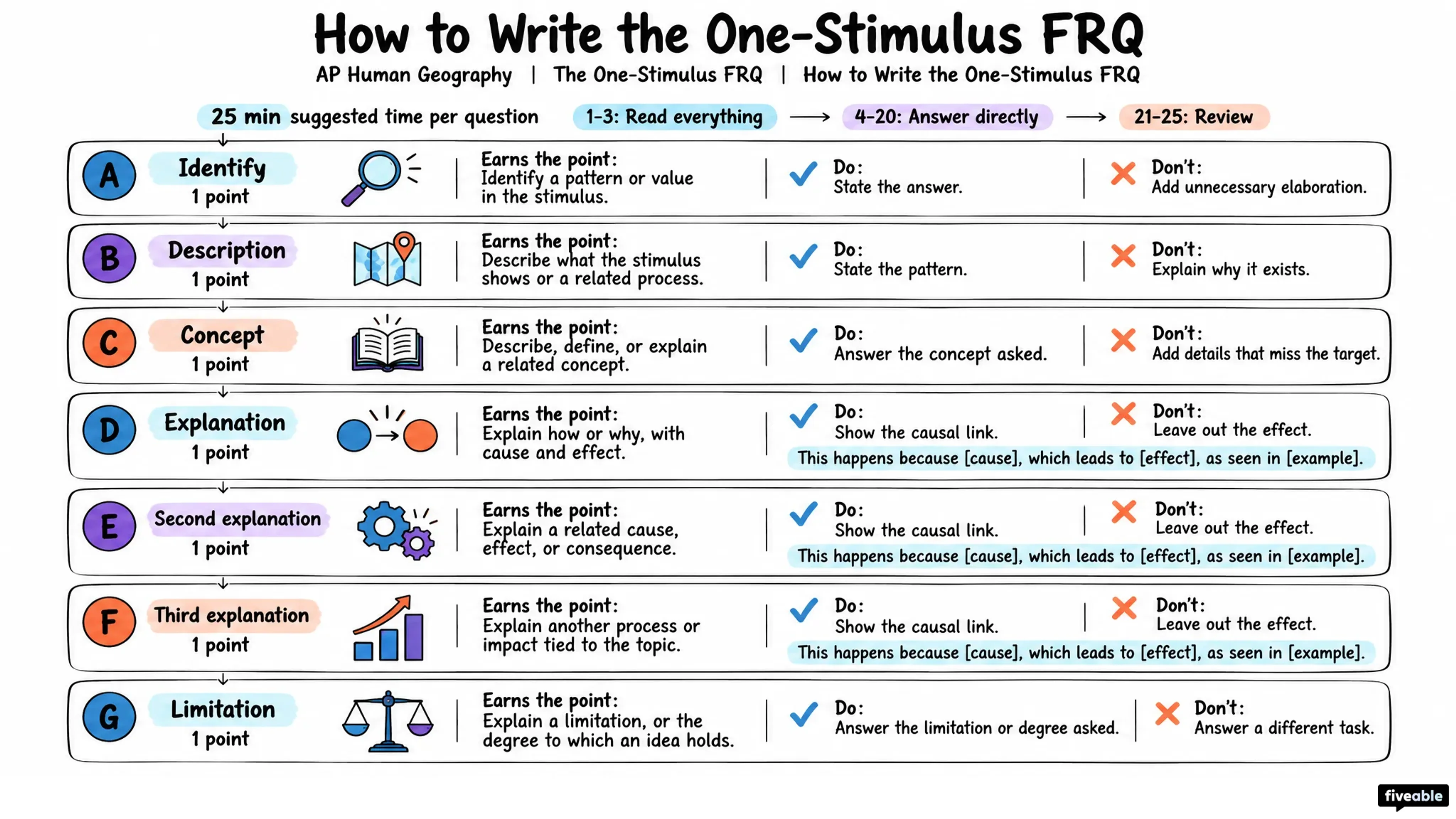
One-Stimulus FRQ skill sheet
Every rubric point on one page: what earns it, what to do and what to avoid. Tap the sheet to see it full size.
How One-Stimulus FRQ practice works
Each question follows the exam’s format, from the full prompt to a score on every part.
Read the question and stimulus
The source and all seven parts, A through G, laid out the way the exam shows them.
Write on a 25-minute timer
The time to plan for on exam day. Pause it or turn it off, and your response saves as you go.
Submit for a score out of 7
Your response is scored against the scoring guidelines written for that question. Your first score is included.
Feedback on every part
A summary at the top tells you what to work on next. Below it, each part shows whether you earned the point and what the scoring guidelines were looking for.
Detailed Feedback
Part A: 1/1 point
Earned the point. You identified the map as a graduated symbol map, which matches the proportional symbol style used to show different total vote amounts by symbol size. To make this even stronger, you could say that the pie charts get bigger in states with more total votes.
Part B: 1/1 point
Earned the point. You described a correct spatial pattern by placing the strongest Democratic support in the New England/northeastern part of the country. To make this even stronger, you could also mention the West Coast, since that is another major cluster on the map.
Part C: 0/1 point
Did not earn the point. You named elections and polls, but those are not the population data collection method used to apportion electoral votes. To earn this point, you needed to describe the decennial census and say that the government counts people by household/address, using questionnaires and follow-up visits.
What 729 scored One-Stimulus FRQs show
Patterns from the practice One-Stimulus FRQs students have turned in on Fiveable. Students lose the most points on Part F: third explanation.
A: Identify
82%
C: Concept
72%
B: Description
69%
E: Second explanation
69%
G: Limitation
67%
D: Explanation
64%
F: Third explanation
62%
20%
of responses earned all 7 points
4.9 of 7
average score
+1.2 points
average gain when students rewrote the same One-Stimulus FRQ after feedback
729 practice responses from 270 students, scored on Fiveable through October 10, 2026.
Questions about the One-Stimulus FRQ
How many responses can I get scored?
You can read every question without a plan. Your first scored response is included. A plan unlocks unlimited scoring.
What kind of stimulus does it use?
One source: a map, chart, graph, data table, photo, or infographic. Several parts ask you to read it directly.
Do I have to mention the stimulus in my answer?
When a part points to the map, data, or image, yes. A correct answer that never uses the source can miss the point.
How is FRQ 2 different from FRQs 1 and 3?
FRQ 1 has no stimulus, and FRQ 3 gives you two sources to compare. FRQ 2 builds its question around one source.
Can I write my answer by hand?
Yes. You can type, or switch the editor to handwrite, write on paper, and add a photo of your page. The exam itself is typed, so typing is good practice.
More AP Human Geography practice
No-Stimulus FRQ practice
No-stimulus FRQs with the full scenario and all seven parts.
AP Human Geography FRQs
Every FRQ type for AP Human Geography, with practice for each.
Write your first One-Stimulus FRQ
Pick one from the list, or let us choose for you.
Teaching AP Human Geography? Assign these One-Stimulus FRQs to your class