AP US Government SCOTUS Comparison FRQ Practice
69 SCOTUS Comparison questions written in the AP format. Pick one, read the case summary and all three parts, and write your response. Fiveable scores each SCOTUS Comparison FRQ response part by part on the AP rubric.
Your first scored response is included. A plan unlocks unlimited scoring.
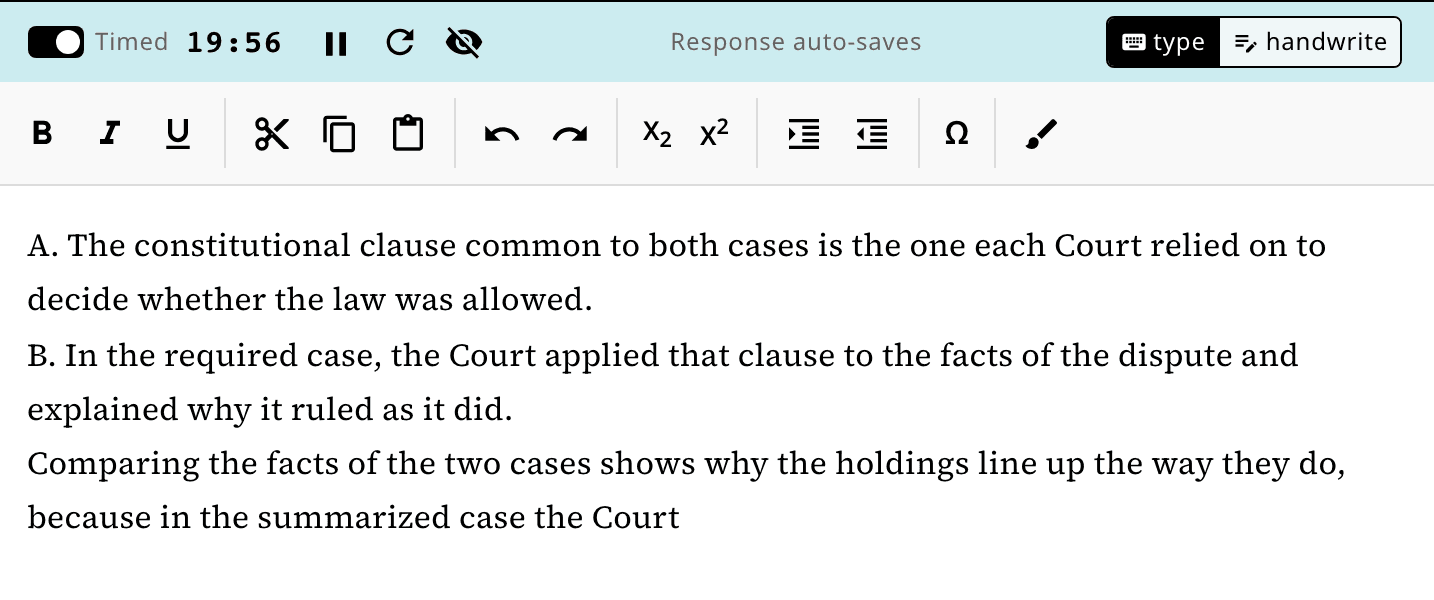
69 questions
sorted by unit
Affordable Care Act insurance mandate and McCulloch’s national bank
Unit 1: Foundations of American Democracy
This question requires you to compare a Supreme Court case you studied in class with one you have not studied in class. A summary of the Supreme Court case you did not study in class is presented and provides all of the information you need to know about this case to answer the prompts.
National Federation of Independent Business v. Sebelius (2012)
Amid intense public interest, Congress passed the Patient Protection and Affordable Care Act (ACA), which became effective March 23, 2010. The ACA sought to address the fact that millions of Americans had no health insurance, yet actively participated in the health care market, consuming health care services for which they did not pay. The ACA contained a minimum coverage provision by amending the tax code and providing an individual mandate, stipulating that by 2014, non-exempt individuals who failed to purchase and maintain a minimum level of health insurance must pay a tax penalty. The ACA also contained an expansion of Medicaid, which states had to accept in order to receive Federal funds for Medicaid, and an employer mandate to obtain health coverage for employees. Shortly after Congress passed the ACA, Florida and 12 other states brought actions in the United States District Court for the Northern District of Florida seeking a declaration that the ACA was unconstitutional on several grounds. These states were subsequently joined by 13 additional states, the National Federation of Independent businesses, and individual plaintiffs Kaj Ahburg and Mary Brown.
No; Yes, under the Taxing and Spending Clause; Unanswered; Yes. Chief Justice John G. Roberts, Jr., largely joined by Justices Ruth Bader Ginsburg, Stephen G. Breyer, Sonia Sotomayor, and Elena Kagan, authored the majority opinion. The Court reached the following conclusions: The justices unanimously agreed that the Anti-Injunction Act did not bar the suit. Congress did not intend that the payment for non-compliance with the Individual Mandate be a tax for purposes of the Anti-Injunction Act.
Respond to parts A, B, and C.
Identify the constitutional clause that is common to both McCulloch v. Maryland (1819) and National Federation of Independent Business v. Sebelius (2012).
Explain how the facts in McCulloch v. Maryland and National Federation of Independent Business v. Sebelius led to different holdings.
Explain how the holding in National Federation of Independent Business v. Sebelius reflects the concept of federalism.
What the SCOTUS Comparison FRQ asks
The SCOTUS Comparison question is FRQ 3 on the AP US Government exam. You get a summary of a Supreme Court case that isn’t on the required list and compare it to one of the required cases from the course.
- 20 min
- suggested writing time
- 4 points
- across parts A to C
- 12.5%
- of your exam score
Part A: Identify
What the two cases share, usually a constitutional clause
1 pt
Part B: Compare
The required case’s facts and holding, and why the outcomes differ or match
2 pts
Part C: Connect
How a holding reflects a broader principle, like federalism
1 pt
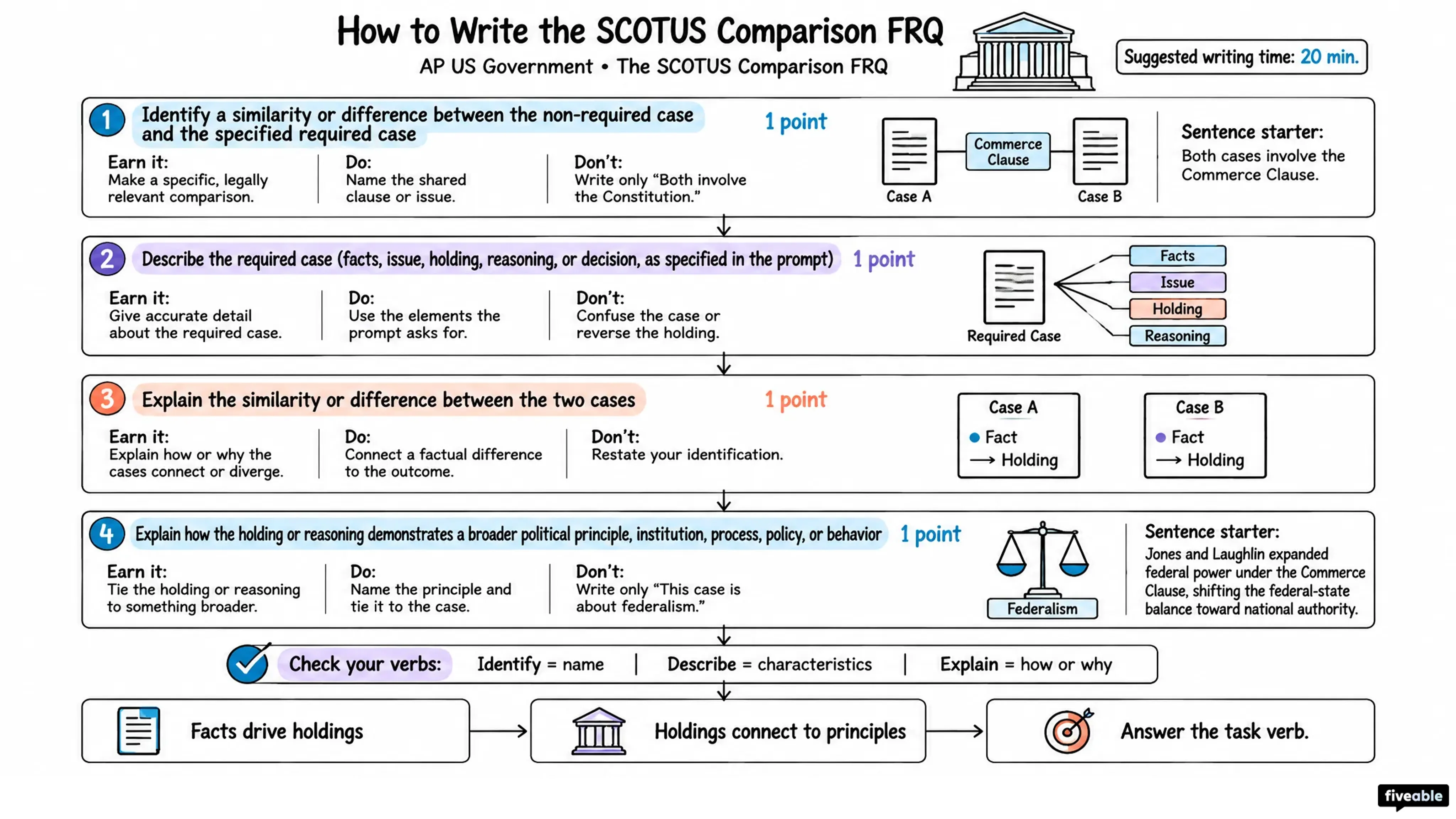
SCOTUS Comparison FRQ skill sheet
Every rubric point on one page: what earns it, what to do and what to avoid. Tap the sheet to see it full size.
How SCOTUS Comparison FRQ practice works
Each question follows the exam’s format, from the full prompt to a score on every part.
Read the case summary
The summarized case and all three parts, A through C, laid out the way the exam shows them.
Write on a 20-minute timer
The time to plan for on exam day. Pause it or turn it off, and your response saves as you go.
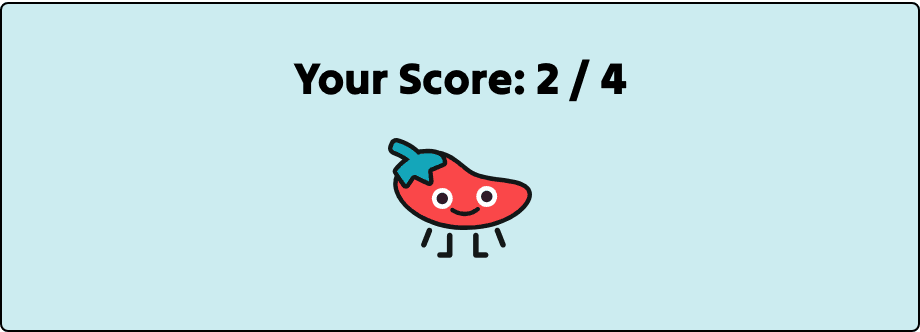
Submit for a score out of 4
Your response is scored against the scoring guidelines written for that question. Your first score is included.
Feedback on every part
A summary at the top tells you what to work on next. Below it, each part shows whether you earned the point and what the scoring guidelines were looking for.
Detailed Feedback
Part A: 1/1 point
Earned the point. You correctly identified the Equal Protection Clause of the Fourteenth Amendment as the common constitutional clause in both cases.
Part B(B1): 1/1 point
Earned the point. You accurately described the key facts of Shaw v. Reno — that North Carolina drew congressional districts based on race to increase Black representation, and the Court ruled this racial gerrymandering unconstitutional under the Equal Protection Clause. To make this even stronger, be more precise: the Court's holding was that race cannot be the primary factor in drawing districts, not that race can never be considered at all.
Part B(B2): 0/1 point
Did not earn the point. You were on the right track by trying to compare the two cases, but your explanation of how the facts led to different holdings is unclear and contains errors. You wrote that both cases concluded 'laws based on race that favored one over the other were constitutional' — but that's not accurate, and it doesn't capture the key difference. The real contrast is this: in Shaw, the Court struck down a state action (racial gerrymandering), limiting state power. In Shelby County, the Court struck down a federal law (the VRA's preclearance formula) because it used outdated data to impose unequal burdens on states, thereby restoring state power. Your explanation of Shelby County also mischaracterizes the holding — the Court didn't rule Section 4(b) unconstitutional because it harmed minority voters; it ruled it unconstitutional because the coverage formula was outdated and no longer matched current conditions. To earn this point, you needed to clearly explain how the facts in each case led to opposite outcomes in terms of federal vs. state power.
What 623 scored SCOTUS Comparison FRQs show
Patterns from the practice SCOTUS Comparison FRQs students have turned in on Fiveable. Students lose the most points on Part C: connect.
A: Identify
92%
B: Compare
78%
C: Connect
75%
50%
of responses earned all 4 points
3.2 of 4
average score
+0.6 points
average gain when students rewrote the same SCOTUS Comparison FRQ after feedback
623 practice responses from 281 students, scored on Fiveable through October 25, 2026.
Questions about the SCOTUS Comparison FRQ
How many responses can I get scored?
You can read every question without a plan. Your first scored response is included. A plan unlocks unlimited scoring.
Do I need to know the case in the summary?
No. The summary gives you its facts, issue, and holding. You need to know the required case the question names.
Why is Part B worth 2 points?
One point is for describing the required case accurately. The other is for explaining why the two cases led to similar or different outcomes.
Are these real College Board questions?
No. We wrote them in the AP format, with the same three parts, and wrote scoring guidelines for each one.
Can I write my answer by hand?
Yes. Switch the editor to handwrite, write on paper, and add a photo of your page.
More AP US Government practice
Concept Application FRQ practice
Concept Application questions with the full scenario and all three parts.
Quantitative Analysis FRQ practice
Quantitative Analysis questions with the full data set and all four parts.
Argument Essay practice
Argument Essays with the full prompt and its list of foundational documents.
AP US Government FRQs
Every FRQ type for AP US Government, with practice for each.
See the SCOTUS Comparison FRQ rubric points students miss most, from responses scored on Fiveable.
Write your first SCOTUS Comparison FRQ
Pick one from the list, or let us choose for you.
Teaching AP US Government? Assign these SCOTUS Comparison FRQs to your class