AP US Government Concept Application FRQ Practice
40 Concept Application questions written in the AP format. Pick one, read the full scenario, and write your response. Fiveable scores each Concept Application FRQ response part by part on the AP rubric.
Your first scored response is included. A plan unlocks unlimited scoring.
40 questions
sorted by unit
Federal education funding and national-state power balance
Unit 1: Foundations of American Democracy
In 2023, the United States Congress passed the 'Modern Schools Connectivity Act' to address the digital divide in education. The legislation appropriated $50 billion to be distributed to states specifically for the installation of fiber-optic cables in public school districts. To receive the money, states were required to adhere to strict federal guidelines regarding the selection of contractors and the technical specifications of the cables. The Department of Education was tasked with overseeing compliance.
Governor Elena Wright of the state of West Dakota publicly criticized the legislation's rigid requirements. She argued that the mountainous geography of her state made fiber-optic installation impractical and prohibitively expensive in rural areas. Instead, Governor Wright lobbied the federal government to allow her state to use the funds for satellite internet technology and teacher training programs, which she argued would better serve her constituents. She urged Congress to convert the funding into a grant that would provide states with greater flexibility in determining how to best achieve the goal of improved connectivity, rather than being tied to specific federal mandates.
Respond to parts A, B, and C.
Describe the type of federal grant represented by the 'Modern Schools Connectivity Act' in the scenario.
Explain how the type of funding mechanism requested by Governor Wright would affect the balance of power between the national and state governments compared to the original legislation.
Explain how the scenario illustrates the tension between the implied powers of Congress and the Tenth Amendment.
What the Concept Application FRQ asks
The Concept Application question is FRQ 1 on the AP US Government exam. You get a short political scenario and answer three parts that apply course concepts to it, such as describing an action and explaining its effects.
- 20 min
- suggested writing time
- 3 points
- across parts A to C
- 12.5%
- of your exam score
Part A: Describe
An action, power, or idea shown in the scenario
1 pt
Part B: Explain
How it connects to policymaking, an institution, or behavior
1 pt
Part C: Explain
How the scenario shows a course concept or could change an outcome
1 pt
How Concept Application FRQ practice works
Each question follows the exam’s format, from the full prompt to a score on every part.
Read the scenario and parts
The political scenario and all three parts, A through C, laid out the way the exam shows them.
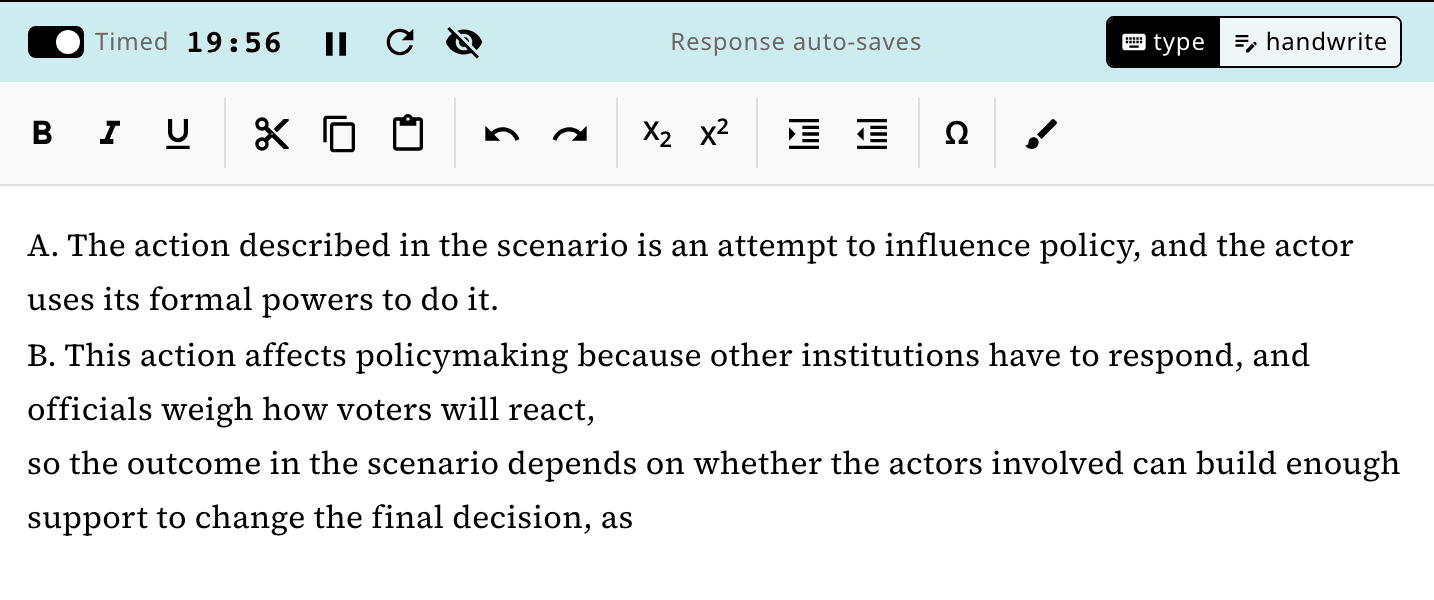
Write on a 20-minute timer
The time to plan for on exam day. Pause it or turn it off, and your response saves as you go.
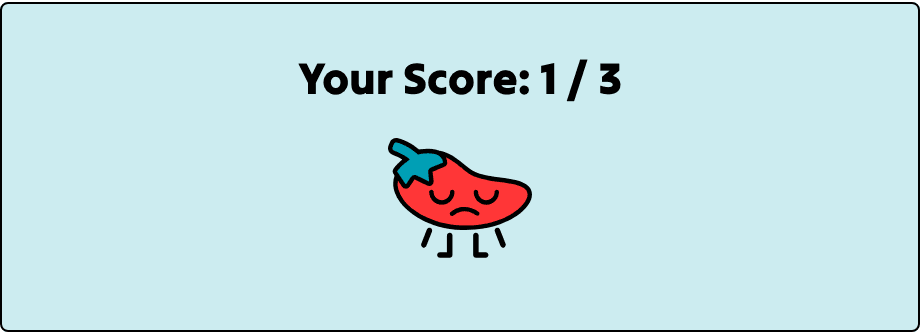
Submit for a score out of 3
Your response is scored against the scoring guidelines written for that question. Your first score is included.
Feedback on every part
A summary at the top tells you what to work on next. Below it, each part shows whether you earned the point and what the scoring guidelines were looking for.
Detailed Feedback
Part A: 1/1 point
You identified the executive order and described how it required utilities to grant DHS network access without a new law from Congress.
Part B: 1/1 point
You explained that Congress prohibited funding for the monitoring program, preventing DHS from carrying out the order.
Part C: 0/1 point
You described the policy conflict, but you did not identify that the president and Congress are controlled by opposing parties, a required element of divided government.
What 1,261 scored Concept Application FRQs show
Patterns from the practice Concept Application FRQs students have turned in on Fiveable. Students lose the most points on Part C: explain.
B: Explain
79%
A: Describe
71%
C: Explain
69%
43%
of responses earned all 3 points
2.2 of 3
average score
+0.6 points
average gain when students rewrote the same Concept Application FRQ after feedback
1,261 practice responses from 464 students, scored on Fiveable through October 26, 2026.
Questions about the Concept Application FRQ
How many responses can I get scored?
You can read every question without a plan. Your first scored response is included. A plan unlocks unlimited scoring.
How long should each part be?
Usually two to four focused sentences. Each part earns one point for doing what its task verb asks, so extra length doesn’t add points.
How is Concept Application different from Quantitative Analysis?
Concept Application gives you a written scenario. Quantitative Analysis gives you a chart, table, or map and asks four parts about the data.
Are these real College Board questions?
No. We wrote them in the AP format, with the same three parts, and wrote scoring guidelines for each one.
Can I write my answer by hand?
Yes. Switch the editor to handwrite, write on paper, and add a photo of your page.
More AP US Government practice
Quantitative Analysis FRQ practice
Quantitative Analysis questions with the full data set and all four parts.
SCOTUS Comparison FRQ practice
SCOTUS Comparison questions with the full case summary and all three parts.
Argument Essay practice
Argument Essays with the full prompt and its list of foundational documents.
AP US Government FRQs
Every FRQ type for AP US Government, with practice for each.
See the Concept Application FRQ rubric points students miss most, from responses scored on Fiveable.
Write your first Concept Application FRQ
Pick one from the list, or let us choose for you.
Teaching AP US Government? Assign these Concept Application FRQs to your class