AP Environmental Science Calculation FRQ Practice
144 Analyze an Environmental Problem Doing Calculations questions written in the AP format. Pick one, read the full question, and write your response. Fiveable scores each Calculation FRQ response part by part on the AP rubric.
Your first scored response is included. A plan unlocks unlimited scoring.

144 questions
sorted by unit
Wetland restoration, nutrient cycling, coastal water quality
Unit 1: The Living World: Ecosystems
A coastal community is experiencing declining water quality due to agricultural runoff containing excess nitrogen and phosphorus. Local ecologists propose restoring a 50-hectare freshwater wetland that was drained 40 years ago for development. The restored wetland would serve as a natural filter for nutrients while providing habitat for native species. The community must evaluate the ecological and economic benefits of this restoration project.
Parameter | Current Degraded Site | Expected Post-Restoration |
|---|---|---|
Net Primary Productivity (NPP) | 1,200 kcal/m²/yr | 8,400 kcal/m²/yr |
Nitrogen removal rate | 5 kg/hectare/yr | 180 kg/hectare/yr |
Phosphorus in incoming water | 0.85 mg/L | 0.85 mg/L |
Phosphorus in outgoing water | 0.78 mg/L | 0.12 mg/L |
Water flow through wetland | 2.4 × 10⁶ liters/day | 2.4 × 10⁶ liters/day |
Identify the specific biogeochemical cycle that does NOT have a significant atmospheric reservoir and is most likely to limit primary productivity in freshwater wetland ecosystems.
Describe one ecosystem service, other than nutrient filtration, that the restored wetland would provide to the coastal community.
Explain how the process of denitrification in the restored wetland would reduce the amount of nitrogen reaching coastal waters, including the form of nitrogen that is removed from the ecosystem.
Calculate the amount of energy, in kcal/m²/yr, that would be available to secondary consumers in the restored wetland food web. Show your work. Based on Table 1, the expected net primary productivity (NPP) of the restored wetland is 8,400 kcal/m²/yr. Energy transfer efficiency between trophic levels in wetland ecosystems averages 10%.
Calculate the percent change in net primary productivity between the current degraded site and the expected post-restoration wetland. Show your work. Based on Table 1, the restored wetland is expected to have a net primary productivity of 8,400 kcal/m²/yr, while the current degraded site has an NPP of 1,200 kcal/m²/yr.
Propose one realistic management practice the restoration team could implement to prevent the establishment of invasive plant species, such as purple loosestrife or phragmites, that could outcompete native wetland vegetation for resources.
Calculate the total mass of phosphorus, in kilograms per year, that the restored wetland would remove from the water. Show your work. (Note: 1 kg = 1 × 10⁶ mg) Based on Table 1, phosphorus concentration in water entering the wetland is 0.85 mg/L, and phosphorus in water leaving the wetland is expected to be 0.12 mg/L. The water flow through the restored wetland is 2.4 × 10⁶ liters per day. The wetland operates year-round.
What the Calculation FRQ asks
This is FRQ 3 on the AP Environmental Science exam. You get an environmental problem with numbers, explain the science, run calculations that show the scale of the problem, and propose a solution. Three parts are calculations worth 2 points each, and on some questions the solution comes before them.
- 24 min
- suggested writing time
- 10 points
- across parts A to G
- 1/3
- of your FRQ points
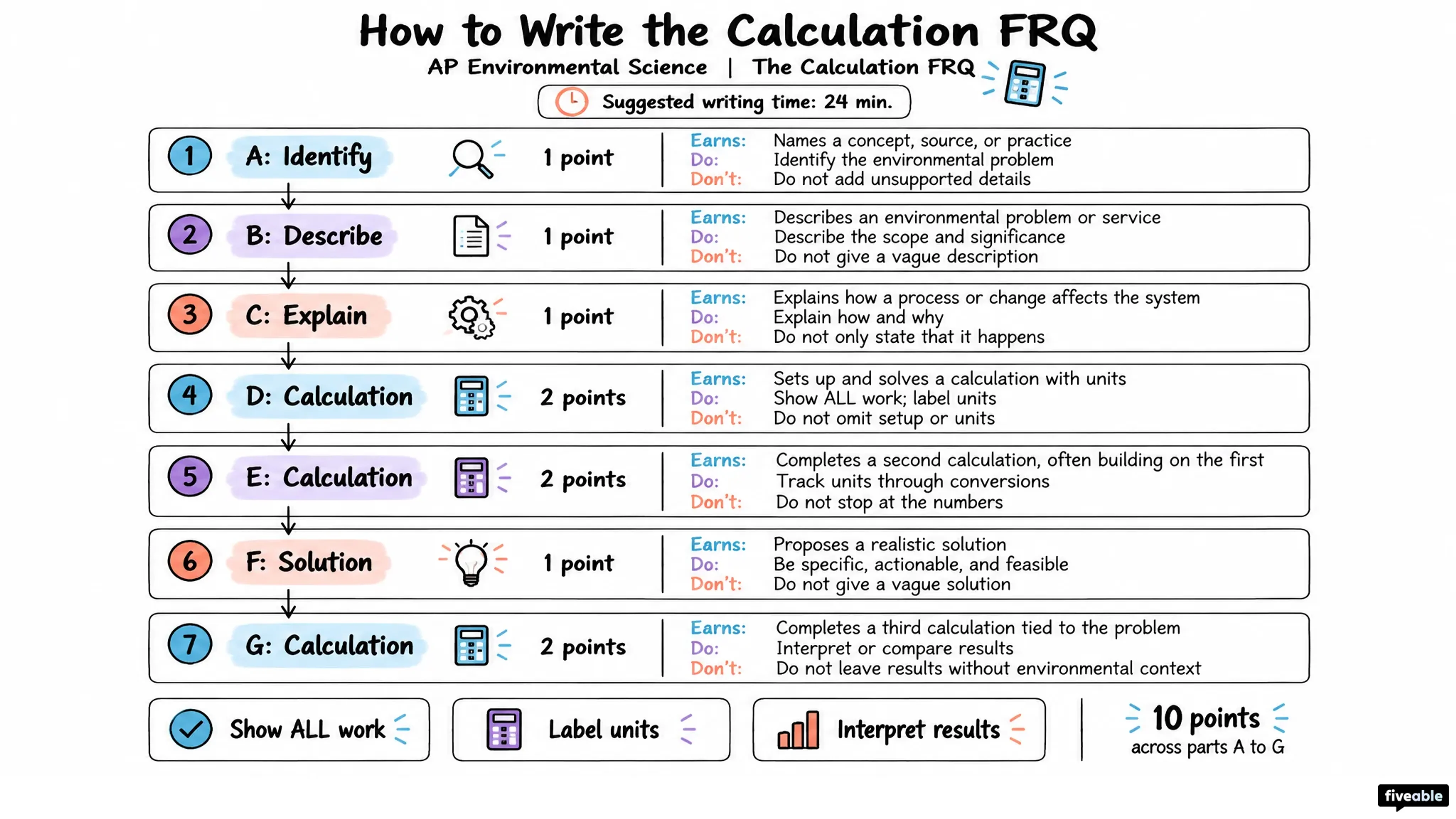
Part A: Identify
Name a concept, source, or practice in the scenario
1 pt
Part B: Describe
Describe an environmental problem or service
1 pt
Part C: Explain
Explain how a process or change affects the system
1 pt
Part D: Calculation
Set up and solve a calculation, with units
2 pts
Part E: Calculation
A second calculation, often building on the first
2 pts
Part F: Solution
Propose a realistic solution
1 pt
Part G: Calculation
A third calculation tied to the problem
2 pts
Calculation FRQ skill sheet
Every rubric point on one page: what earns it, what to do and what to avoid. Tap the sheet to see it full size.
How Calculation FRQ practice works
Each question follows the exam’s format, from the full prompt to a score on every part.
Read the full question
The scenario, the numbers you need, and every part, laid out the way the exam shows them.
Write on a 24-minute timer
The time to plan for on exam day. Pause it or turn it off, and your response saves as you go.
Submit for a score out of 10
Your response is scored against the scoring guidelines written for that question. Your first score is included.
Feedback on every part
A summary at the top tells you what to work on next. Below it, each part shows whether you earned the point and what the scoring guidelines were looking for.
Detailed Feedback
Part A: 1/1 point
The student correctly identifies strip mining as an acceptable type of surface mining. Full credit earned.
Part B: 1/1 point
The student correctly describes that removal of vegetation destroys habitat and leads to loss of biodiversity, which matches an acceptable response. Full credit earned.
Part F: 0/2 points
The student uses the wrong denominator in the percent change formula. The correct setup divides by the original value (7.5), not the new value (6.0). The student divided by 6.0, yielding -25% instead of the correct -20%. Neither the setup point nor the calculation point can be awarded because the formula is incorrectly applied.
Questions about the Calculation FRQ
How many responses can I get scored?
You can read every question without a plan. Your first scored response is included. A plan unlocks unlimited scoring.
How do I show my work?
Type each step with its units, the way you’d write it on paper. You can also switch the editor to handwrite, write on paper, and add a photo of your page.
What calculations come up?
Percent change, unit conversions, rates, and totals, like the land, water, or energy a plan needs. Each calculation part is worth 2 points.
How is FRQ 3 different from FRQ 2?
Both ask about an environmental problem and a solution. FRQ 3 adds calculations worth 2 points each. FRQ 2 centers on reading data.
Are these real College Board questions?
No. We wrote them in the AP format, with the same parts, and wrote scoring guidelines for each one.
More AP Environmental Science practice
Investigation Design FRQ practice
Design an Investigation questions with the scenario, the figures, and every part.
Data Analysis FRQ practice
Quantitative data questions with the scenario, the data, and all ten parts.
AP Environmental Science FRQs
Every FRQ type for AP Environmental Science, with practice for each.
See the Calculation FRQ rubric points students miss most, from responses scored on Fiveable.
Write your first Calculation FRQ
Pick one from the list, or let us choose for you.
Teaching AP Environmental Science? Assign these Calculation FRQs to your class