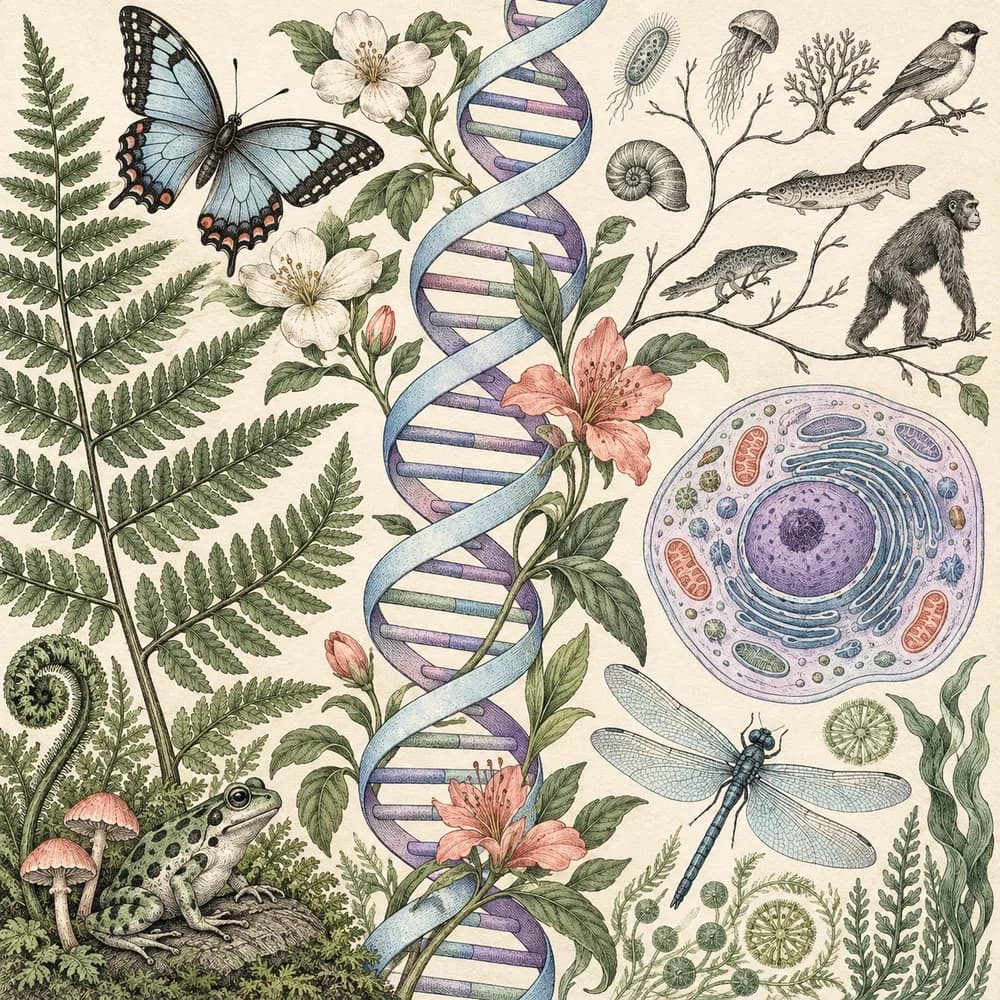
IST states that living systems store, retrieve, transmit, and respond to information. Most biological information is genetic, encoded in DNA base sequences and passed from parent to offspring. But information also flows between cells through signal transduction pathways and between organisms through behavior. IST covers DNA structure, replication, transcription, translation, gene regulation, heredity, and cell communication.
- Central dogma: The flow of genetic information from DNA to RNA to protein; DNA is transcribed into mRNA, which is translated into a polypeptide.
- Gene expression regulation: The control of when, where, and how much a gene is transcribed and translated; includes operons in prokaryotes and transcription factors in eukaryotes.
- Signal transduction: The process by which a cell converts an extracellular signal into an intracellular response, typically involving a receptor, a relay molecule, and a cellular response.
- Epigenetics: Heritable changes in gene expression that do not involve changes to the DNA sequence itself, such as DNA methylation and histone modification.
Explain how a hydrophilic signaling molecule like epinephrine triggers a cellular response without entering the cell. Name the three stages of signal transduction involved.
| Information type | Molecule | Transmitted by | Example |
|---|
| Genetic (heritable) | DNA | DNA replication and cell division | Passing alleles from parent to offspring |
| Gene expression | mRNA, protein | Transcription and translation | Lac operon responding to lactose |
| Cell-to-cell signaling | Ligand (hormone, neurotransmitter) | Signal transduction pathway | Epinephrine triggering glycogen breakdown |
| Epigenetic | Methylated DNA, modified histones | Mitosis (not always meiosis) | X-chromosome inactivation in mammals |