AP African American Studies Visual-Source SAQ Practice
173 Visual-Source Short Answer Questions written in the AP format. Pick one, study the image and all three parts, and write a short answer to each. Fiveable scores each Visual-Source SAQ response part by part on the AP rubric.
Your first scored response is included. A plan unlocks unlimited scoring.
173 questions
sorted by unit
Catlett's Negro es Bello, the Black Campus movement and Black Studies
Unit 1: Origins of the African Diaspora
Answer all parts of the question that follows.
Describe the visual message conveyed by Elizabeth Catlett's 1969 artwork Negro es Bello.
Explain how the 1969 date of Catlett's Negro es Bello relates to the context of the Black Campus movement.
Explain how artistic expressions like Catlett's Negro es Bello contributed to the broader development of African American Studies as an academic discipline.
What the Visual-Source SAQ asks
The visual-source short-answer question is one of the two source-based SAQs in Section II of the AP African American Studies exam. You get one image, such as a photograph, a work of art, or a map, and answer three parts that start with the image and move out to the course around it.
- 13 min
- suggested time per SAQ
- 3 points
- one for each part, A to C
- 18%
- of your exam score, for all three SAQs
Part A: Describe
What the image shows, or its creator’s perspective or purpose
1 pt
Part B: Explain
A course development or context the image connects to
1 pt
Part C: Explain
A pattern across the course, such as a cause, a change, or a comparison
1 pt
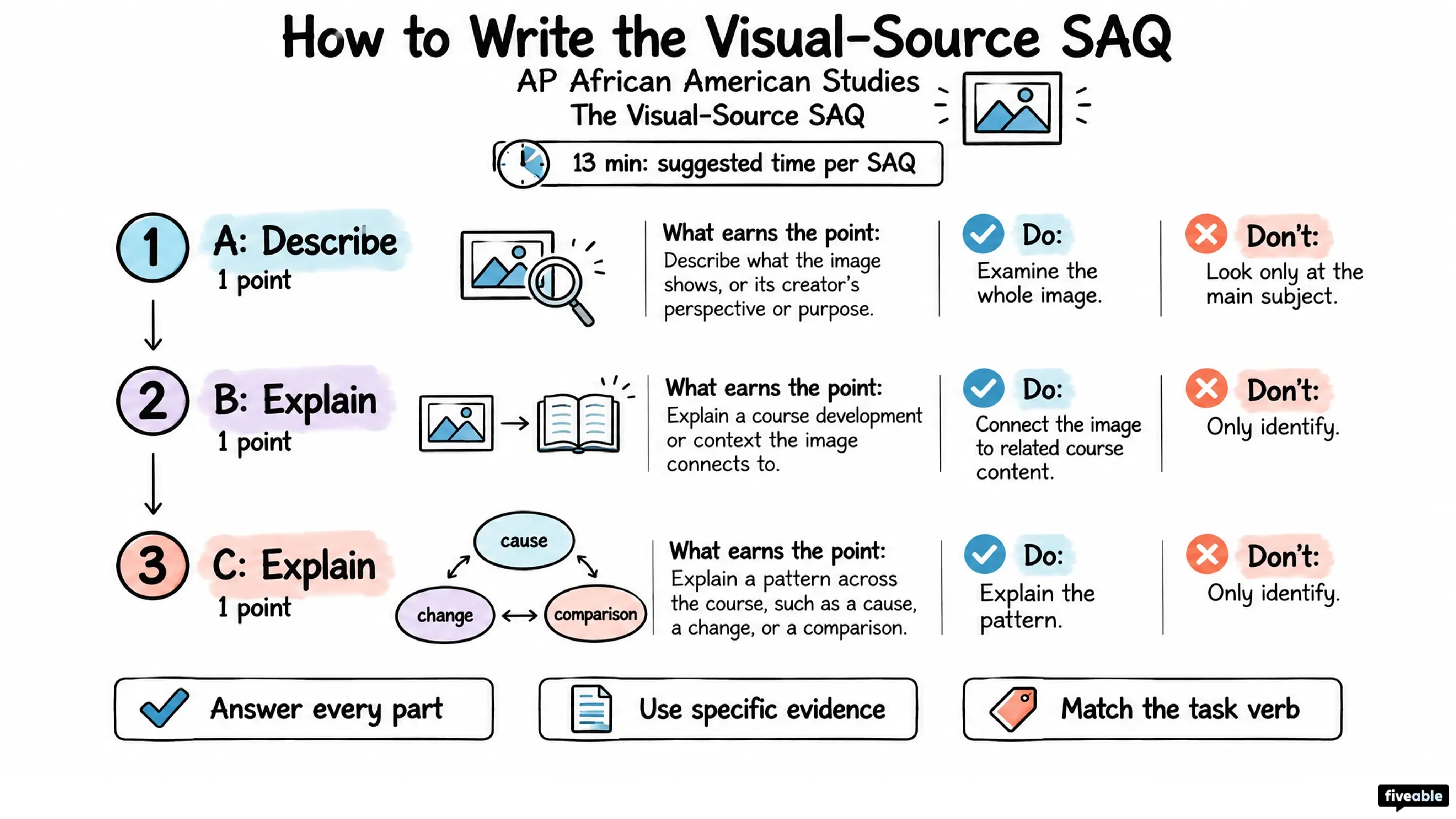
Visual-Source SAQ skill sheet
Every rubric point on one page: what earns it, what to do and what to avoid. Tap the sheet to see it full size.
How Visual-Source SAQ practice works
Each question follows the exam’s format, from the full prompt to a score on every part.
Read the source and question
The image and all three parts, A through C, laid out the way the exam shows them.
Write on a 13-minute timer
About the time each SAQ gets on exam day. Pause it or turn it off, and your response saves as you go.
Submit for a score out of 3
Your response is scored against the scoring guidelines written for that question. Your first score is included.
Feedback on every part
A summary at the top tells you what to work on next. Below it, each part shows whether you earned the point and what the scoring guidelines were looking for.
Detailed Feedback
Part A: 1/1 point
The response earns the point. The student correctly identifies that the structures served as a demonstration of political authority and power, noting that the scale of construction reflected the ruler's resources and reinforced his dominance over subjects and visitors. This aligns with the acceptable response that the structures housed the seat of political power or rulers.
Part B: 0/1 point
The response does not earn the point. The student identifies that Great Zimbabwe and Mali were in different geographic locations, but this is not a meaningful economic, cultural, or social difference as required by the prompt. The response fails to describe any substantive difference in trade networks, commodities, cultural practices, or social structures between the two empires. A stronger answer would have noted, for example, that Great Zimbabwe traded gold and ivory through Indian Ocean and Swahili Coast networks, while Mali traded gold and kola nuts across trans-Saharan routes and was also known for Islamic scholarship in Timbuktu.
Questions about the Visual-Source SAQ
How many responses can I get scored?
You can read every question without a plan. Your first scored response is included. A plan unlocks unlimited scoring.
What does the visual source look like?
One image, such as a photograph, an illustration, a painting, or a map. Here, part A asks about the image itself, and parts B and C move to the course around it.
Will I have seen the source before?
Maybe. On the exam, one of the two source-based SAQs uses a required course source you studied in class, and the other uses a source you haven’t seen.
How is this SAQ different from the other two?
The text-source SAQ gives you a written source instead of an image. The no-source SAQ has no source, so every example comes from what you know about the course.
Can I write my answer by hand?
Yes. The exam is typed, so typing is the closest practice. You can also switch the editor to handwrite, write on paper, and add a photo of your page.
More AP African American Studies practice
Text-Source SAQ practice
Text-source short-answer questions with the text and all four parts.
AP African American Studies FRQs
Every FRQ type for AP African American Studies, with practice for each.
Write your first Visual-Source SAQ
Pick one from the list, or let us choose for you.
Teaching AP African American Studies? Assign these Visual-Source SAQs to your class