AP African American Studies DBQ Practice
42 Document-Based Questions written in the AP format. Pick one, read the prompt and all five sources, and write your essay. Fiveable scores each DBQ response part by part on the AP rubric.
Your first scored response is included. A plan unlocks unlimited scoring.
42 questions
sorted by unit
African American cultural production, identity, institutional development
Evaluate the extent to which African American cultural production during the Harlem Renaissance era (1915-1940) served as a foundation for both immediate community identity formation and long-term institutional development in African American Studies and political consciousness through the 1970s.
Respond to the prompt with a defensible thesis or claim that establishes a line of reasoning.
Describe a broader historical or disciplinary context relevant to the topic of the prompt.
Support an argument in response to the prompt using at least three of the sources.
Use at least one additional piece of specific evidence (beyond that found in the sources) relevant to your argument.
For at least two sources, explain how or why the perspective, purpose, context, and/or audience for each source is relevant to your argument.
Reference or cite the sources you use in your argument. You can reference or cite the source letter, title, or author.
Document 1
Source: Mary Schmidt Campbell, author, published in Renaissance Art of Black America, 1987
Driven by the charismatic zeal of Marcus Garvey, a Jamaican who had migrated to New York, the Harlem-based UNIA [Universal Negro Improvement Association] captured the grass-roots sensibility of the New Negro [and]…the fervent belief in the beauty and nobility of an African homeland, and the deep cultural cleft between Black and White America. If Garvey's movement was evidence of a breach between the races in the promised land of the North, art was the hope for a reconciliation. For intellectuals like [Alain] Locke and W.E.B. Du Bois…art could bridge the gap between the Black and the White worlds if only the Black artist was allowed the opportunity to hone his talents. Given his rich folk background, his African heritage, and his ethnic pride, the Black artist had an aesthetic and a message to impart. Art, the essence of the civilized man, would be final proof that the New Negro not only had something positive to contribute to American life but had, indeed, ascended to new cultural heights. Harlem, the center of the New Negro Movement and the capital of Black America during the 1920s, was naturally the center of the artistic movement as well.
Document 2
Source: Les Fétiches by Loïs Mailou Jones, 1938
Document 3
Source: Katherine Dunham, Cabin in the Sky, 1940
Document 4
Source: Miss Suzie Porter, "Harlem," 1915
Document 5
Source: Program for the First National Council for Black Studies Annual Conference, 1975
What the DBQ asks
The Document-Based Question is the essay in Section II of the AP African American Studies exam. You get five sources, such as speeches, letters, photographs, or artwork, and write an argument that uses them and your own knowledge.
- 45 min
- to read the sources and write
- 7 points
- across rows A to E
- 12%
- of your exam score
Part A: Thesis
A defensible claim that sets up a line of reasoning
1 pt
Part B: Contextualization
A broader historical or disciplinary context for the prompt
1 pt
Part C: Evidence
Three sources used to support the argument, plus one example beyond them
3 pts
Part D: Source use
Why two sources’ perspective, purpose, context, or audience matters to the argument
1 pt
Part E: Reasoning
Causation, comparison, or change and continuity that frames the argument
1 pt
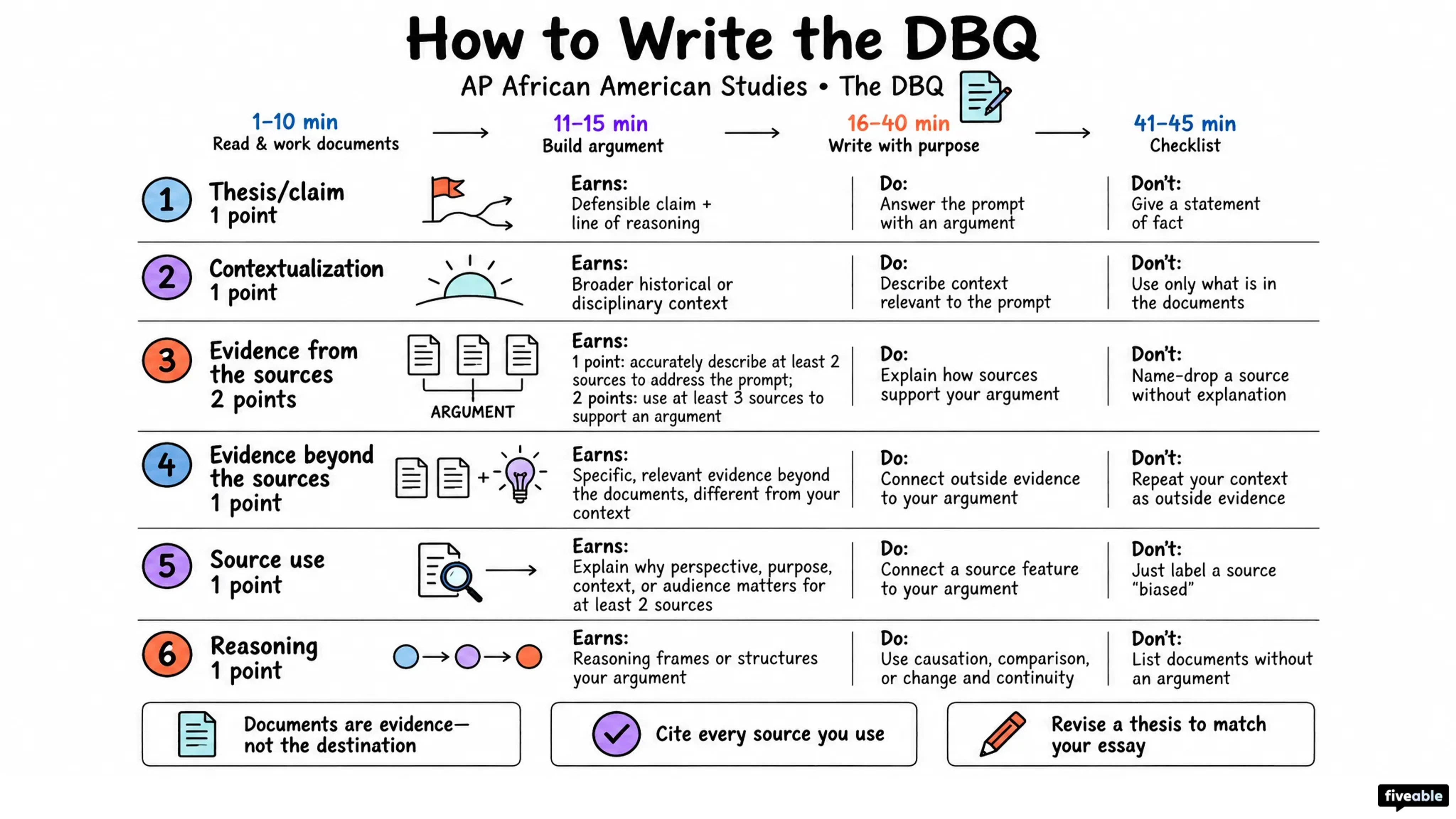
DBQ skill sheet
Every rubric point on one page: what earns it, what to do and what to avoid. Tap the sheet to see it full size.
How DBQ practice works
Each question follows the exam’s format, from the full prompt to a score on every part.
Read the prompt and sources
The prompt and all five sources, laid out the way the exam shows them.
Write on a 45-minute timer
The time to plan for on exam day. Pause it or turn it off, and your response saves as you go.
Submit for a score out of 7
Your response is scored against the scoring guidelines written for that question. Your first score is included.
Feedback on every part
A summary at the top tells you what to work on next. Below it, each part shows whether you earned the point and what the scoring guidelines were looking for.
Detailed Feedback
Part A: 0/1 point
Did not earn the point. You evaluated the extent by stating that the experiences 'largely sparked' the idea of unalienable rights, but you did not establish a line of reasoning. To earn this point, your thesis must explain HOW or WHY their experiences shaped these discussions (for example, by mentioning that their first-hand narratives exposed the horrors of the slave trade or that their legal challenges forced courts to address their rights).
Part B: 1/1 point
Earned the point, but this is on the thin side of what earns it. You provided relevant context by describing the transatlantic slave trade and how enslaved people were treated as property, which sets up the discussion about human rights. To make this stronger, include more specific historical details about the period, such as the Enlightenment's focus on natural rights or the specific legal codes that stripped Africans of their rights.
Part C1: 1/1 point
Earned the point. You accurately described the content of three documents (Source 1, Source 2, and Source 5) relevant to the topic.
Questions about the DBQ
How many responses can I get scored?
You can read every question without a plan. Your first scored response is included. A plan unlocks unlimited scoring.
How many sources do I need to use?
Three of the five, used to support your argument and cited by letter, title, or author. Explaining the perspective, purpose, context, or audience of two of them earns a separate point.
How is this DBQ different from the history DBQs?
It has five sources instead of seven, and using three of them as support earns full document credit. The exam gives it 45 minutes instead of 60.
Are these real College Board questions?
No. We wrote them in the AP format, with five sources each, and wrote scoring guidelines for each one.
Can I write my answer by hand?
Yes. The exam is typed, so typing is the closest practice. You can also switch the editor to handwrite, write on paper, and add a photo of your page.
More AP African American Studies practice
Visual-Source SAQ practice
Visual-source short-answer questions with the image and all three parts.
Text-Source SAQ practice
Text-source short-answer questions with the text and all four parts.
AP African American Studies FRQs
Every FRQ type for AP African American Studies, with practice for each.
Write your first DBQ
Pick one from the list, or let us choose for you.
Teaching AP African American Studies? Assign these DBQs to your class