AP African American Studies Text-Source SAQ Practice
263 Text-Source Short Answer Questions written in the AP format. Pick one, read the text and all four parts, and write a short answer to each. Fiveable scores each Text-Source SAQ response part by part on the AP rubric.
Your first scored response is included. A plan unlocks unlimited scoring.

263 questions
sorted by unit
Alain Locke's 'New Negro' and Harlem Renaissance cultural identity
Unit 1: Origins of the African Diaspora
Source: Alain Locke, a scholar in New York City, article about a cultural shift published in Survey Graphic magazine, March 1925
The migrant masses, shifting from countryside to city, hurdle several generations of experience at a leap, but more important, the same thing happens spiritually in the lifeattitudes and self-expression of the Young Negro, in his poetry, his art, his education and his new outlook, with the additional advantage, of course, of the poise 1 and greater certainty of knowing what it is all about.... To all of this the New Negro is keenly responsive as an augury 2 of a new democracy in American culture.... He now becomes a conscious contributor and lays aside the status of a beneficiary and ward 3 for that of a collaborator and participant in American civilization. The great social gain in this is the releasing of our talented group from the arid 4 fields of controversy and debate to the productive fields of creative expression.
Answer all parts of the question that follows.
Describe the main claim Alain Locke makes in the excerpt about the "New Negro" in 1925.
Explain how the context of the Great Migration shaped Locke's perspective on the "New Negro" as expressed in the excerpt.
Explain how Locke's vision of African Americans moving from "beneficiary and ward" to "collaborator and participant" in 1925 relates to later developments in the Black Campus movement of the 1960s and 1970s.
Explain how the cultural and intellectual contributions of African American artists and writers during the Harlem Renaissance influenced African American activism and social movements in the late twentieth century.
What the Text-Source SAQ asks
The text-source short-answer question is one of the two source-based SAQs in Section II of the AP African American Studies exam. You read one text, such as a speech, a letter, or a scholarly excerpt, and answer four parts that start in the source and move across the course.
- 13 min
- suggested time per SAQ
- 4 points
- one for each part, A to D
- 18%
- of your exam score, for all three SAQs
Part A: Describe
A claim or piece of evidence in the text
1 pt
Part B: Explain
A course concept or context the text connects to
1 pt
Part C: Explain
A pattern across the course, such as a cause, a change, or a comparison
1 pt
Part D: Explain
A link to another era or to the discipline of African American Studies
1 pt
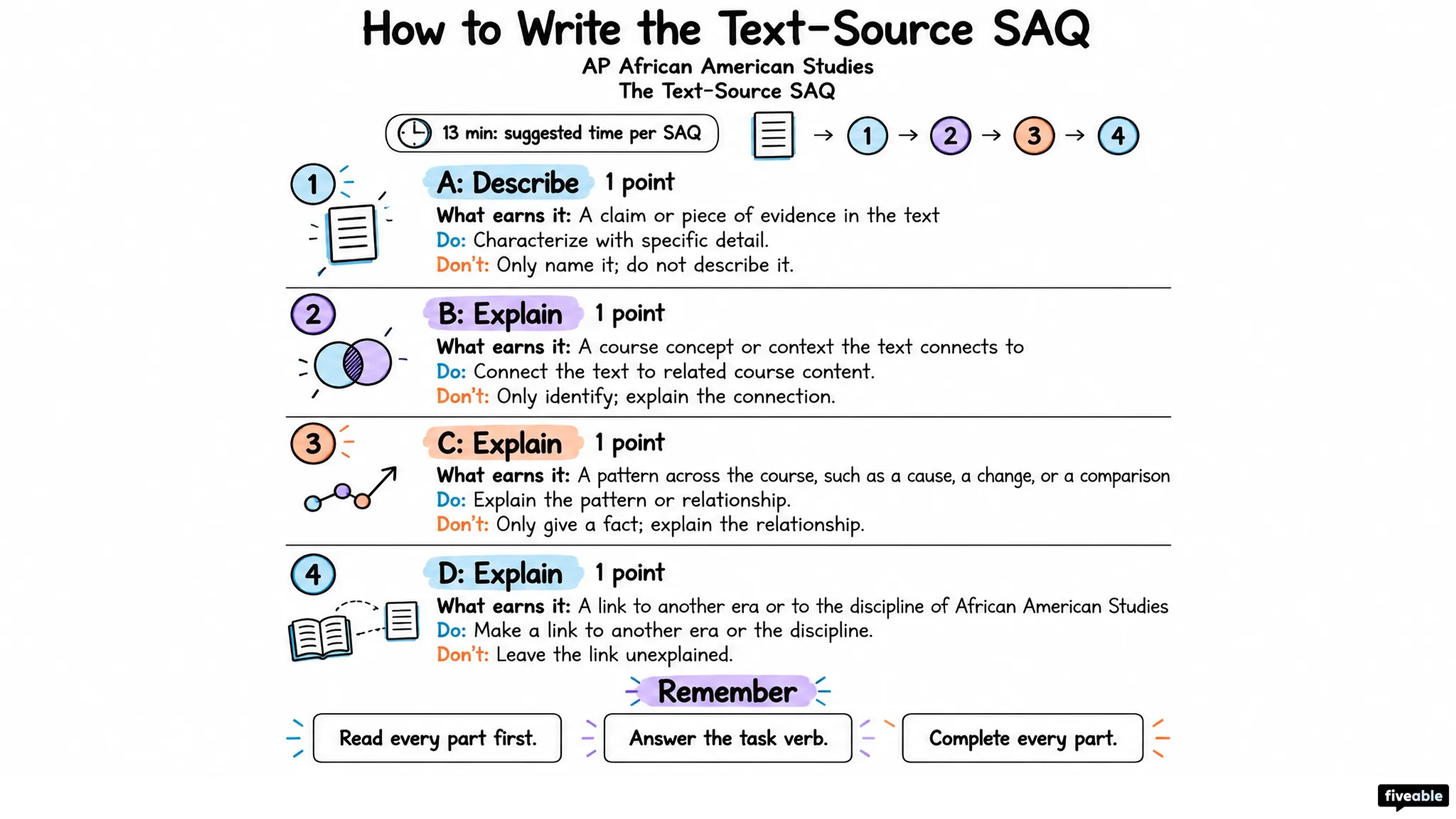
Text-Source SAQ skill sheet
Every rubric point on one page: what earns it, what to do and what to avoid. Tap the sheet to see it full size.
How Text-Source SAQ practice works
Each question follows the exam’s format, from the full prompt to a score on every part.
Read the source and question
The text and all four parts, A through D, laid out the way the exam shows them.
Write on a 13-minute timer
About the time each SAQ gets on exam day. Pause it or turn it off, and your response saves as you go.
Submit for a score out of 4
Your response is scored against the scoring guidelines written for that question. Your first score is included.
Feedback on every part
A summary at the top tells you what to work on next. Below it, each part shows whether you earned the point and what the scoring guidelines were looking for.
Detailed Feedback
Part A: 1/1 point
The response earns the point. The student accurately describes the broader historical context by referencing the Plessy v. Ferguson decision of 1896 and the 'separate but equal' doctrine, which is one of the acceptable responses listed in the rubric. The connection to Du Bois's motivation to speak out is clear and historically grounded.
Part B: 1/1 point
The response earns the point. The student provides a specific example — poll taxes — and explains how the federal government's failure to enforce the Fifteenth Amendment allowed states to disenfranchise African Americans. The connection between the economic conditions of sharecropping and the inability to pay poll taxes adds meaningful context. This aligns with the rubric's acceptable response about the Fifteenth Amendment and disenfranchisement measures.
Part C: 0/1 point
The response does not earn the point. While the student correctly identifies Martin Luther King Jr. and mentions nonviolent protest, the description is too vague and general. The rubric requires a specific example of how King or another leader advocated for rights — such as leading specific marches, organizing sit-ins, or collaborating with named organizations. Phrases like 'gave speeches' and 'worked with the government' are insufficiently specific to satisfy the requirement for a described advocacy method.
Questions about the Text-Source SAQ
How many responses can I get scored?
You can read every question without a plan. Your first scored response is included. A plan unlocks unlimited scoring.
Why does this SAQ have four parts?
On the 2025 exam, the text-source SAQ had four parts, A through D, worth 4 points. The visual-source and no-source SAQs had three parts each.
What kind of text will I read?
A written source such as a speech, a letter, a poem, a law, or a scholar’s writing. Here, part A asks about the text itself, and the later parts move to related course content and connections across time.
Will I have seen the source before?
Maybe. On the exam, one of the two source-based SAQs uses a required course source you studied in class, and the other uses a source you haven’t seen.
How is this SAQ different from the other two?
The visual-source SAQ gives you an image instead of a text. The no-source SAQ has no source, so every example comes from what you know about the course.
More AP African American Studies practice
Visual-Source SAQ practice
Visual-source short-answer questions with the image and all three parts.
AP African American Studies FRQs
Every FRQ type for AP African American Studies, with practice for each.
Write your first Text-Source SAQ
Pick one from the list, or let us choose for you.
Teaching AP African American Studies? Assign these Text-Source SAQs to your class