4.1 Principles of gravimetric analysis

⚗️Analytical Chemistry Unit 4 Review
4.1 Principles of gravimetric analysis
⚗️ Analytical Chemistry
Gravimetric analysis is a quantitative method that determines how much of an analyte is present by measuring the mass of a solid precipitate. You precipitate the analyte out of solution, isolate it, and weigh it, then use stoichiometry to back-calculate the original concentration. Because it relies on mass measurements rather than instrument calibration, gravimetric analysis can achieve very high accuracy when performed carefully.
The quality of your results hinges on factors like whether precipitation was complete, whether the precipitate is pure, and how carefully you handle weighing. Understanding these principles helps you decide when gravimetric methods are the right tool and how to avoid common sources of error.
Gravimetric Analysis Principles

Top images from around the web for Fundamental Concepts
Quantitative Chemical Analysis | Chemistry for Majors View original
Is this image relevant?
Quantitative Chemical Analysis | Chemistry: Atoms First View original
Is this image relevant?
Lab 4 Introduction | Chemistry I Laboratory Manual View original
Is this image relevant?
Quantitative Chemical Analysis | Chemistry for Majors View original
Is this image relevant?
Quantitative Chemical Analysis | Chemistry: Atoms First View original
Is this image relevant?
Fundamental Concepts
Gravimetric analysis works by converting the analyte into an insoluble compound through a chemical reaction with a precipitating agent. The precipitate is then separated, purified, and weighed. From that mass, you calculate the analyte's concentration using the stoichiometric relationship between the analyte and the precipitate.
For this to work, three conditions must hold:
- The precipitation reaction must be quantitative, meaning virtually all of the analyte is converted to the precipitate.
- The precipitate must have a known, fixed composition so the stoichiometry is reliable.
- The precipitate must be pure enough that its mass accurately reflects only the analyte of interest.
Gravimetric Analysis Steps
A complete gravimetric determination follows these steps in order:
- Sample preparation — Dissolve the sample in a suitable solvent and adjust solution conditions (pH, temperature, ionic strength) to favor the precipitation reaction.
- Precipitation — Add the precipitating agent to the sample solution. The analyte reacts to form an insoluble compound that drops out of solution.
- Digestion — Heat the mixture (often for 30 minutes to several hours) to promote particle growth and agglomeration. Larger crystals are purer and easier to filter than fine particles.
- Filtration — Separate the precipitate from the mother liquor using gravity filtration, vacuum (suction) filtration, or centrifugation.
- Washing — Rinse the collected precipitate with a wash solution that removes adsorbed impurities and excess reagents without dissolving the precipitate itself. A dilute electrolyte solution is often used to prevent peptization (redispersion of the precipitate).
- Drying or ignition — Dry the precipitate in an oven to remove moisture, or ignite it in a muffle furnace to convert it to a thermally stable weighing form. For example, hydrous iron(III) oxide is ignited to .
- Weighing — Measure the mass of the dried or ignited precipitate on an analytical balance (typically ±0.0001 g precision).
Accuracy and Precision in Gravimetric Analysis

Factors Affecting Accuracy
Accuracy refers to how close your measured value is to the true value. Several issues can introduce systematic error:
- Incomplete precipitation — If the reaction doesn't go to completion, some analyte stays in solution, and you underestimate the concentration. Using excess precipitating agent and optimizing pH/temperature helps drive the reaction forward.
- Coprecipitation — Impurities get trapped within or adsorbed onto the precipitate as it forms. This adds extra mass and causes you to overestimate the analyte concentration. Digestion and slow precipitation from dilute solution reduce coprecipitation.
- Postprecipitation — A second substance slowly precipitates onto the surface of the primary precipitate over time. This is different from coprecipitation because it worsens the longer the precipitate sits in the mother liquor. Filtering promptly after digestion minimizes this problem.
- Weighing errors — Poor balance calibration, fingerprints on crucibles, or not cooling samples to room temperature in a desiccator before weighing all introduce systematic bias.
Factors Affecting Precision
Precision refers to how reproducible your results are across replicate measurements:
- Particle size distribution — Inconsistent crystal sizes lead to variable filtration and washing efficiency between replicates. Controlled digestion conditions help produce uniform particles.
- Sample heterogeneity — If the analyte isn't evenly distributed in the original sample, different subsamples will give different results. Thorough mixing or grinding before sampling is essential.
- Procedural variations — Small differences in precipitation time, digestion temperature, washing volume, or drying duration between trials degrade precision. Following a strict, standardized protocol reduces this variability.
- Random weighing errors — Air drafts, temperature fluctuations near the balance, and vibrations cause random scatter in mass readings.
Stoichiometry in Gravimetric Analysis

Calculating Analyte Concentration
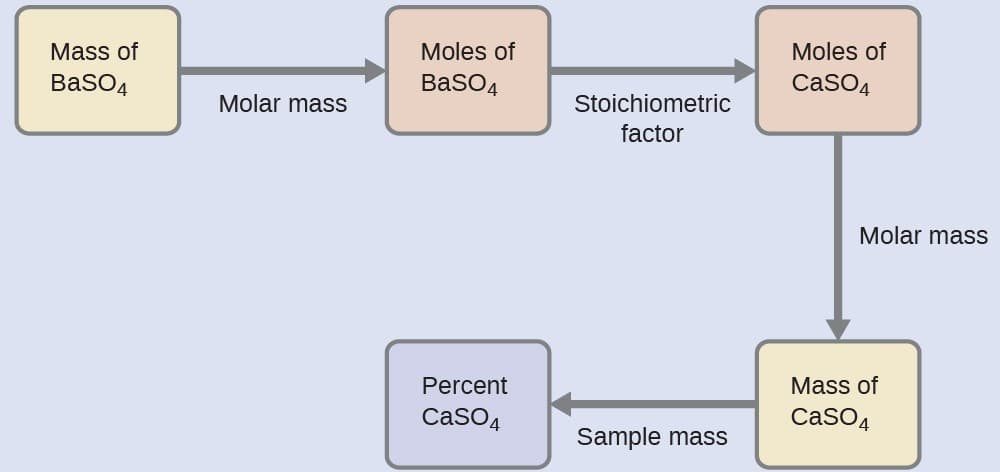
Once you have the precipitate mass, you convert it to the mass (or moles) of analyte using the balanced equation for the precipitation reaction. The general relationship is:
The stoichiometric factor is the molar ratio of analyte to precipitate from the balanced equation. If one mole of precipitate corresponds to one mole of analyte, the factor is 1. If two moles of analyte produce one mole of precipitate, the factor is 2.
To get concentration, divide the mass of analyte by the sample volume (in liters) and the molar mass of the analyte:
Example Calculation
Problem: A 50.00 mL sample solution produces 0.2870 g of dried precipitate. What is the chloride ion concentration?
Step 1: Write the balanced precipitation reaction.
Step 2: Identify the stoichiometric factor. The equation shows a 1:1 molar ratio of to .
Step 3: Gather molar masses.
- Molar mass of = 143.32 g/mol
- Molar mass of = 35.45 g/mol
Step 4: Calculate moles of .
Step 5: Use the 1:1 ratio to find moles of .
Step 6: Calculate concentration.
Pay attention to significant figures throughout. Your final answer should reflect the least number of significant figures from your measured quantities (here, four sig figs from the mass and volume).
Gravimetric Method Suitability
Factors to Consider
Not every analyte or sample is a good candidate for gravimetric analysis. When evaluating whether a gravimetric approach makes sense, consider these properties:
- Selectivity — The precipitating agent should react specifically with the target analyte. If other ions in the sample form precipitates with the same reagent, you'll get interference and inaccurate results.
- Solubility — The precipitate needs a very low solubility product () so that essentially all of the analyte is removed from solution. High solubility means analyte loss and low recovery.
- Filterability — Large, well-formed crystals filter quickly and wash cleanly. Fine, gelatinous precipitates clog filters and trap impurities. Digestion and controlled precipitation conditions improve filterability.
- Stability — The final weighing form must be chemically stable. It shouldn't absorb moisture from the air, decompose at drying/ignition temperatures, or react with atmospheric .
- Stoichiometric reliability — The precipitate must have a definite, reproducible composition. If the formula varies (as with some hydrated compounds), you can't calculate the analyte mass accurately.
Suitability for Different Analytical Problems
Gravimetric methods work best for major components (roughly >1% by mass) in relatively simple sample matrices where high accuracy is needed. Classic applications include determining sulfate as , chloride as , and iron as .
For trace-level analytes or complex matrices with many potential interferences, techniques like atomic spectroscopy, chromatography, or electrochemical methods are usually better choices because of their higher sensitivity and selectivity.
Practical factors also matter: gravimetric analysis tends to be time-consuming (hours to complete one determination), requires careful technique, and uses relatively simple equipment. It's often chosen when absolute accuracy is more important than speed, or when the lab lacks expensive instrumentation.
See Fiveable more often in Google
Mark Fiveable as a preferred source and Google is more likely to show you our guides in Top Stories, with a "preferred" badge in AI Mode and AI Overviews.