10.2 Lie algebras and exponential map
Updated March 2026Fiveable Content Team

🌿Algebraic Geometry Unit 10 Review
10.2 Lie algebras and exponential map
🌿 Algebraic Geometry
Unit 10 – Algebraic Groups and Lie Algebras
Lie algebras and the exponential map are key concepts in algebraic groups. They provide a powerful tool for studying the local structure of Lie groups, connecting abstract algebra with geometry and analysis.
The exponential map bridges Lie algebras and Lie groups, allowing us to construct one-parameter subgroups and explore group properties. It's essential for understanding the structure and classification of algebraic groups, including simple and semisimple Lie algebras.
Lie algebras and algebraic groups
Definition and properties of Lie algebras
- A Lie algebra is a vector space over a field equipped with a binary operation called the Lie bracket, denoted , satisfying:
- Bilinearity: and for and
- Alternativity: for all
- Jacobi identity: for all
- Examples of Lie algebras include:
- The vector space of matrices over a field with the commutator bracket ()
- The vector space of smooth vector fields on a manifold with the Lie bracket of vector fields ()
Relation between Lie algebras and algebraic groups
- The Lie algebra of an algebraic group is the tangent space at the identity element, , with the Lie bracket given by the commutator of left-invariant vector fields
- For each Lie group homomorphism , there is an associated Lie algebra homomorphism between their corresponding Lie algebras, preserving the Lie bracket structure
- The adjoint representation of a Lie group on its Lie algebra is given by the differential of the conjugation map, , where for and , and is the conjugation map
- Examples of the correspondence between Lie groups and Lie algebras:
- The Lie algebra of the general linear group is the space of complex matrices
- The Lie algebra of the special orthogonal group is the space of skew-symmetric real matrices
Exponential map for Lie groups
Definition and properties of the exponential map
- The exponential map is a local diffeomorphism from a neighborhood of in the Lie algebra to a neighborhood of the identity element in the Lie group
- For a matrix Lie group , the exponential map is given by the matrix exponential: for
- The exponential map satisfies the property for and , making it a group homomorphism from to
- The derivative of the exponential map at is the identity map,
- Examples of exponential maps:
- For the Lie group , the exponential map is the matrix exponential for
- For the Lie group , the exponential map is given by the Rodrigues' rotation formula , where is a skew-symmetric matrix representing a rotation by angle about the axis

Construction of one-parameter subgroups
- The exponential map is used to construct one-parameter subgroups of a Lie group, which are smooth homomorphisms from to of the form for some
- One-parameter subgroups are the integral curves of left-invariant vector fields on the Lie group
- The exponential map establishes a bijection between the Lie algebra and the set of one-parameter subgroups of
- Examples of one-parameter subgroups:
- In the Lie group , the one-parameter subgroup generated by a matrix is given by
- In the Lie group , the one-parameter subgroup generated by a skew-symmetric matrix represents rotations about the axis by angles proportional to
Properties and applications of the exponential map
Surjectivity and generating properties
- The exponential map is surjective for connected, simply connected Lie groups, meaning every element of can be written as for some
- For compact Lie groups, the exponential map is not necessarily surjective, but its image generates a dense subset of the group
- Examples:
- The exponential map of the Lie group , the group of unitary matrices with determinant 1, is surjective because is simply connected
- The exponential map of the Lie group , the group of orthogonal matrices with determinant 1, is not surjective, but its image generates a dense subset of
Baker-Campbell-Hausdorff formula
- The Baker-Campbell-Hausdorff formula expresses the product of two exponentials in a Lie group in terms of a single exponential: , where is a series in terms of nested Lie brackets of and
- The first few terms of the Baker-Campbell-Hausdorff formula are:
- The Baker-Campbell-Hausdorff formula is useful for approximating products in Lie groups and studying the local structure of Lie groups near the identity
- Example: In the Lie group , the Baker-Campbell-Hausdorff formula gives an approximation of the product of two matrices close to the identity: for small matrices
Structure and classification of Lie algebras
Simple and semisimple Lie algebras
- A Lie algebra is simple if it has no non-trivial ideals and is not abelian. The classification of simple Lie algebras over leads to the four infinite families , and five exceptional Lie algebras
- A Lie algebra is semisimple if it is a direct sum of simple Lie algebras. The Killing form, a symmetric bilinear form on , is non-degenerate if and only if is semisimple
- Examples of simple and semisimple Lie algebras:
- The Lie algebra of traceless complex matrices is simple for
- The Lie algebra of skew-symmetric complex matrices is simple for and semisimple for
Levi decomposition and solvable radical
- The Levi decomposition states that any finite-dimensional Lie algebra can be written as a semidirect product , where is a semisimple subalgebra (the Levi factor) and is the solvable radical
- The solvable radical is the maximal solvable ideal of , and it consists of the nilpotent and abelian parts of the Lie algebra
- The Levi decomposition is unique up to conjugation by elements of the group
- Example: The Lie algebra of the Poincaré group, the semidirect product of translations and Lorentz transformations in special relativity, has a Levi decomposition , where is the Lorentz Lie algebra and is the abelian Lie algebra of translations
Root systems and classification
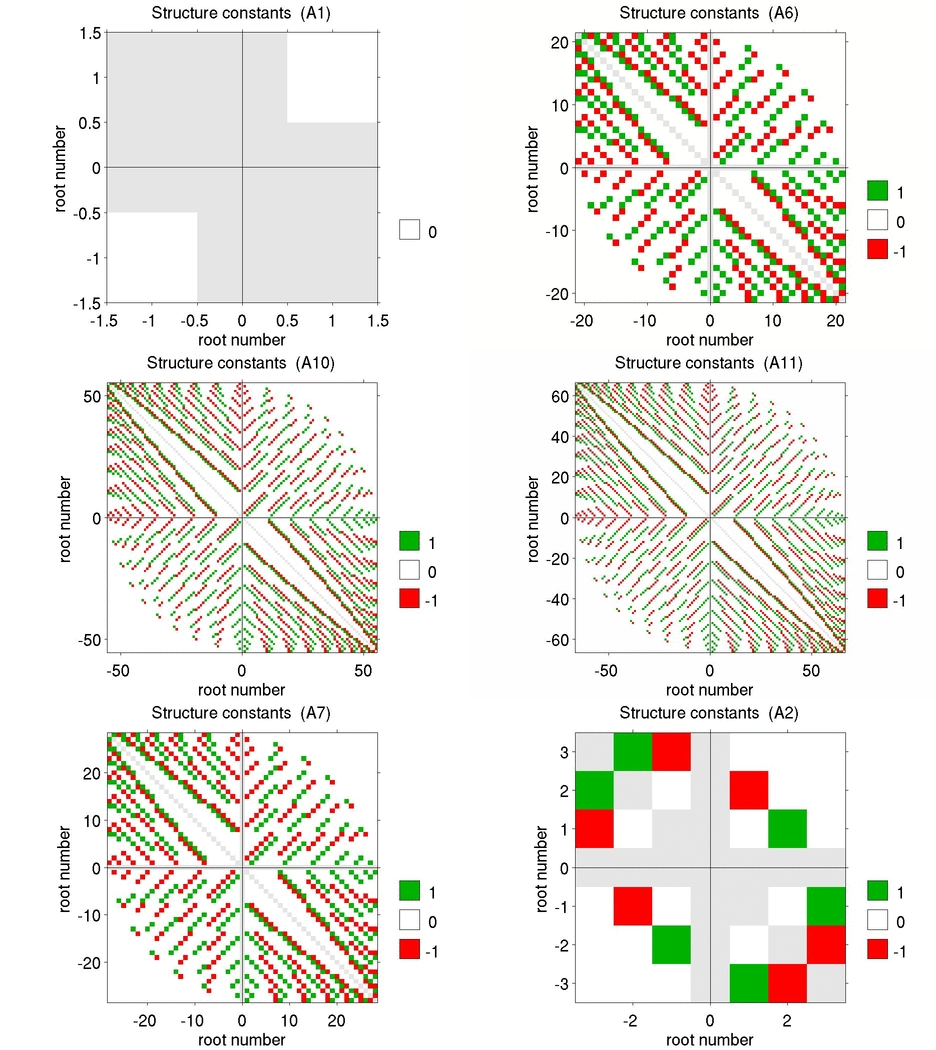
- The structure of a semisimple Lie algebra is determined by its root system, a configuration of vectors in a Euclidean space satisfying certain integrality and reflection conditions
- A root system is a finite set Φ of non-zero vectors in a Euclidean space 𝔢 satisfying:
- If α ∈ Φ, then the only multiples of α in Φ are ±α
- For each α ∈ Φ, the reflection σ_α(β) = β - 2\frac{(β,α)}{(α,α)}α leaves Φ invariant
- For all α, β ∈ Φ, the number 2\frac{(β,α)}{(α,α)} is an integer
- The classification of root systems leads to the classification of semisimple Lie algebras, with each simple Lie algebra corresponding to an irreducible root system
- Examples of root systems and their corresponding Lie algebras:
- The root system corresponds to the special linear Lie algebra
- The root system corresponds to the symplectic Lie algebra
See Fiveable more often in Google
Mark Fiveable as a preferred source and Google is more likely to show you our guides in Top Stories, with a "preferred" badge in AI Mode and AI Overviews.