7.1 Lever systems and mechanical advantage

🏃Sports Biomechanics Unit 7 Review
7.1 Lever systems and mechanical advantage
🏃 Sports Biomechanics
Lever Systems in the Human Body
Lever systems explain how your bones, joints, and muscles work together to produce movement. Every time you throw a ball, jump, or even nod your head, lever systems determine how much force you can generate and how fast you can move. These concepts are central to sports biomechanics because they reveal the trade-offs your body makes between force and speed.
Mechanical advantage quantifies that trade-off. It tells you whether a particular lever arrangement favors producing large forces or producing fast, wide-ranging movements. Grasping both ideas gives you the tools to analyze technique, design training programs, and understand injury mechanics.
Types of Lever Systems
Every lever in the body has three components:
- Fulcrum — the joint (axis of rotation)
- Effort — the force applied by a muscle at its attachment point
- Resistance (load) — the external force the lever must overcome (body weight, a barbell, gravity acting on a limb, etc.)
The arrangement of these three components defines the lever class.
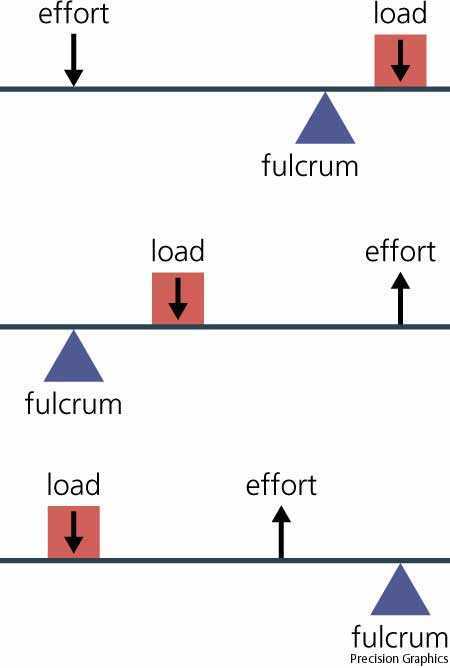
First-class levers place the fulcrum between the effort and the resistance. Think of a seesaw. In the body, the atlanto-occipital joint is the classic example: the neck extensors pull behind the fulcrum while the weight of the face and skull sits in front of it. First-class levers can favor either force or speed, depending on which arm is longer.
Second-class levers place the resistance between the fulcrum and the effort. The textbook example is the ankle during a calf raise: the ball of the foot is the fulcrum, body weight pushes down through the tibia (resistance), and the calf muscles pull up on the calcaneus behind it. These levers always have a mechanical advantage greater than 1, making them strong but relatively slow.
Third-class levers place the effort between the fulcrum and the resistance. This is the most common type in the human body. During a biceps curl, the elbow is the fulcrum, the biceps inserts just a few centimeters distal to the joint (effort), and the weight sits out in the hand (resistance). The effort arm is much shorter than the resistance arm, so these levers sacrifice force for speed and range of motion.
Multiple lever systems often work together to produce complex movements. Walking, for instance, involves coordinated action of hip, knee, and ankle levers, while postural control relies on the interplay between spinal and lower-limb lever systems.
Function and Applications
Each lever class fills a different biomechanical role:
- First-class levers are often involved in stabilization and balance. The neck lever keeps your head upright and allows controlled nodding.
- Second-class levers excel at force production for weight-bearing tasks. The Achilles tendon and foot lever generates the large push-off forces needed during running and jumping.
- Third-class levers prioritize speed and precision. The biceps-forearm lever lets you move your hand quickly through a large arc, which matters for throwing, striking, and fine motor skills.
Understanding lever types helps you analyze movement patterns in sport, design targeted strength or rehab exercises, and evaluate tool or equipment ergonomics.
Mechanical Advantage in Movement

Concept and Calculation
Mechanical advantage (MA) is the ratio of output force to input force, or equivalently, the ratio of the effort arm to the resistance arm:
- = output force (force applied to the load)
- = input force (force the muscle produces)
- = distance from the fulcrum to the point where effort is applied
- = distance from the fulcrum to the point where the load acts
When MA > 1, the lever amplifies force. A calf raise is a good example: the effort arm (fulcrum-to-calcaneus distance) is longer than the resistance arm (fulcrum-to-tibia distance), so the calf muscles can lift your entire body weight without matching it pound-for-pound.
When MA < 1, the lever amplifies speed and range of motion instead. During a biceps curl, the biceps inserts roughly 5 cm from the elbow, while the hand holding the weight might be 35 cm away. That gives an MA of about 0.14, meaning the muscle must produce roughly 7 times the load force, but in return the hand moves much faster and farther than the muscle's shortening distance.
Application in Human Movement
Second-class levers generally provide the greatest mechanical advantage in the body, which is why they appear where large forces are needed (standing on your toes, pushing off the ground).
Third-class levers dominate most limb movements despite their mechanical disadvantage. The speed and range of motion they provide are essential for throwing, kicking, writing, and countless other tasks.
The key trade-off: you can't maximize both force and speed with the same lever arrangement. Sprinting demands rapid limb cycling (low MA, third-class levers doing most of the work), while a heavy squat prioritizes force output (the ankle's second-class lever and favorable joint angles become critical). Recognizing this trade-off is fundamental to analyzing efficiency, programming exercises, and refining sport technique.
Lever Systems and Movement Efficiency
Force Production and Lever Systems
The ratio of the effort arm to the resistance arm directly controls how much force a lever can deliver and how fast it can move.
- First-class levers can go either way. During neck extension the effort arm is relatively long, favoring force. Shift the geometry and the same lever type can favor speed.
- Second-class levers always favor force production but are limited in speed and range of motion. They suit high-force tasks like rising from a squat or pushing off the ground.
- Third-class levers allow rapid, precise movements but are mechanically disadvantaged for force. They're responsible for the fine motor skills of the hand and the fast limb actions in throwing and striking.
Efficiency and Optimization
Movement efficiency depends on how well the lever system balances the force-speed trade-off for a given task.
Muscle architecture interacts with lever geometry. Pennation angle (the angle of muscle fibers relative to the tendon) affects how much force reaches the lever. Pennate muscles like the gastrocnemius pack more fibers into a given volume and transmit high forces, which pairs well with the ankle's second-class lever. Fusiform muscles like the biceps brachii have fibers running parallel to the tendon, favoring shortening speed, which complements the forearm's third-class lever.
Different activities exploit different lever configurations:
- Walking uses a combination of lever types to minimize energy expenditure, cycling smoothly between hip, knee, and ankle levers.
- Sprinting relies heavily on third-class levers for rapid limb repositioning.
- Powerlifting positions the body to maximize effective lever arms at the hip and knee.
Biomechanical analysis of these lever systems feeds directly into improving sport technique, designing ergonomic workstations, and developing assistive devices for individuals with movement impairments.
Lever Arm Length and Torque
Torque Generation Principles
Torque is the rotational equivalent of force. It determines how effectively a force can rotate a limb around a joint.
- = torque (in N·m)
- = applied force (in N)
- = lever arm length (in m), defined as the perpendicular distance from the line of action of the force to the axis of rotation
A longer lever arm means more torque for the same force. This is why you use a longer wrench handle to loosen a stubborn bolt, and it's why athletes with longer moment arms at certain joints can produce more joint torque with the same muscle force.
In the body, the muscle moment arm (the perpendicular distance from the muscle's line of pull to the joint center) changes throughout the range of motion. That's a critical detail: your muscle's ability to generate torque isn't constant across a movement.
Joint Angles and Torque Production
As a joint moves through its range of motion, the effective lever arm length changes, and so does torque output.
Consider a biceps curl. At full extension the biceps moment arm is short, so torque is low. As the elbow flexes toward 90°, the moment arm increases and torque peaks. Past 90°, the moment arm shortens again and torque drops. This is why the mid-range of a curl feels hardest relative to the load.
Two factors interact to determine peak torque at any joint angle:
- Moment arm length — changes with joint position as described above.
- Muscle length-tension relationship — muscles produce maximum active force near their resting length. At very short or very long lengths, force output drops.
The quadriceps, for example, generate maximum knee-extension torque at approximately 60° of knee flexion, where both the moment arm and the length-tension relationship are near optimal.
Understanding lever arm length and torque production is essential for:
- Analyzing where in a movement an athlete is strongest or weakest
- Designing exercises that load specific ranges of motion (e.g., using bands or chains to match the strength curve)
- Programming rehabilitation protocols that respect joint-angle-specific torque limits
- Building biomechanical models for movement analysis and performance prediction
See Fiveable more often in Google
Mark Fiveable as a preferred source and Google is more likely to show you our guides in Top Stories, with a "preferred" badge in AI Mode and AI Overviews.