6.2 Introduction to Lie groups and Lie algebras

🌀Riemannian Geometry Unit 6 Review
6.2 Introduction to Lie groups and Lie algebras
🌀 Riemannian Geometry
Lie groups and algebras are fundamental structures in mathematics, combining smooth manifolds with group operations. They're crucial for understanding symmetries in physics and geometry, forming a bridge between continuous and discrete mathematics.
The relationship between Lie groups and their associated Lie algebras is deep and powerful. Through tools like the exponential map and one-parameter subgroups, we can study complex group structures by examining their simpler, linearized versions in the Lie algebra.
Lie Groups and Algebras
Fundamental Concepts of Lie Groups and Algebras
- Lie group defines a smooth manifold with group structure where multiplication and inversion operations are smooth
- Lie algebra consists of tangent space at the identity element of a Lie group
- Exponential map connects Lie algebra to Lie group by mapping elements of the algebra to the group
- One-parameter subgroup represents a continuous path in the Lie group, parameterized by a real number
Relationship Between Lie Groups and Algebras
- Lie algebra captures local structure of Lie group near identity element
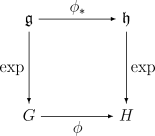
- Exponential map exp: g → G maps Lie algebra g to Lie group G
- One-parameter subgroups form integral curves of left-invariant vector fields on the Lie group
- Lie bracket operation in algebra corresponds to group commutator in Lie group
Examples and Applications
- Matrix Lie groups (GL(n,R), SL(n,R), O(n), SO(n)) serve as concrete examples of Lie groups
- Corresponding matrix Lie algebras (gl(n,R), sl(n,R), o(n), so(n)) demonstrate Lie algebra structure
- Exponential map for matrix Lie groups calculated using matrix exponential series
- Physics applications include describing symmetries in particle physics and quantum mechanics
Structure and Representation
![Fundamental Concepts of Lie Groups and Algebras, Representation Theory [The Physics Travel Guide]](https://storage.googleapis.com/static.prod.fiveable.me/search-images%2F%22Fundamental_concepts_of_Lie_groups_and_algebras_smooth_manifolds_exponential_map_one-parameter_subgroups%22-lie_groups_and_reps.jpg%3Fw%3D1280%26tok%3D447caa.jpg)
Structural Components of Lie Algebras
- Structure constants define Lie bracket operation in terms of basis elements of Lie algebra
- Adjoint representation maps Lie algebra elements to linear transformations on the algebra itself
- Left-invariant vector fields remain unchanged under left translations of the Lie group
- Maurer-Cartan form provides canonical left-invariant 1-form on Lie group, taking values in Lie algebra
Representations and Their Significance
- Adjoint representation Ad: G → GL(g) maps Lie group elements to automorphisms of Lie algebra
- Infinitesimal adjoint representation ad: g → gl(g) derived from adjoint representation
- Left-invariant vector fields form basis for Lie algebra of vector fields on Lie group
- Maurer-Cartan form ω satisfies structural equation dω + 1/2[ω,ω] = 0
Computational Aspects and Applications
- Structure constants calculated by expanding Lie bracket in terms of basis elements
- Adjoint representation computed using matrix exponential for matrix Lie groups
- Left-invariant vector fields constructed by pushing forward basis vectors from identity element
- Maurer-Cartan form used in differential geometry to study geometric properties of Lie groups
See Fiveable more often in Google
Mark Fiveable as a preferred source and Google is more likely to show you our guides in Top Stories, with a "preferred" badge in AI Mode and AI Overviews.