
Quantum states and Dirac notation form the foundation of quantum computing. They provide a concise way to represent and manipulate quantum information, allowing us to describe complex systems with elegance and precision.
Operators and matrices are the workhorses of quantum mechanics. They enable us to transform quantum states, measure observables, and build quantum circuits, giving us the tools to harness the power of quantum systems for computation.
Quantum States and Dirac Notation
Dirac notation for quantum states
- Dirac notation (bra-ket notation) provides a concise way to represent quantum states and operations
- Ket: represents a column vector describing a quantum state (e.g., , )
- Bra: represents a row vector, the dual of the quantum state (e.g., , )
- Inner product: calculates the inner product of two states, yielding a complex number (e.g., )
- Outer product: forms the outer product of two states, resulting in a matrix (e.g., )
- Quantum state representation using Dirac notation allows for compact expressions of quantum systems
- Qubit states: and form the computational basis, representing the two possible states of a qubit
- General qubit state: , where and are complex amplitudes describing the probability of measuring the qubit in each basis state
- Normalization condition: ensures the total probability of measuring the qubit in any state is 1
- State transformations can be concisely expressed using Dirac notation
- Applying an operator to a state: represents the transformation of the state by the operator
- Expectation value of an operator: calculates the average value of the observable represented by the operator for the state
Operators and Matrices in Quantum Systems
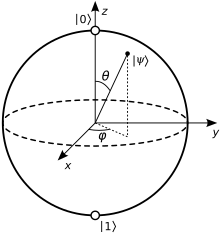
Operators and matrices in quantum systems
- Quantum operators are mathematical objects that act on quantum states and represent physical observables or transformations
- Hermitian operators: , where is the adjoint (complex conjugate transpose) of , represent observables with real eigenvalues (e.g., position, momentum)
- Unitary operators: , where is the identity matrix, represent reversible transformations that preserve the norm of the state (e.g., quantum gates)
- Pauli matrices: , , and are important single-qubit operators representing rotations around the x, y, and z axes of the Bloch sphere
- Matrix representation of quantum states and operators allows for mathematical manipulation and computation
- State vectors are represented as column matrices (e.g., , )
- Operators are represented as square matrices (e.g., , , )
- Matrix multiplication is used for applying operators to states (e.g., )
- Eigenvalues and eigenvectors are crucial concepts in quantum mechanics
- Eigenvalue equation: , where is an eigenvalue and is an eigenvector, describes states that are unchanged by the operator up to a scalar factor
- Spectral decomposition of Hermitian operators: expresses an operator as a sum of its eigenvalues and eigenvectors, which form a complete orthonormal basis
Linear algebra in quantum computing
- Tensor products allow for the description of composite quantum systems
- Combining multiple quantum systems: represents the joint state of two independent quantum systems (e.g., , )
- Kronecker product is used for the matrix representation of tensor products (e.g., )
- Quantum gates and circuits are fundamental building blocks of quantum algorithms
- Representing quantum gates as unitary matrices allows for the mathematical description of their action on quantum states (e.g., Hadamard gate )
- Constructing quantum circuits using matrix multiplication enables the simulation and analysis of quantum algorithms (e.g., represents the application of gates , , and to the initial state )
- Quantum measurements are the process of extracting classical information from quantum systems
- Projective measurements: are operators that project the state onto the basis state (e.g., , )
- Probability of measuring a state: gives the probability of measuring the state in the basis state
- State collapse after measurement: describes the state of the system after measuring and obtaining the outcome corresponding to

Hilbert Spaces in Quantum Mechanics
Hilbert spaces in quantum mechanics
- Definition of Hilbert space: A Hilbert space is a complete inner product space that serves as the mathematical foundation for quantum mechanics
- Complete inner product space: A vector space equipped with an inner product, where every Cauchy sequence converges to an element within the space
- Infinite-dimensional vector space: Hilbert spaces used in quantum mechanics are typically infinite-dimensional, allowing for the description of continuous systems (e.g., position, momentum)
- Properties of Hilbert spaces: Hilbert spaces have several important properties that make them suitable for describing quantum systems
- Completeness: The convergence of Cauchy sequences ensures that limits of sequences of states are well-defined and remain within the Hilbert space
- Orthonormality: Basis vectors satisfy , where is the Kronecker delta, meaning they are orthogonal and normalized (e.g., , )
- Superposition principle: Any state in the Hilbert space can be expressed as a linear combination of basis states (e.g., )
- Hilbert space formalism in quantum mechanics: The Hilbert space formalism provides a rigorous mathematical framework for quantum mechanics
- Wave functions as elements of a Hilbert space: Quantum states are represented by wave functions, which are elements of the Hilbert space (e.g., for a particle in one dimension)
- Operators acting on the Hilbert space: Physical observables and transformations are represented by operators that act on the elements of the Hilbert space (e.g., position operator , momentum operator )
- Observables as Hermitian operators with real eigenvalues: Observables are represented by Hermitian operators, ensuring that their eigenvalues, which correspond to the possible measurement outcomes, are real (e.g., energy operator )