
Fault-tolerant quantum computation protects quantum information from errors, ensuring reliable results even with imperfect systems. It's crucial for realizing large-scale quantum computers that can outperform classical ones in solving complex problems.
Error thresholds are key in fault-tolerance, representing the maximum tolerable error rate for quantum operations. Staying below these thresholds allows errors to be effectively suppressed and corrected, maintaining the integrity of quantum computations over time.
Fault-Tolerant Quantum Computation
Fault-tolerant quantum computation fundamentals
- Fault-tolerant quantum computation involves techniques and protocols that protect quantum information from errors and maintain reliability of quantum computations
- Quantum systems are sensitive to noise and errors which can corrupt quantum states and lead to incorrect computational results
- Fault-tolerance mitigates the impact of errors and ensures quantum computations can be performed reliably even with imperfections
- Enables realization of large-scale, reliable quantum computers that can solve complex problems beyond capabilities of classical computers
- Allows for longer quantum computations by preventing accumulation of errors over time
- Facilitates implementation of quantum error correction which is crucial for maintaining integrity of quantum information
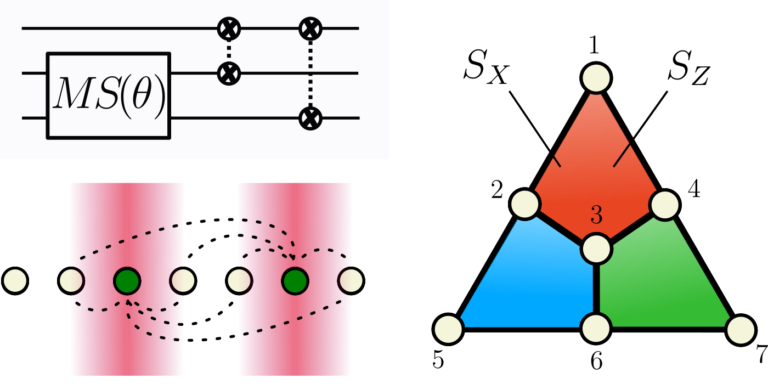
Error thresholds for fault-tolerance
- Error thresholds represent maximum tolerable error rate for individual quantum operations below which fault-tolerant quantum computation is possible
- If error rate of quantum gates and measurements is kept below the threshold, errors can be effectively suppressed and corrected using fault-tolerant techniques
- Exceeding the error threshold leads to accumulation of errors faster than they can be corrected, compromising reliability of the quantum computation
- Achieving fault-tolerance requires:
- Implementing quantum error correction codes that can detect and correct errors (Shor code, Steane code, surface code)
- Performing quantum operations with sufficiently low error rates below the threshold
- Designing fault-tolerant quantum circuits that minimize propagation of errors

Techniques in fault-tolerant circuits
- Quantum error correction:
- Encodes logical qubits into larger number of physical qubits creating redundancy
- Allows for detection and correction of errors without disturbing encoded quantum information
- Concatenated codes:
- Recursively encode logical qubits of an error correction code into another layer of error correction
- Each level of concatenation provides additional protection against errors, exponentially suppressing effective error rate
- Allow for fault-tolerant quantum computation with lower physical error rates compared to single-layer error correction
- Fault-tolerant quantum gates:
- Designed to prevent propagation of errors during quantum operations
- Transversal gates apply same single-qubit gate to each physical qubit in a logical qubit, preventing spread of errors
- Magic state distillation prepares high-fidelity ancillary states that enable fault-tolerant implementation of non-transversal gates
Resource overhead vs error suppression
- Fault-tolerant quantum computation requires significant resource overhead:
- Encoding logical qubits into multiple physical qubits increases number of qubits needed
- Performing fault-tolerant quantum gates and error correction requires additional quantum operations and ancillary qubits
- Higher levels of concatenation or more sophisticated error correction codes provide better error suppression but at cost of increased resource requirements
- Trade-offs involve balancing level of error suppression with available quantum resources
- Choosing appropriate error correction code and concatenation level based on specific quantum hardware and error characteristics
- Optimizing fault-tolerant quantum circuits to minimize resource overhead while maintaining desired level of error suppression
- Ongoing research aims to:
- Develop more efficient fault-tolerant protocols and error correction codes
- Improve error rates of physical quantum devices to reduce required level of error correction
- Explore alternative approaches to fault-tolerance such as topological quantum computing which may offer inherent resilience to errors (, )