
Vision's photochemistry is a marvel of nature, transforming light into neural signals. Rhodopsin, the key player, undergoes rapid changes when hit by photons, kicking off a cascade of events in our eyes.
This process shares similarities with photosynthesis, but is fine-tuned for speed and sensitivity. Both convert light energy, but vision's lightning-fast reactions and high efficiency make it uniquely suited for our visual world.
Photochemistry of Vision
Structure and function of rhodopsin
- Rhodopsin structure combines protein opsin with chromophore 11-cis-retinal
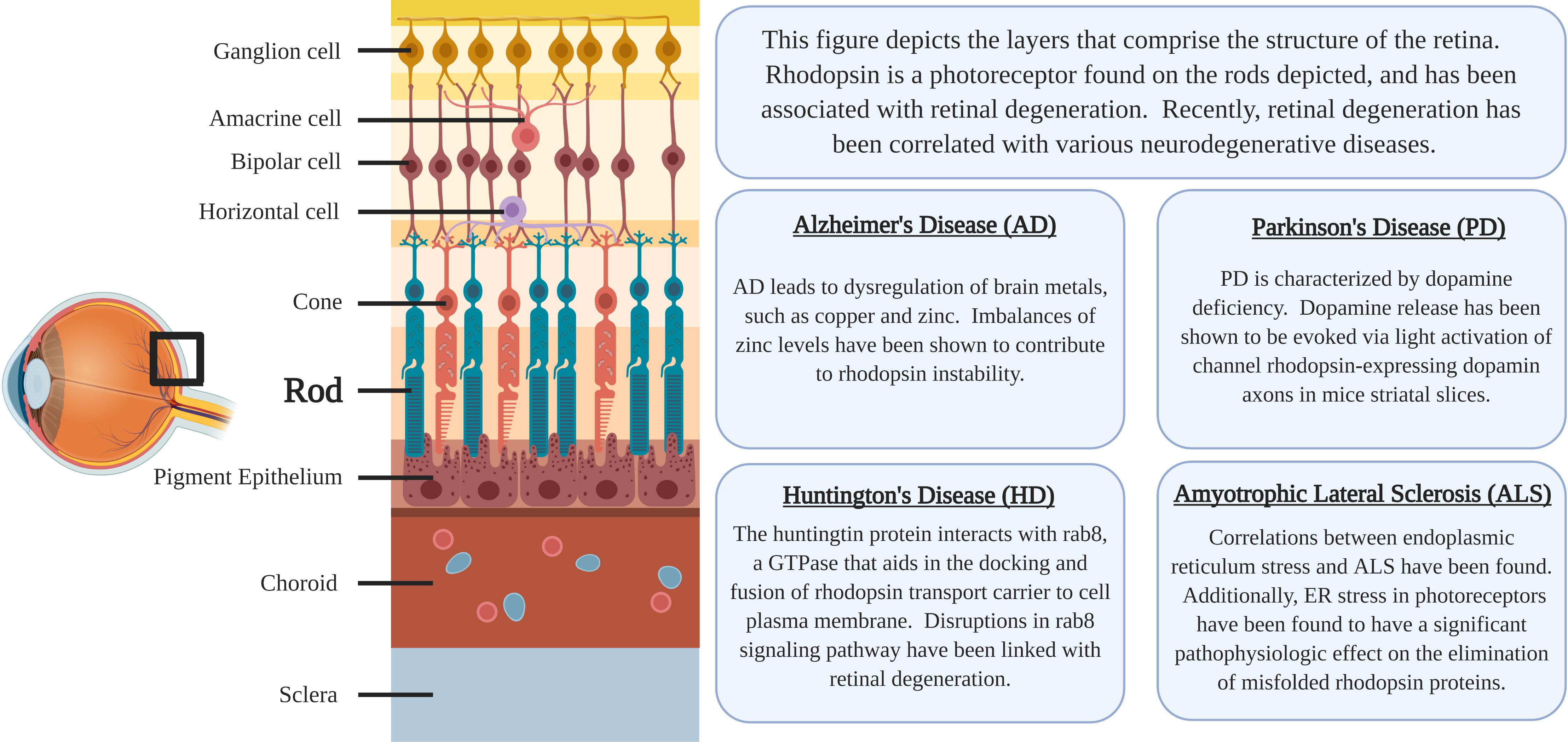
- Located in rod cells of retina acts as light-sensitive receptor protein
- Light absorption triggers conformational changes initiates visual transduction cascade
- Opsin provides protein scaffold for retinal binding and signal propagation
- 11-cis-retinal absorbs light efficiently in visible spectrum (peak ~500 nm)

Retinal isomerization in vision
- Light absorption causes 11-cis-retinal to all-trans-retinal isomerization within femtoseconds
- Isomerization transfers energy from chromophore to opsin protein
- Conformational changes in rhodopsin lead to activation of G-protein transducin
- Process initiates visual signal transduction pathway
- Quantum yield of isomerization ~0.65 ensures efficient light detection
- Photoisomerization occurs through conical intersection mechanism
Signal transduction in visual process
- Activated rhodopsin (metarhodopsin II) triggers transducin activation
- Transducin stimulates cGMP phosphodiesterase
- cGMP hydrolyzed to GMP closing cGMP-gated ion channels
- Rod cell membrane hyperpolarizes
- Neurotransmitter release at synaptic terminal altered
- Signal amplification occurs throughout cascade (one photon can activate ~100 transducin molecules)
- Process sensitivity allows detection of single photons
- Adaptation mechanisms regulate sensitivity in varying light conditions
Vision vs photosynthesis photochemistry
- Similarities involve light absorption by specialized pigments (rhodopsin, chlorophyll) triggering isomerization reactions
- Both convert light energy to chemical signals or energy (ATP, NADPH)
- Differences include primary pigments cellular location (animal vs plant cells) end products (neural signals vs chemical energy)
- Vision operates on faster timescales (femtoseconds) compared to photosynthesis (picoseconds to nanoseconds)
- Quantum efficiency higher in vision (~65%) than photosynthesis (~30% for PSII)
- Vision optimized for sensitivity photosynthesis for energy production