
Differential equations are powerful tools for modeling real-world phenomena. They help us understand how things change over time, from population growth to financial markets. This topic dives into practical applications, showing how these equations can predict and analyze complex systems.
We'll explore various types of differential equations and their uses in economics, finance, and other fields. You'll learn how to interpret solutions, analyze system behavior, and use graphical and numerical methods to gain insights. This knowledge is crucial for making informed decisions in business and management.
Modeling real-world problems
First-order differential equations
- First-order differential equations involve only the first derivative of the unknown function
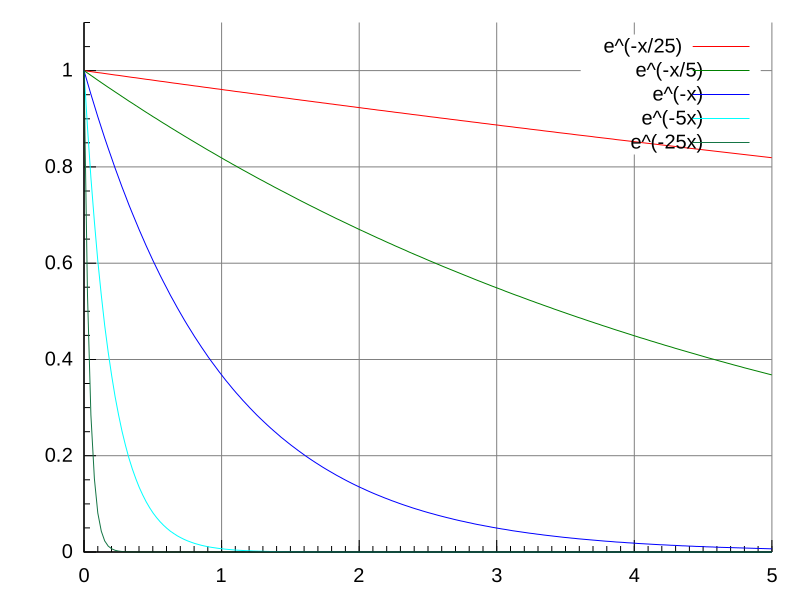
- Model exponential growth and decay, such as:
- Population growth (bacteria, animal populations)
- Radioactive decay (carbon dating, nuclear waste management)
- Compound interest (investments, loans)
Second-order and higher-order differential equations
- Second-order differential equations involve the second derivative of the unknown function
- Model systems with oscillations or vibrations
- Examples: spring-mass systems (vehicles, buildings), electrical circuits (RLC circuits)
- Higher-order differential equations involve higher-order derivatives
- Model more complex systems
- Examples: motion of a pendulum, flow of heat through a material
Partial differential equations
- Partial differential equations involve partial derivatives of the unknown function with respect to multiple variables
- Model problems involving multiple independent variables
- Examples: heat conduction (insulation, cooking), wave propagation (sound waves, light waves)
Applications in economics and finance
Economic growth models
- In economics, differential equations model:
- Growth of capital investments
- Spread of technological innovations
- Dynamics of supply and demand
- Solow-Swan model: first-order differential equation relating the rate of change of the capital-labor ratio to investment and depreciation
- Describes economic growth
- Considers factors such as savings rate, population growth, and technological progress
Financial derivatives pricing
- Black-Scholes equation: partial differential equation modeling the price of financial derivatives (options)
- Based on the underlying asset price, time to expiration, and market volatility
- Used for pricing and risk management of options contracts
Predator-prey models
- Lotka-Volterra equations: pair of first-order differential equations modeling predator-prey population dynamics
- Applied to competitive markets and strategic interactions between firms
- Examples: modeling competition between companies, market share dynamics
Interpreting solutions
Solution characteristics
- The solution to a differential equation is a function satisfying the equation
- Represents the behavior of the modeled system over time or space
- For initial value problems, the solution depends on the initial conditions
- Initial conditions represent the system's state at a specific point in time or space
Equilibrium solutions and stability
- Equilibrium solutions represent the long-term behavior of the system
- Rates of change are balanced
- System remains in a steady state
- Stability of equilibrium solutions determines the system's response to small perturbations
- Stable equilibrium: system returns to equilibrium after perturbation
- Unstable equilibrium: system diverges away from equilibrium

Qualitative behavior of solutions
- Qualitative behavior of solutions provides insights into the system's underlying dynamics
- Oscillations (periodic behavior)
- Exponential growth or decay (unbounded growth or decay)
- Asymptotic behavior (convergence to a limit)
- Qualitative insights can be used for:
- Making predictions about the system's behavior
- Informing decision-making processes
Behavior of solutions over time
Graphical representations
- Direction field: graphical representation of the slopes of solution curves in the phase plane
- Provides a qualitative picture of solution behavior over time
- Helps visualize the general trend of solutions
- Phase portrait: graphical representation of solution trajectories in the phase plane
- Shows the long-term behavior of the system
- Illustrates the stability of equilibrium points
Bifurcation analysis
- Bifurcation analysis studies how solution behavior changes as a parameter varies
- Identifies transitions in qualitative behavior
- Examples: transition from stable equilibrium to oscillations, onset of chaos
- Helps understand the system's sensitivity to parameter changes
Numerical methods
- Numerical methods approximate solutions of differential equations that cannot be solved analytically
- Euler's method: simple first-order method for initial value problems
- Runge-Kutta methods: higher-order methods for improved accuracy
- Numerical solutions help study solution behavior over time
- Visualize solution trajectories
- Estimate long-term behavior and equilibrium solutions
Sensitivity analysis
- Sensitivity analysis studies how solutions depend on initial conditions and parameters
- Assesses the robustness and reliability of model predictions
- Helps quantify uncertainty in the model
- Important for understanding the impact of uncertainties on the system's behavior