
Syntactic trees visually represent sentence structure, showing relationships between constituents like subjects and predicates. They use nodes, branches, and rules to map out how words and phrases fit together in a hierarchical way.
Major phrases like noun phrases and verb phrases form the building blocks of sentences. Understanding how these phrases relate to each other through dominance, sisterhood, and other structural relationships is key to grasping sentence organization.
Syntactic Structure and Tree Representation
Construction of syntactic trees
- Syntactic trees visually represent sentence structure showing hierarchical relationships between constituents (subject, predicate, object)
- Tree components include root node (S for sentence), branches connecting nodes, terminal nodes (individual words)
- Phrase structure rules guide tree construction (S → NP VP)
- Binary branching splits each node into two branches
- Triangles represent internal structure not shown in detail
Identification of major phrases
- Noun Phrase (NP) functions as subject or object contains noun as head (the red ball)
- Verb Phrase (VP) forms predicate contains verb as head (quickly ran away)
- Prepositional Phrase (PP) modifies other phrases or clauses begins with preposition (under the table)
- Adjective Phrase (AP) modifies nouns contains adjective as head (extremely happy)
- Adverb Phrase (AdvP) modifies verbs, adjectives, or other adverbs contains adverb as head (very quietly)
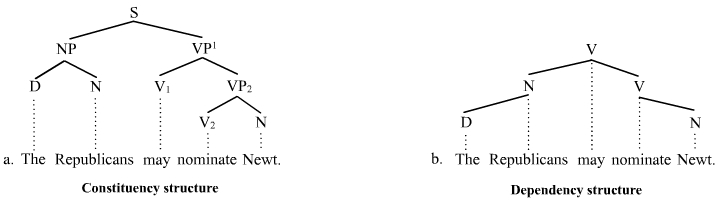
Constituent Relationships and Structural Elements
Relationships between syntactic constituents
- Dominance higher nodes dominate lower nodes represents hierarchical relationships
- Sisterhood nodes share same parent important for understanding phrase structure
- C-command relationship between non-dominating nodes crucial for explaining linguistic phenomena (binding, negative polarity items)
- Immediate constituents elements directly below node in tree
- Projection lexical categories project to phrase level (N → NP, V → VP)
Heads vs complements in syntax
- Heads core element of phrase determine syntactic category (noun in NP, verb in VP)
- Complements complete meaning of head often required by head's subcategorization frame (object in transitive VP)
- Head-initial vs. head-final languages vary order of heads and complements (English vs Japanese)
- Specifiers precede head in phrase often determiners in NPs or subjects in clauses (the in "the book")
- Adjuncts optional modifiers can usually be omitted without affecting grammaticality (quickly in "run quickly")