
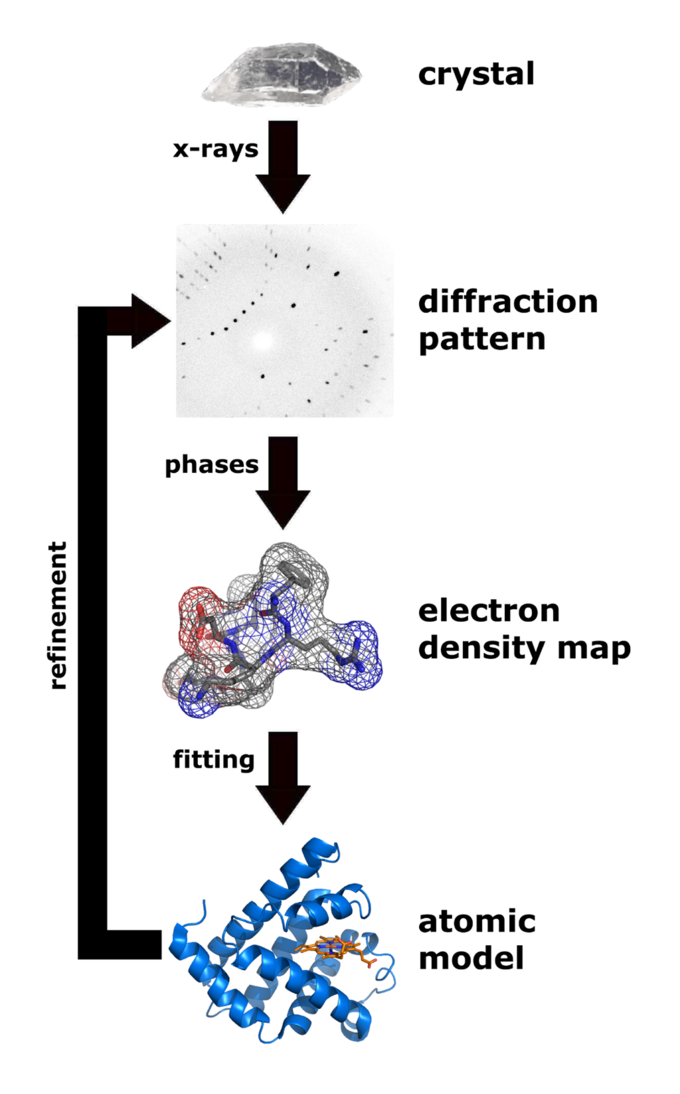
X-ray diffraction (XRD) is a powerful tool for peering into the atomic structure of materials. By bouncing X-rays off crystals, scientists can unlock secrets about their composition and arrangement, using principles like Bragg's Law to interpret the resulting patterns.
XRD isn't just about pretty pictures, though. It's a versatile technique for identifying materials, measuring particle sizes, and even analyzing complex mixtures. When compared to neutron scattering, XRD shines at atomic-scale details, while neutrons excel at larger structures and magnetic properties.
X-ray Diffraction (XRD)
Principles of X-ray diffraction
- X-rays interact with electrons in crystalline materials scatter and interfere
- Bragg's Law describes conditions for constructive interference
- Constructive interference produces diffraction peaks destructive interference results in no signal
- Diffraction pattern unique to crystal structure enables material identification and analysis
Interpretation of diffraction data
- Peak position identification reveals interplanar spacing and lattice parameters
- Peak intensity measurement indicates atomic positions and crystal symmetry
- Peak width analysis provides information on crystallite size and strain
- Crystallinity assessment through peak sharpness and background noise
- Lattice parameter calculation using peak positions and Miller indices
- Miller indices assignment based on peak positions and crystal system
- Crystallite size estimation using Scherrer equation relates peak broadening to particle size
- Phase identification
- Compare experimental patterns with database of known materials
- Rietveld refinement method fits theoretical pattern to experimental data for complex mixtures
XRD vs neutron scattering capabilities
- Length scale comparison
- XRD probes atomic to nanometer scale structures
- Neutron scattering investigates nanometer to micrometer scale features
- Structural information provided
- XRD reveals crystal structure and phase composition
- Neutron scattering uncovers large-scale structures and magnetic ordering
- Sample requirements
- XRD primarily used for crystalline materials
- Neutron scattering applicable to both crystalline and amorphous materials
- Sensitivity to light elements
- XRD has limited sensitivity to elements with low atomic numbers
- Neutron scattering highly sensitive to hydrogen and other light elements
- Magnetic structure analysis
- XRD offers limited capability for magnetic materials
- Neutron scattering excels at analyzing magnetic structures and ordering
Neutron Scattering
Neutron scattering for nanomaterials
- Neutron-nucleus interaction basis for scattering unlike X-rays which interact with electrons
- Coherent scattering provides structural information incoherent scattering reveals dynamics
- Elastic scattering maintains neutron energy inelastic scattering involves energy transfer
- Advantages:
- Deep penetration allows bulk material analysis
- Isotope sensitivity enables contrast variation experiments
- Magnetic moment interaction provides magnetic structure information
- Techniques:
- Small-angle neutron scattering (SANS) probes large-scale structures (1-100 nm)
- Neutron diffraction analyzes crystal structure and magnetic ordering
- Neutron reflectometry investigates thin film and multilayer structures