
Quantum bits, or qubits, are the building blocks of quantum computing. Unlike classical bits, qubits can exist in multiple states at once, thanks to quantum superposition. This unique property allows quantum computers to process information in ways that classical computers can't.
Quantum gates are the tools used to manipulate qubits. These gates perform operations on qubits, creating superpositions and entanglement. By combining these gates, we can build quantum circuits that solve complex problems faster than classical computers ever could.
Quantum Bits and Quantum Gates Fundamentals
Qubits vs classical bits
- Quantum bits (qubits) serve as basic unit of quantum information analogous to classical bits in conventional computing
- Qubits can exist in multiple states simultaneously represented by quantum mechanical systems (electron spin, photon polarization, atomic energy levels)
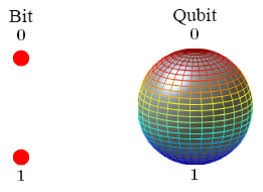
- Classical bits limited to binary states (0 or 1) while qubits operate on continuous spectrum of states visualized as points on Bloch sphere
- Qubit state represented in Dirac notation where and are complex numbers satisfying
- Measurement of classical bits yields deterministic outcome whereas qubit measurement produces probabilistic result collapsing superposition
Concept of quantum superposition
- Quantum superposition fundamental principle allows quantum systems to exist in multiple states simultaneously
- Mathematically represented as linear combination of basis states
- Exhibits coherence maintaining phase relationships and interference where states can enhance or cancel each other
- Enables parallel processing of information leading to exponential increase in computational power
- Illustrated by thought experiments (Schrödinger's cat) and physical phenomena (double-slit experiment)
Basic quantum gates
- Quantum gates perform reversible operations on qubits represented by unitary matrices
- Hadamard gate (H) creates superposition transforming to with matrix
- CNOT (Controlled-NOT) two-qubit gate flips target qubit if control qubit is with matrix
- Pauli gates perform single-qubit rotations: X gate (NOT) , Y gate , Z gate
- Gates manipulate qubit states, create entanglement, and implement quantum algorithms in circuits
Analysis of quantum circuits
- Quantum circuit analysis involves applying gates sequentially from left to right and calculating matrix products for multiple gates
- Analysis steps:
- Identify initial qubit states
- Apply each gate operation
- Compute resulting state vector
- Common circuit elements include initialization (usually state), single-qubit gates, multi-qubit gates, and measurement
- Quantum teleportation circuit demonstrates application of Hadamard, CNOT, and measurement operations
- Quantum state tomography reconstructs quantum states from measurements
- Quantum circuit simulators used for verification but face limitations with increasing qubit numbers