
Memory Types: Short-Term, Long-Term, and Working
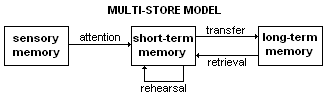
Memory is how your brain processes, stores, and retrieves information. There are three main types you need to know: short-term memory, long-term memory, and working memory. Each handles information differently in terms of how much it can hold, how long it lasts, and what it's used for. Together, these systems explain how you go from hearing something in lecture to (hopefully) remembering it on the exam.
Short-Term Memory (STM)
Short-term memory is a temporary holding area for information you're currently aware of. It lasts about 15–30 seconds without rehearsal, and it has a small capacity: roughly 7 ± 2 items, a finding known as Miller's Law. "Items" here can be individual digits, letters, or larger meaningful units called chunks (more on chunking below).
- Sometimes called primary or active memory
- Information gets encoded mainly as acoustic (sound-based) codes, though visual and semantic codes are also used
- If you don't actively rehearse the information, it decays or gets displaced by new incoming information
- Retrieval is fast and accurate as long as the information hasn't faded yet
A classic example: you look up a phone number and repeat it to yourself while you dial. The moment you stop rehearsing, it's gone.
Long-Term Memory (LTM)
Long-term memory is your brain's relatively permanent storage system. Its capacity is considered virtually unlimited, and memories can last anywhere from minutes to an entire lifetime.
Getting information into LTM requires deeper processing than STM. Instead of just repeating something, you encode it through meaningful associations, categorization, and imagery. The richer the encoding, the stronger the memory trace.
LTM is divided into several subtypes:
- Episodic memory: personal experiences and events (your 10th birthday party, what you ate for breakfast)
- Semantic memory: general knowledge and facts (knowing that Paris is the capital of France)
- Procedural memory: motor skills and learned procedures (riding a bike, typing on a keyboard)
Retrieval from LTM can be explicit (conscious, deliberate recall) or implicit (unconscious influence on your behavior). Retrieval is affected by cues, context, and interference from competing memories.
Working Memory
Working memory is not just a passive storage bin. It's an active processing system that holds and manipulates information during complex cognitive tasks like reasoning, reading comprehension, and problem-solving.
A key distinction: short-term memory simply holds information, while working memory works with it. Working memory draws on both STM and LTM, pulling in stored knowledge as needed.
- Capacity is more limited than STM, around 4 ± 1 items
- Duration is brief, usually up to a few minutes, and depends on active maintenance
- Information is constantly updated and manipulated to meet the demands of whatever task you're doing
Think of mentally solving without paper. You have to hold the numbers, perform the operation, and track partial results all at once. That's working memory in action.
The most widely cited model of working memory is Baddeley's model, which includes the phonological loop (verbal/acoustic info), the visuospatial sketchpad (visual/spatial info), the central executive (attention and coordination), and the episodic buffer (integrating information across systems). If your course covers this model, know the role of each component.
Memory Capacity and Duration
| Feature | Short-Term Memory | Working Memory | Long-Term Memory |
|---|---|---|---|
| Capacity | ~7 ± 2 items | ~4 ± 1 items | Virtually unlimited |
| Duration | 15–30 seconds (without rehearsal) | Up to a few minutes (with active processing) | Minutes to a lifetime |
| Example | Remembering a phone number while dialing | Mentally solving a math problem | Recalling childhood events years later |
Notice that working memory holds fewer items than STM. That's because working memory is doing more with each item. You're not just storing information; you're transforming it.
Attention's Role in Memory Formation
Attention is the gatekeeper of memory. Without it, information rarely makes it past sensory processing into any memory store.
Attention in Encoding
Your brain is constantly bombarded with sensory input. Attention selects what gets processed and filters out the rest. This is why divided attention during encoding leads to weaker memories. Studies on multitasking consistently show that trying to encode new information while doing something else (texting during lecture, for instance) produces significantly worse recall later.
- Focused attention on key information strengthens encoding
- Filtering out irrelevant stimuli (like background noise while studying) frees up processing resources
Attention in Maintenance and Retrieval
Once information is encoded, attention continues to play a role:
- Maintenance rehearsal: repeating information to keep it active in STM (saying a phone number over and over). This keeps information alive but doesn't necessarily transfer it to LTM.
- Elaborative rehearsal: connecting new information to existing knowledge, which promotes transfer to LTM. Creating a mnemonic device is a good example.
- During retrieval, attention guides your search through LTM and helps you select the right memory from among competing options. Focusing on specific contextual details (where you were, what you were doing) can serve as effective retrieval cues.
Encoding, Storage, and Retrieval
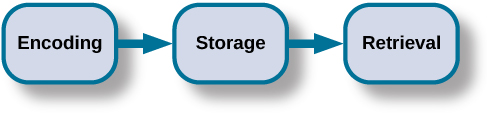
These three processes apply to every memory type, but they work differently in each.
In Short-Term Memory
- Encoding: Sensory information is converted into a usable code, primarily acoustic but also visual or semantic
- Storage: Information is held briefly through active rehearsal; without it, the memory decays within seconds
- Retrieval: Fast and straightforward, as long as the information hasn't decayed or been displaced by newer items
In Long-Term Memory
- Encoding: Information is processed deeply through elaboration, organization, meaningful associations, and imagery. The more connections you build, the better the encoding.
- Storage: Memories are stored in a relatively permanent form across different subtypes (episodic, semantic, procedural)
- Retrieval: Can be explicit (consciously recalling a past vacation) or implicit (your fingers "knowing" where the keys are on a keyboard). Retrieval success depends heavily on the availability of cues and the context in which the memory was formed.
In Working Memory
- Encoding: Information is actively pulled from both sensory input and LTM, then combined and manipulated
- Storage: Temporary and dynamic; maintained through rehearsal, chunking, and continuous updating
- Retrieval: Rapid and flexible. Information is constantly refreshed and reorganized to meet the demands of the current task.
For example, when you read a complex sentence, working memory holds the beginning of the sentence while you process the end, pulls word meanings from LTM, and integrates everything into a coherent understanding. All of that happens in real time.