7.2 Aggregate Supply (AS) Curve

🥨Intermediate Macroeconomic Theory Unit 7 Review
7.2 Aggregate Supply (AS) Curve
🥨 Intermediate Macroeconomic Theory
Short-run vs Long-run Aggregate Supply

Top images from around the web for Short-run Aggregate Supply (SRAS) Curve
File:Aggregate Demand-Aggregate Supply.jpg - Wikimedia Commons View original
Is this image relevant?
The Aggregate Market – Introduction to Macroeconomics View original
Is this image relevant?
The Aggregate Market – Introduction to Macroeconomics View original
Is this image relevant?
File:Aggregate Demand-Aggregate Supply.jpg - Wikimedia Commons View original
Is this image relevant?
The Aggregate Market – Introduction to Macroeconomics View original
Is this image relevant?
Short-run Aggregate Supply (SRAS) Curve
The SRAS curve shows the relationship between the price level and the quantity of real GDP supplied in the short run, holding other factors constant. It slopes upward because of sticky wages and prices.
Why does this upward slope exist? When the price level rises, firms sell output at higher prices while their input costs (locked-in wages, existing contracts for rent and materials) stay relatively fixed. That gap means higher profits, which gives firms an incentive to produce more. On the flip side, when the price level falls, workers resist nominal wage cuts. Union contracts, minimum wage laws, and simple human psychology all make wages slow to adjust downward. This stickiness is what makes the short run different from the long run.
Long-run Aggregate Supply (LRAS) Curve
The LRAS curve is a vertical line at the economy's potential GDP (also called full-employment output). Its verticality reflects a core idea: in the long run, all wages and prices fully adjust, so the price level has no effect on real output.
What determines where that vertical line sits? Factors that are independent of the price level:
- Technology and productivity (better production methods, automation)
- Capital stock (the total quantity of machinery, factories, and equipment)
- Size and quality of the labor force (population growth, immigration, education levels)
Because these factors don't respond to price level changes, the economy always gravitates back to potential GDP in the long run, regardless of whether prices are high or low.
Factors Influencing AS Curve Shape
Elasticity of the SRAS Curve
The slope of the SRAS curve isn't constant. It depends on how much spare capacity the economy has.
When spare capacity is low (economy near or at potential GDP):
- The SRAS curve is steeper (less elastic). Firms struggle to increase output because factory space is limited and skilled workers are scarce.
- Firms competing for scarce resources bid up input costs (wages rise, raw material prices climb), so higher price levels translate mostly into higher costs rather than more output.
When spare capacity is high (economy well below potential GDP):
- The SRAS curve is flatter (more elastic). Firms can ramp up production easily by putting idle machinery back to work and hiring from a large pool of unemployed workers.
- Input costs stay relatively stable because resources are abundant, so higher price levels translate mostly into more output rather than higher costs.

Why the LRAS Curve Is Vertical
The vertical LRAS reflects the fact that long-run output depends only on the economy's productive capacity. Over time, that capacity grows through:
- Productivity improvements: automation, better production techniques, and innovation let firms produce more with the same inputs
- Capital accumulation: investment in new factories, equipment, and infrastructure raises output capacity
- Labor force growth: population increases, immigration, and rising labor force participation expand the number of available workers; education and training improve their productivity
None of these factors depend on the price level, which is why the LRAS doesn't slope in either direction.
Determinants of AS Curve Shifts
Input Price Changes
Changes in input prices shift the SRAS curve (not the LRAS, since these are typically short-run cost changes).
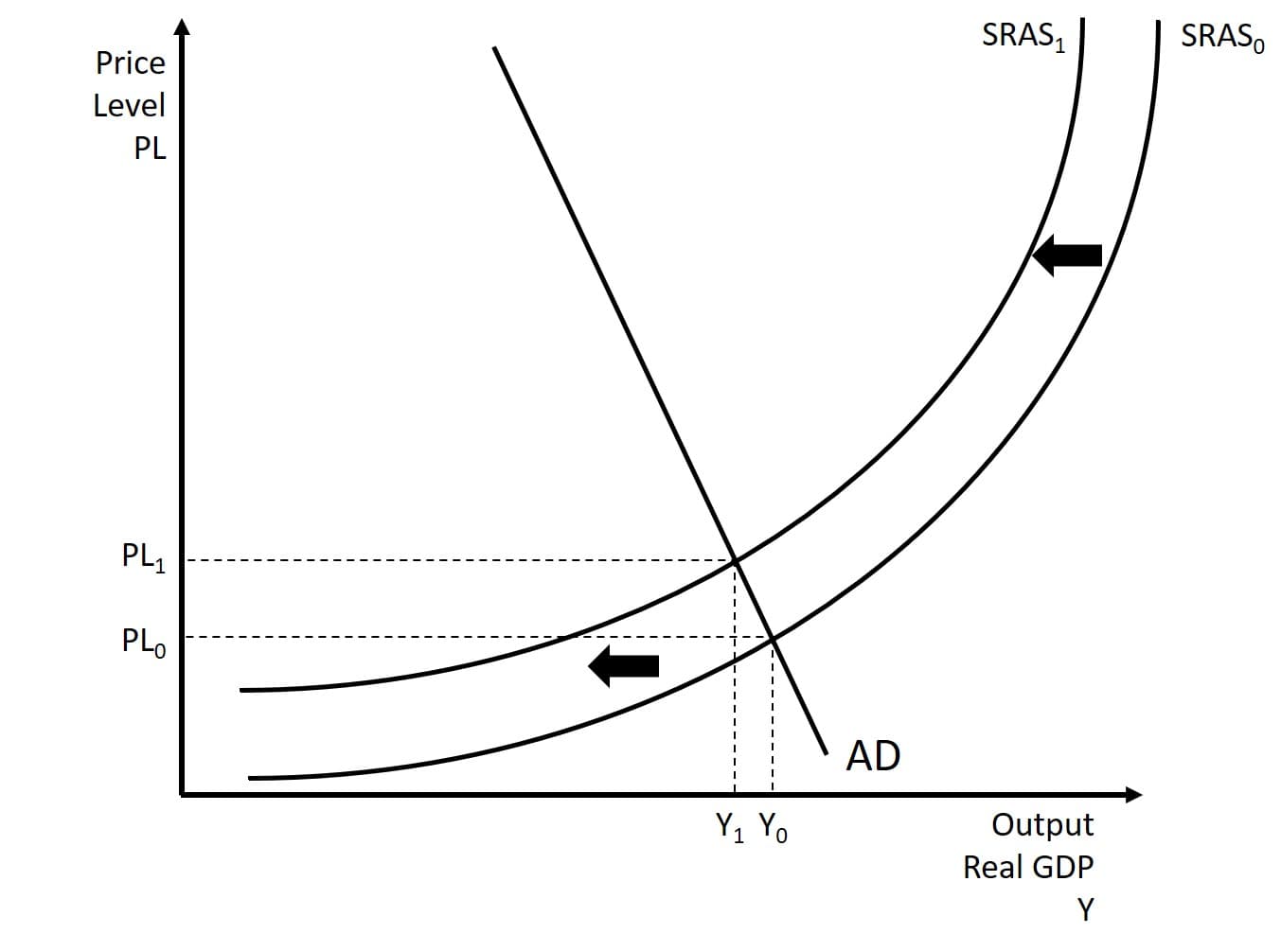
- Rising input prices → SRAS shifts left (AS decreases). Higher wages from minimum wage hikes or collective bargaining raise labor costs. Oil price shocks or tariffs on imported materials squeeze profit margins. Firms cut back production at every price level.
- Falling input prices → SRAS shifts right (AS increases). Lower wages from increased labor market competition reduce costs. Cheaper raw materials from new extraction technologies or government subsidies on key inputs improve margins, encouraging firms to expand output.
Productivity and Technology Changes
Productivity gains are unique because they shift both curves to the right. When firms can produce more output with the same inputs, unit costs fall (shifting SRAS right) and the economy's productive capacity expands (shifting LRAS right). Think of the introduction of computers and the internet: these raised output per worker across the economy, allowing more production without generating inflationary pressure.

Labor Force Changes
Changes in the labor force primarily shift the LRAS curve because they alter the economy's long-run productive capacity.
- Population growth and immigration expand the pool of available workers, enabling higher total output
- Improvements in education and skills training raise worker productivity, effectively increasing what the existing labor force can produce
Both shift the LRAS to the right, moving potential GDP to a higher level.
Government Policies
Government policy can shift AS in either direction, depending on whether it raises or lowers production costs.
Policies that shift SRAS left (higher costs):
- Environmental regulations like emissions standards raise compliance costs
- Occupational safety mandates and required employee benefits add to firms' per-unit costs
Policies that shift SRAS right (lower costs):
- Subsidies for specific industries (agricultural subsidies, R&D grants) reduce input costs
- Tax incentives like accelerated depreciation or payroll tax cuts lower the cost of capital and labor, encouraging more production
Impact of AS Changes on Equilibrium
Short-run Equilibrium Effects
To trace the effect of an AS shift, think about what happens at the intersection of AD and SRAS.
- SRAS shifts right (e.g., falling oil prices, a productivity breakthrough): the new equilibrium has a lower price level and higher real GDP. This helps close recessionary gaps and reduces unemployment.
- SRAS shifts left (e.g., an oil price shock, a natural disaster destroying productive capacity): the new equilibrium has a higher price level and lower real GDP. This combination of rising prices and falling output is called stagflation, and it's one of the hardest situations for policymakers to address.
Long-run Equilibrium Effects
A rightward shift in LRAS (from technological progress or labor force growth) increases potential GDP. Because this expands the economy's capacity, real GDP rises without putting upward pressure on prices. This is the foundation of sustainable long-run economic growth: higher living standards with price stability.
Interaction with Economic Conditions
The impact of an AS shift depends on where the economy starts:
- Below potential GDP (recessionary gap): an increase in AS helps close the gap and move toward full employment
- At or above potential GDP: an increase in AS relieves inflationary pressure by expanding capacity to meet demand
AS shifts also interact with shifts in aggregate demand:
- A rightward AS shift can offset the inflationary impact of rising AD (e.g., productivity growth absorbing demand-driven price pressure)
- A leftward AS shift can amplify the recessionary effects of falling AD (e.g., an oil shock hitting at the same time as a demand contraction)
Understanding this interaction is central to policy analysis. Fiscal stimulus and accommodative monetary policy work on the AD side, but supply-side reforms (deregulation, investment incentives, education spending) work on the AS side. The most effective policy response depends on which curve is shifting and in which direction.
See Fiveable more often in Google
Mark Fiveable as a preferred source and Google is more likely to show you our guides in Top Stories, with a "preferred" badge in AI Mode and AI Overviews.