14.3 Quantum game theory

🎱Game Theory Unit 14 Review
14.3 Quantum game theory
🎱 Game Theory
Quantum mechanics in game theory
Quantum game theory extends classical game theory by incorporating principles from quantum mechanics. Instead of players choosing from a fixed set of classical strategies, they manipulate qubits and exploit phenomena like superposition and entanglement to access strategies that have no classical counterpart. The result is new types of equilibria and, in some cases, resolutions to dilemmas that are inescapable in classical settings.

Top images from around the web for Fundamental principles
Interference as an information-theoretic game – Quantum View original
Is this image relevant?
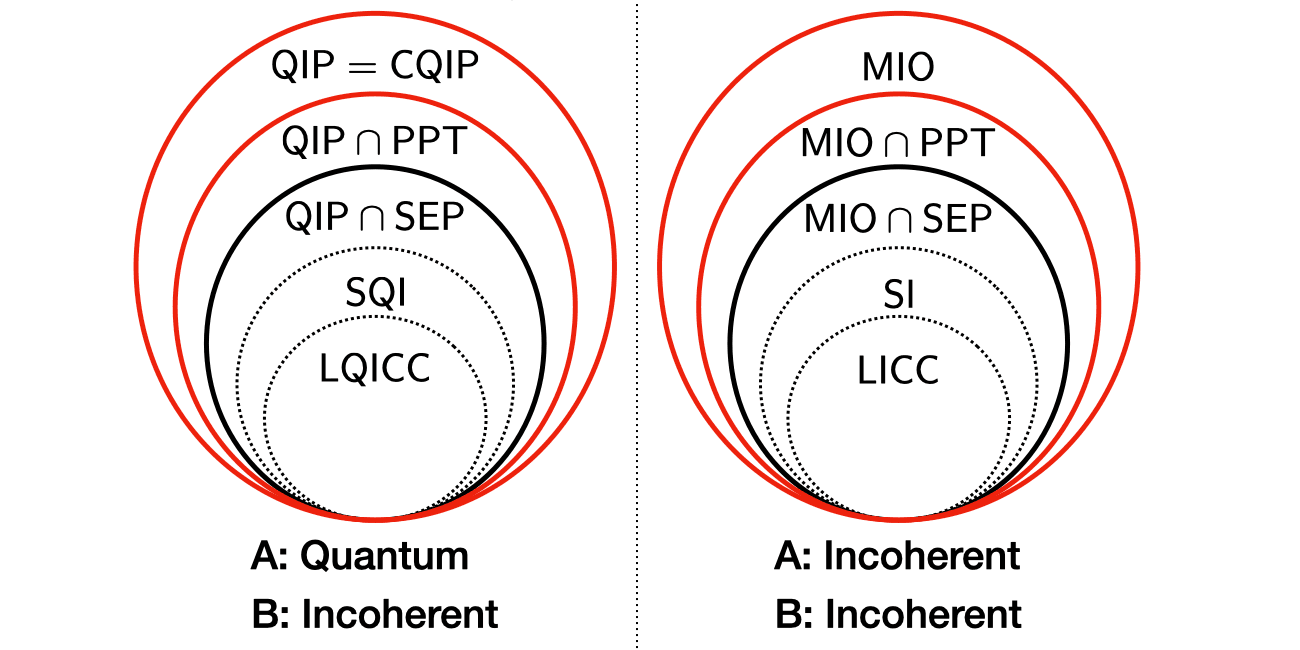
Hierarchy of quantum operations in manipulating coherence and entanglement – Quantum View original
Is this image relevant?
Interference as an information-theoretic game – Quantum View original
Is this image relevant?
Hierarchy of quantum operations in manipulating coherence and entanglement – Quantum View original
Is this image relevant?
Fundamental principles
Three quantum-mechanical ideas matter most here:
- Superposition allows a quantum system to exist in a combination of multiple states at once, rather than being locked into a single definite state. In game-theoretic terms, a player's strategy can be a superposition of classical choices, only "collapsing" to a definite action when measured.
- Entanglement is a correlation between quantum particles so strong that the state of one particle cannot be described independently of the others, regardless of the distance between them. In quantum games, entanglement acts as a shared resource that lets players coordinate in ways impossible through any classical communication or correlation device.
- Measurement causes a quantum system's wavefunction to collapse into one definite outcome. In a quantum game, measurement of the final quantum state determines each player's payoff.
Mathematical tools
- Pauli matrices (, , ) represent single-qubit quantum gates and are the building blocks for describing how players transform their qubits.
- The density matrix () describes the statistical state of a quantum system, which is especially useful when a system is in a mixed state (a probabilistic combination of pure states) rather than a single pure superposition.
- Hilbert space provides the mathematical framework for the state space. Each player's set of quantum operations lives in its own Hilbert space, and the tensor product of these individual spaces constructs the joint strategy space for a multi-player quantum game.
Quantum game formulation
Setting up a quantum game
A quantum game typically follows a structure introduced by Eisert, Wilkens, and Lewenstein (1999):
- Initialize the game state. Each player receives a qubit, initially set to . An entangling operator (often denoted ) is applied to the joint state, creating entanglement between the players' qubits.
- Players choose quantum strategies. Each player applies a unitary operator (a quantum gate) to their own qubit. Because unitary operators form a continuous set, the strategy space is far richer than the finite set of classical choices.
- Disentangle and measure. A disentangling operator is applied, and then the final quantum state is measured. The measurement outcome determines the payoffs according to a predefined payoff function.
Key quantum gates used in this process:
- The Hadamard gate () puts a qubit into an equal superposition of and .
- The controlled-NOT gate (CNOT) entangles two qubits by flipping the second qubit's state conditional on the first.
Quantum strategies and equilibria
Because the strategy space in a quantum game is continuous and players can exploit entanglement, entirely new equilibria emerge:
- Non-classical Nash equilibria can exist that have no analogue in the classical version of the same game.
- Entanglement creates correlations between players' strategies that go beyond anything achievable with classical shared randomness (correlated equilibria in the classical sense).
- These quantum equilibria can be Pareto-superior to classical ones, meaning all players can be made better off simultaneously.
Classical vs. Quantum Game Theory

Differences in equilibria and outcomes
| Feature | Classical Game Theory | Quantum Game Theory |
|---|---|---|
| Strategy space | Finite (or mixed over finite set) | Continuous unitary operators on qubits |
| Correlation device | Shared randomness (correlated equilibrium) | Entanglement (stronger-than-classical correlations) |
| Equilibrium types | Nash, correlated, subgame-perfect, etc. | All classical types plus non-classical quantum equilibria |
| Achievable outcomes | Bounded by classical strategy sets | Can reach outcomes outside the classical feasible set |
Resolution of classical dilemmas
Quantum strategies can break out of traps that are unavoidable in classical games:
- Prisoner's Dilemma: In the classical version, mutual defection is the unique Nash equilibrium despite mutual cooperation being Pareto-optimal. In the Eisert-Wilkens-Lewenstein quantum version, when players share a maximally entangled state, a quantum strategy exists where mutual cooperation becomes a Nash equilibrium. Neither player can improve their payoff by deviating unilaterally.
- Newcomb's Paradox: This decision problem involves choosing between one box or two, where a predictor has already filled the boxes based on a forecast of your choice. Quantum formulations allow strategies that sidestep the classical conflict between dominance reasoning and expected-utility maximization.
- Braess's Paradox: In classical networks, adding extra capacity can paradoxically reduce overall performance. Quantum game-theoretic models of network routing can, under certain entanglement conditions, eliminate this paradox by aligning individual incentives with system-wide efficiency.
Applications of Quantum Game Theory
Quantum cryptography and security
Quantum game theory provides a natural framework for analyzing quantum key distribution (QKD) protocols. The interaction between a sender, receiver, and potential eavesdropper can be modeled as a quantum game, where security guarantees follow from the equilibrium analysis. Quantum auction design is another application: auction mechanisms built on quantum principles can enforce fairness and make collusion between bidders detectable.
Quantum networks and communication
Optimizing quantum networks involves strategic decisions at each node about routing, resource allocation, and error correction. Quantum game theory helps model conflicts between nodes and find equilibrium strategies that maximize network throughput. It also applies to the analysis of quantum repeaters, devices essential for long-distance quantum communication, where the placement and operation of repeaters can be framed as a cooperative or competitive game.
Quantum machine learning and algorithms
Quantum game-theoretic ideas have been applied to algorithm design in quantum machine learning. For instance, quantum classifiers can use entanglement between feature qubits to capture correlations that classical classifiers miss, potentially improving classification accuracy on certain tasks. More broadly, adversarial frameworks in machine learning (like GANs) have quantum analogues where the competition between generator and discriminator is modeled as a quantum game.
Quantum social choice theory
Voting systems and collective decision-making can also be analyzed through a quantum lens. Quantum voting protocols allow voters to submit superpositions of votes, and the aggregation process respects quantum mechanical constraints. Quantum game theory helps analyze whether such protocols are resistant to strategic manipulation and whether quantum effects can circumvent classical impossibility results (like the Gibbard-Satterthwaite theorem) under certain conditions.
See Fiveable more often in Google
Mark Fiveable as a preferred source and Google is more likely to show you our guides in Top Stories, with a "preferred" badge in AI Mode and AI Overviews.