11.2 Replicator dynamics and population games

🎱Game Theory Unit 11 Review
11.2 Replicator dynamics and population games
🎱 Game Theory
Replicator Dynamics and Population Games
Replicator dynamics provides the core mathematical machinery for tracking how strategies rise and fall in a population over time. Rather than asking "what should a rational player do?", it asks "which strategies will grow when individuals are randomly matched and rewarded according to a payoff matrix?" This connects evolutionary game theory to concrete, testable predictions about population-level behavior.

Top images from around the web for Understanding Replicator Dynamics
Nash equilibrium - Simulace.info View original
Is this image relevant?

Genome-driven evolutionary game theory helps understand the rise of metabolic interdependencies ... View original
Is this image relevant?
Nash equilibrium - Simulace.info View original
Is this image relevant?
Genome-driven evolutionary game theory helps understand the rise of metabolic interdependencies ... View original
Is this image relevant?
Replicator Dynamics in Game Theory
Understanding Replicator Dynamics
Replicator dynamics models a large population where individuals each play a fixed strategy. They're randomly paired, they interact, and they receive payoffs determined by the game's payoff matrix. Strategies that earn higher-than-average payoffs grow in frequency; strategies that earn below average shrink.
The key intuition: a strategy doesn't need to be "good" in absolute terms. It just needs to outperform the current population average. This means a strategy's success depends on what everyone else is doing, which is why the dynamics can be rich and surprising.
- Fitness of a strategy is its expected payoff given the current mix of strategies in the population
- Average fitness is the population-wide weighted average of all strategies' fitnesses
- A strategy's share of the population grows when its fitness exceeds the average, and shrinks when it falls below
Applications of Replicator Dynamics
In biology, replicator dynamics models the evolution of behavioral traits (aggression vs. cooperation, foraging strategies) and tracks how gene frequencies shift under selection pressure.
In economics, the same framework applies to market competition: which business strategies or technologies gain market share over time? Strategies here aren't consciously "chosen" by evolution; they spread because they yield higher payoffs.
In the social sciences, replicator dynamics helps explain the spread of social norms, opinion dynamics, and why certain conventions become dominant while others disappear.
Modeling Population Strategy Evolution
The Replicator Equation
The replicator equation is the central equation of this topic. For a population with strategies, the change in frequency of strategy over time is:
where:
- is the current frequency (proportion) of strategy in the population
- is the fitness of strategy , calculated as , where are entries of the payoff matrix
- is the average fitness across the whole population
Notice the structure: the growth rate is proportional to itself (a strategy that's nearly extinct changes slowly) and to the fitness gap . This multiplicative form is what makes it "replicator" dynamics: strategies replicate in proportion to their current prevalence and their relative success.
Reading the equation step by step:
- Compute each strategy's fitness using the payoff matrix and current population mix
- Compute the average fitness as the weighted sum of all fitnesses
- For each strategy, multiply its current frequency by its fitness advantage (or disadvantage)
- That product gives you the rate at which that strategy's share is increasing or decreasing
Extensions and Techniques
The basic replicator equation assumes infinite population size, no mutation, and well-mixed interactions. Each of these assumptions can be relaxed:
- Mutation: Add a term that allows strategies to "mutate" into other strategies at some small rate. This prevents any strategy from going fully extinct and can change which equilibria are reachable.
- Population structure: Instead of one well-mixed population, model subpopulations on a network or spatial grid, with migration between them.
- Stochastic effects: For finite populations, random drift matters. Stochastic differential equations or agent-based simulations capture this noise.
For solving the equations, you can use numerical simulation (discretize time, update frequencies iteratively using Euler's method or similar) or analytical techniques like linearization around fixed points to determine stability without simulating the full trajectory.
Stability and Convergence of Population Games
Evolutionarily Stable Strategies (ESS)
An evolutionarily stable strategy (ESS) is a strategy that, once established in a population, cannot be invaded by any small group of mutants playing a different strategy.
Formally, a strategy is an ESS if, for every alternative strategy , at least one of these conditions holds:
- Strict best reply against itself:
- Better against the invader (when tied against itself): and
Condition 1 is the standard case: the incumbent does strictly better against itself than any mutant does. Condition 2 handles the trickier situation where a mutant does equally well against the incumbent but loses in head-to-head matchups with itself.
A classic example is the Hawk-Dove game. Pure Hawk and pure Dove are not ESS on their own, but a specific mixed strategy (play Hawk with probability , where is the resource value and is the cost of fighting) is evolutionarily stable.
Nash Equilibria and Stability
Every ESS is a Nash equilibrium, but not every Nash equilibrium is an ESS. The relationship works like this:
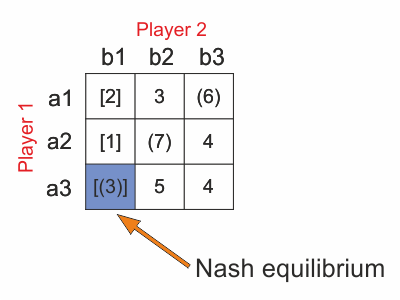
- A Nash equilibrium is a fixed point of the replicator dynamics: if the population sits at that strategy mix, frequencies don't change ( for all ).
- But a fixed point can be unstable. A small perturbation could push the population away from it, never to return. An ESS, by contrast, is a stable fixed point that the population returns to after small perturbations.
To determine stability, you linearize the replicator equation around the fixed point and examine the Jacobian matrix. If all eigenvalues of the Jacobian have negative real parts, the fixed point is asymptotically stable (an attractor). If any eigenvalue has a positive real part, the fixed point is unstable (a repeller).
Convergence Properties
What the population converges to depends on both the game structure and where the population starts:
- Single stable equilibrium: In many coordination games, the population converges to one dominant strategy. Which one depends on initial conditions and the basins of attraction.
- Stable mixed equilibrium: Some games (like Hawk-Dove) have an interior fixed point where multiple strategies coexist at stable frequencies.
- Cyclic behavior: In Rock-Paper-Scissors, no pure or mixed strategy is asymptotically stable. Strategy frequencies cycle endlessly, with each strategy periodically rising and falling.
- Multiple basins of attraction: When several stable fixed points exist, the initial population composition determines which equilibrium the system reaches. The boundary between basins can be sharp.
The speed of convergence also varies. Large fitness differences between strategies drive fast convergence; small differences mean the population drifts slowly toward equilibrium.
Replicator Dynamics Outcomes
Interpreting Evolutionary Outcomes
Stable fixed points of the replicator dynamics tell you the long-run composition of the population. These are the strategy mixes that persist because no alternative can gain a foothold.
When multiple stable equilibria exist, history matters. Two populations playing the same game but starting from different initial mixes can end up at completely different outcomes. This is why basins of attraction are important to map out: they tell you which initial conditions lead where.
Emergence of Cooperative Behavior
One of the most studied questions in evolutionary game theory is how cooperation survives when defection pays off in any single interaction (as in the Prisoner's Dilemma). Replicator dynamics shows that cooperation can emerge and persist through several mechanisms:
- Reciprocity: In repeated interactions, strategies like Tit-for-Tat (cooperate first, then copy your opponent's last move) can invade populations of defectors once they reach a critical mass. The key is that future interactions make retaliation possible.
- Spatial structure: When individuals interact mainly with neighbors (on a lattice or network), cooperators can form clusters that shield each other from exploitation by defectors.
- Group selection: If competition occurs between groups as well as within them, groups with more cooperators can outcompete groups dominated by defectors, even though defectors have an advantage within any single group.
Each mechanism changes the effective payoff structure, allowing cooperation to become an ESS under conditions where it otherwise wouldn't be.
Model Assumptions and Limitations
The standard replicator dynamics rests on several simplifying assumptions you should keep in mind:
- Infinite population: No random drift. In real (finite) populations, a strategy can go extinct by chance even if it has above-average fitness.
- Deterministic dynamics: The trajectory is fully determined by initial conditions. Adding noise or mutation can qualitatively change outcomes, sometimes stabilizing strategies that would otherwise be unstable.
- Well-mixed population: Every individual is equally likely to interact with every other. Spatial or network structure can dramatically alter which strategies thrive.
- Timescale separation: The model assumes evolution is slow relative to individual interactions. If strategies change on a similar timescale to interactions, the dynamics become more complex.
These limitations don't make the model useless. They make it a starting point. Comparing replicator dynamics predictions with experimental data (from biology, behavioral economics, or computational simulations) helps identify where the basic model works and where extensions are needed.
See Fiveable more often in Google
Mark Fiveable as a preferred source and Google is more likely to show you our guides in Top Stories, with a "preferred" badge in AI Mode and AI Overviews.