6.1 Genetic drift and the founder effect

🙈Evolutionary Biology Unit 6 Review
6.1 Genetic drift and the founder effect
🙈 Evolutionary Biology
Population Genetics Mechanisms

Top images from around the web for Genetic drift and allele frequencies
Population Genetics | Boundless Biology View original
Is this image relevant?
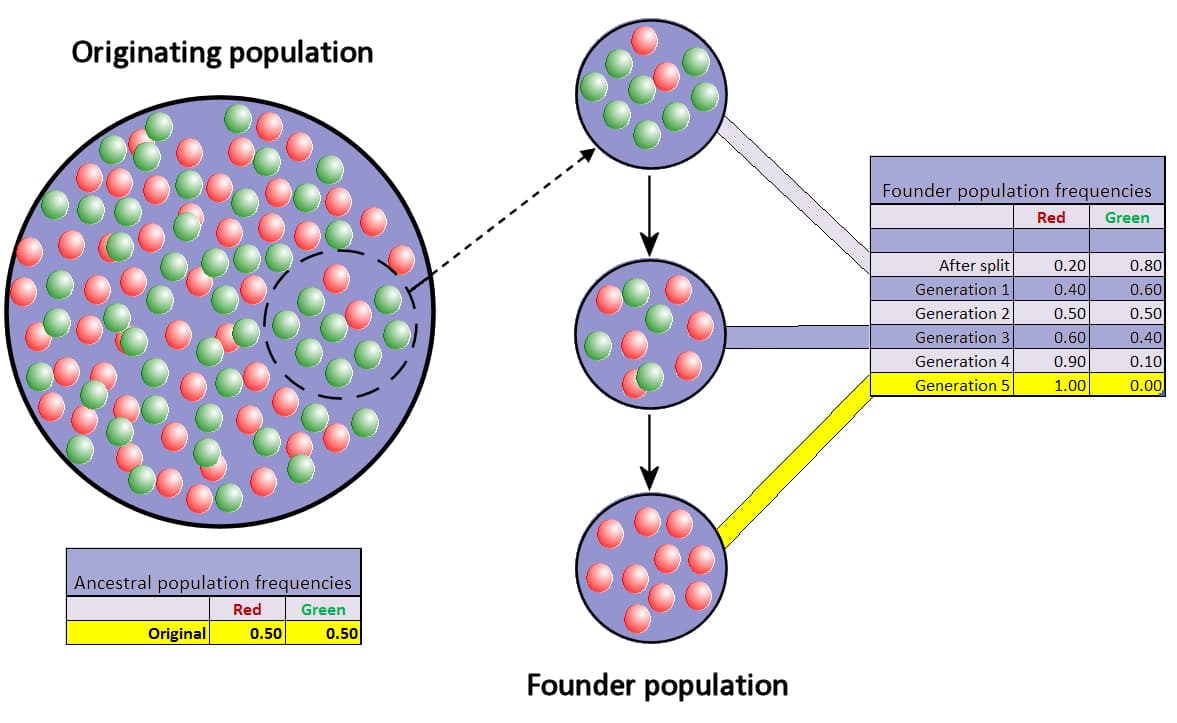
File:Founder effect with drift.jpg - Wikipedia View original
Is this image relevant?
Structure of populations, genetic drift, importance for evolution - WikiLectures View original
Is this image relevant?
Population Genetics | Boundless Biology View original
Is this image relevant?
File:Founder effect with drift.jpg - Wikipedia View original
Is this image relevant?
Genetic drift and allele frequencies
Genetic drift refers to random changes in allele frequencies from one generation to the next, caused purely by chance rather than by any selective advantage. It affects all populations, but its impact is far more pronounced in small ones.
Two main chance processes drive drift:
- Sampling error in reproduction — Not every individual reproduces, and even those that do pass on a random half of their alleles. In a small population, this random sampling can shift allele frequencies substantially in a single generation.
- Random survival — Which individuals survive to reproduce isn't always determined by their genotype. Accidents, storms, or other chance events can eliminate alleles regardless of their fitness value.
Over time, genetic drift tends to fix alleles (push them to 100% frequency) or lose them entirely (0% frequency). This reduces genetic diversity within a population while increasing genetic differences between populations that started out similar.
The strength of drift is captured mathematically by the variance in allele frequency change per generation:
where is the current allele frequency and is the effective population size. Notice that as gets smaller, the variance gets larger, meaning allele frequencies bounce around more dramatically each generation.

Founder effect in new populations
The founder effect is a special case of genetic drift that occurs when a small group of individuals breaks off from a larger population and establishes a new one. Think of a handful of birds blown to a remote island by a storm, or a small group of humans migrating to settle a new region.
Because the founders are a tiny, random sample of the original population, they almost certainly carry allele frequencies that differ from the source. Some alleles may be overrepresented, others may be missing entirely. The new population then grows from this skewed genetic starting point.
Consequences of the founder effect include:
- Reduced genetic diversity compared to the source population
- Elevated frequency of otherwise rare alleles, which can increase the prevalence of genetic disorders. For example, the Old Order Amish in Lancaster County, Pennsylvania, have unusually high rates of Ellis-van Creveld syndrome because the founding families happened to carry the recessive allele.
- Rapid genetic divergence from the original population, which can contribute to speciation over time
Another classic example is the Pitcairn Islanders, descended from a tiny group of HMS Bounty mutineers and their Tahitian companions. Their gene pool reflects the very small number of founders rather than the broader British or Polynesian populations they came from.

Population size and genetic drift
The relationship between population size and drift intensity is inverse: the smaller the population, the stronger the effect of drift.
The key variable here is effective population size (), which is almost always smaller than the actual census size (). Several factors reduce :
- Unequal sex ratios — If only a few males mate (as in elephant seal harems), the effective size drops well below the total count.
- Variation in reproductive success — When some individuals produce many offspring and others produce none, shrinks.
- Fluctuating population size — is disproportionately influenced by generations when the population was smallest.
In small populations, alleles reach fixation or loss much faster. A population bottleneck is a dramatic, temporary reduction in population size that amplifies drift. Northern elephant seals were hunted down to roughly 20–30 individuals in the 1890s. Even though the population has since recovered to over 100,000, genetic diversity remains extremely low because the entire species passed through that narrow genetic window.
Genetic drift vs. natural selection
These two forces both change allele frequencies, but they work in fundamentally different ways.
| Feature | Genetic Drift | Natural Selection |
|---|---|---|
| Direction | Random, non-directional | Directional, favoring alleles that increase fitness |
| Predictability | Unpredictable outcomes | Generally predictable based on fitness differences |
| Effect of population size | Strongest in small populations | Effective in populations of any size |
| Effect on genetic variation | Reduces variation within populations | Can reduce (directional, stabilizing) or maintain variation (balancing, disruptive) |
| Relationship to adaptation | Changes are unrelated to environmental fit | Promotes adaptation to environmental conditions |
In large populations, natural selection usually dominates because fitness differences reliably steer allele frequencies. In small populations, drift can overpower selection, causing even beneficial alleles to be lost or harmful alleles to become fixed purely by chance.
A useful rule of thumb: when the selection coefficient is much smaller than , drift dominates. When is much larger than , selection dominates. This means that in a population of , an allele needs a fairly strong selective advantage to resist being swept around by drift.
A real-world example of selection winning out: antibiotic resistance in bacteria spreads rapidly through large bacterial populations because the selective advantage is enormous. But in a tiny, isolated bacterial colony, even a resistance allele could be lost to drift before it spreads.
See Fiveable more often in Google
Mark Fiveable as a preferred source and Google is more likely to show you our guides in Top Stories, with a "preferred" badge in AI Mode and AI Overviews.