11.3 Extinction events and their evolutionary impact

🙈Evolutionary Biology Unit 11 Review
11.3 Extinction events and their evolutionary impact
🙈 Evolutionary Biology
Earth's history is marked by five major extinction events that drastically reduced global biodiversity. These "Big Five" extinctions wiped out various species groups, from marine invertebrates to dinosaurs, reshaping ecosystems and altering dominant taxonomic groups.
Mass extinctions were caused by various factors, including asteroid impacts, volcanic eruptions, and climate change. These events had significant evolutionary consequences, favoring organisms with specific traits and leading to adaptive radiations in vacant niches, ultimately shaping modern biodiversity patterns.
Major Extinction Events and Their Causes

Top images from around the web for Major extinction events in Earth's history
Earth's five mass extinction events View original
Is this image relevant?
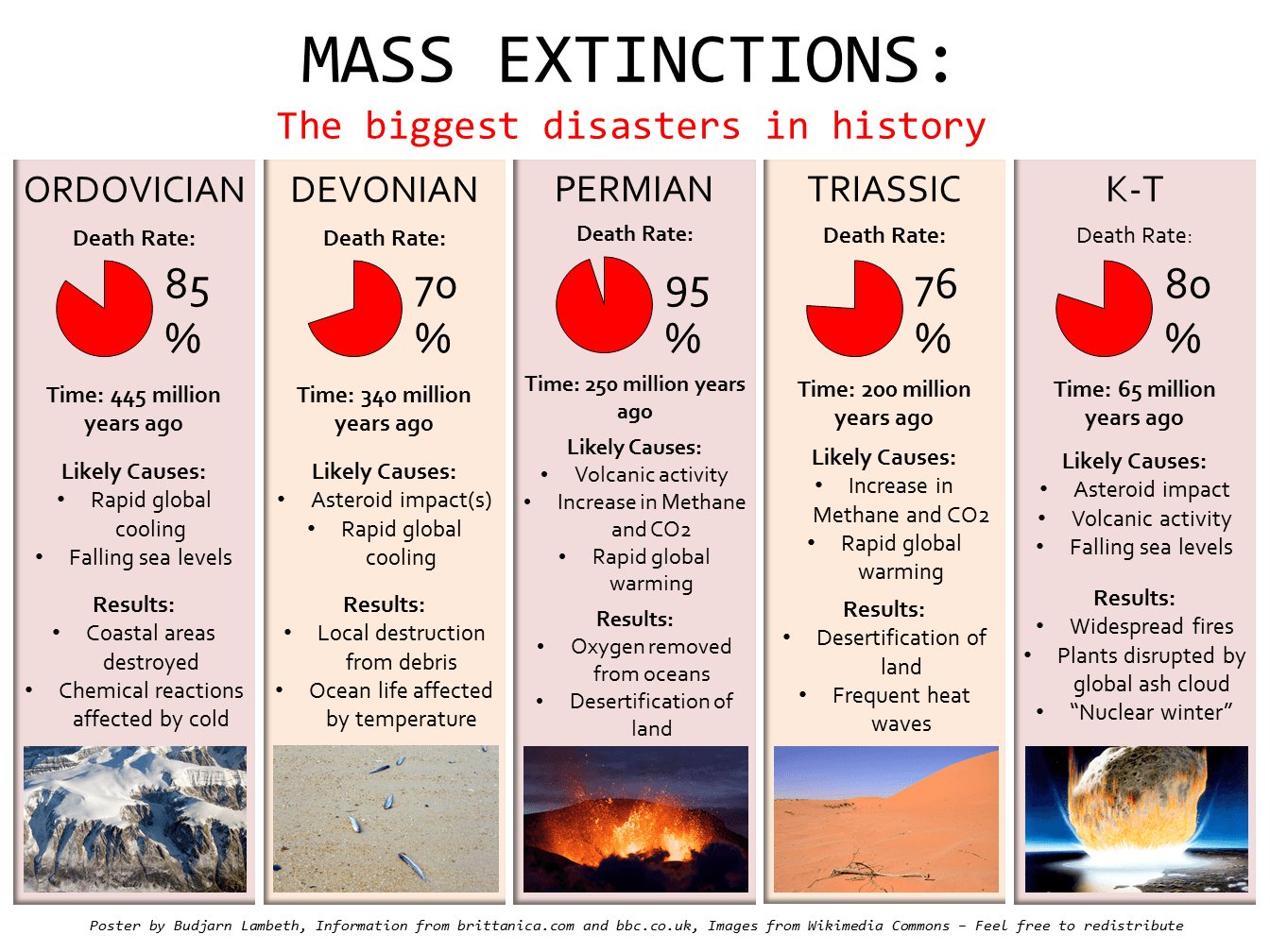
Big 5 Mass Extinctions Poster by BudCharles on DeviantArt View original
Is this image relevant?
Charting Earth’s (Many) Mass Extinctions — Blog of the Long Now View original
Is this image relevant?
Earth's five mass extinction events View original
Is this image relevant?
Big 5 Mass Extinctions Poster by BudCharles on DeviantArt View original
Is this image relevant?
Major extinction events in Earth's history
- "Big Five" mass extinctions drastically reduced global biodiversity at different geological times
- End-Ordovician (444 million years ago) wiped out many marine invertebrates
- Late Devonian (383-359 million years ago) affected reef-building organisms and fish
- End-Permian (252 million years ago) eliminated 95% of marine species and 70% of terrestrial vertebrates
- End-Triassic (201 million years ago) led to decline of many reptile groups
- End-Cretaceous (66 million years ago) marked end of non-avian dinosaurs
- End-Permian extinction dubbed "The Great Dying" reshaped Earth's ecosystems led to dominance of synapsids and archosaurs (ancestors of mammals and dinosaurs)
- End-Cretaceous extinction eliminated non-avian dinosaurs allowed radiation of mammals and birds into vacant niches
- Mass extinctions impact biodiversity by reducing species richness altering ecosystem structures changing dominant taxonomic groups (trilobites to ammonites)

Causes of mass extinctions
- Asteroid impacts like Chicxulub crater (Yucatan Peninsula) linked to End-Cretaceous extinction
- Dust and aerosols blocked sunlight caused global cooling disrupted photosynthesis
- Volcanic eruptions such as Siberian Traps associated with End-Permian extinction
- Released greenhouse gases and toxic compounds triggered acid rain and ocean acidification
- Global climate change induced rapid warming or cooling events sea level fluctuations altered ocean circulation patterns
- Other potential causes include gamma-ray bursts methane clathrate release anoxic events in oceans

Evolutionary Consequences and Significance
Evolutionary consequences of extinctions
- Selective survival favored organisms with specific traits
- Generalist diets allowed adaptation to changing food sources
- Burrowing or aquatic lifestyles provided protection from environmental stressors
- Small body size reduced resource requirements
- Examples: mammals after End-Cretaceous extinction Lystrosaurus after End-Permian extinction
- Emergence of evolutionary innovations through adaptive radiations in vacant niches
- Development of new survival strategies (flight in birds)
- Accelerated morphological changes (rapid diversification of mammalian body plans)
- Restructuring of ecological communities shifted trophic structures altered predator-prey relationships changed competitive dynamics
Impact of extinctions on evolution
- Evolutionary opportunities arose from release of competitive constraints
- Expansion into new ecological niches (mammals diversifying into former dinosaur habitats)
- Increased rates of speciation (adaptive radiations of cichlid fish)
- Macroevolutionary patterns influenced by mass extinctions
- Punctuated equilibrium demonstrated rapid evolutionary changes after extinctions
- Adaptive radiations following extinctions (Galapagos finches)
- Changes in morphological disparity across clades
- Long-term impacts on biodiversity shaped modern ecosystems
- Shifts in dominant taxonomic groups (reptiles to mammals)
- Alterations in global species composition (loss of trilobites gain of bony fish)
- Influence on modern biodiversity patterns (latitudinal diversity gradient)
- Significance for evolutionary theory challenged gradualism highlighted importance of contingency in evolution emphasized role of extrinsic factors in shaping life's history
See Fiveable more often in Google
Mark Fiveable as a preferred source and Google is more likely to show you our guides in Top Stories, with a "preferred" badge in AI Mode and AI Overviews.