8.3 Carbon Sequestration and Mitigation Strategies

🔆Environmental Chemistry I Unit 8 Review
8.3 Carbon Sequestration and Mitigation Strategies
🔆 Environmental Chemistry I
Carbon sequestration for climate change

Top images from around the web for Natural and anthropogenic carbon sequestration
Carbon sequestration - Wikipedia View original
Is this image relevant?
Soil carbon | Environment, land and water | Queensland Government View original
Is this image relevant?
Fossil Fuels (Coal and Gas) | Sustainability: A Comprehensive Foundation View original
Is this image relevant?
Carbon sequestration - Wikipedia View original
Is this image relevant?
Soil carbon | Environment, land and water | Queensland Government View original
Is this image relevant?
Natural and anthropogenic carbon sequestration
Carbon sequestration is the process of capturing atmospheric and locking it away in long-term storage. The goal is straightforward: reduce the concentration of greenhouse gases in the atmosphere to slow climate change.
Nature already does this through natural carbon sinks:
- Forests (terrestrial ecosystems) absorb through photosynthesis and store carbon in biomass and leaf litter
- Oceans (marine ecosystems) dissolve at the surface and transport it to depth through physical and biological processes
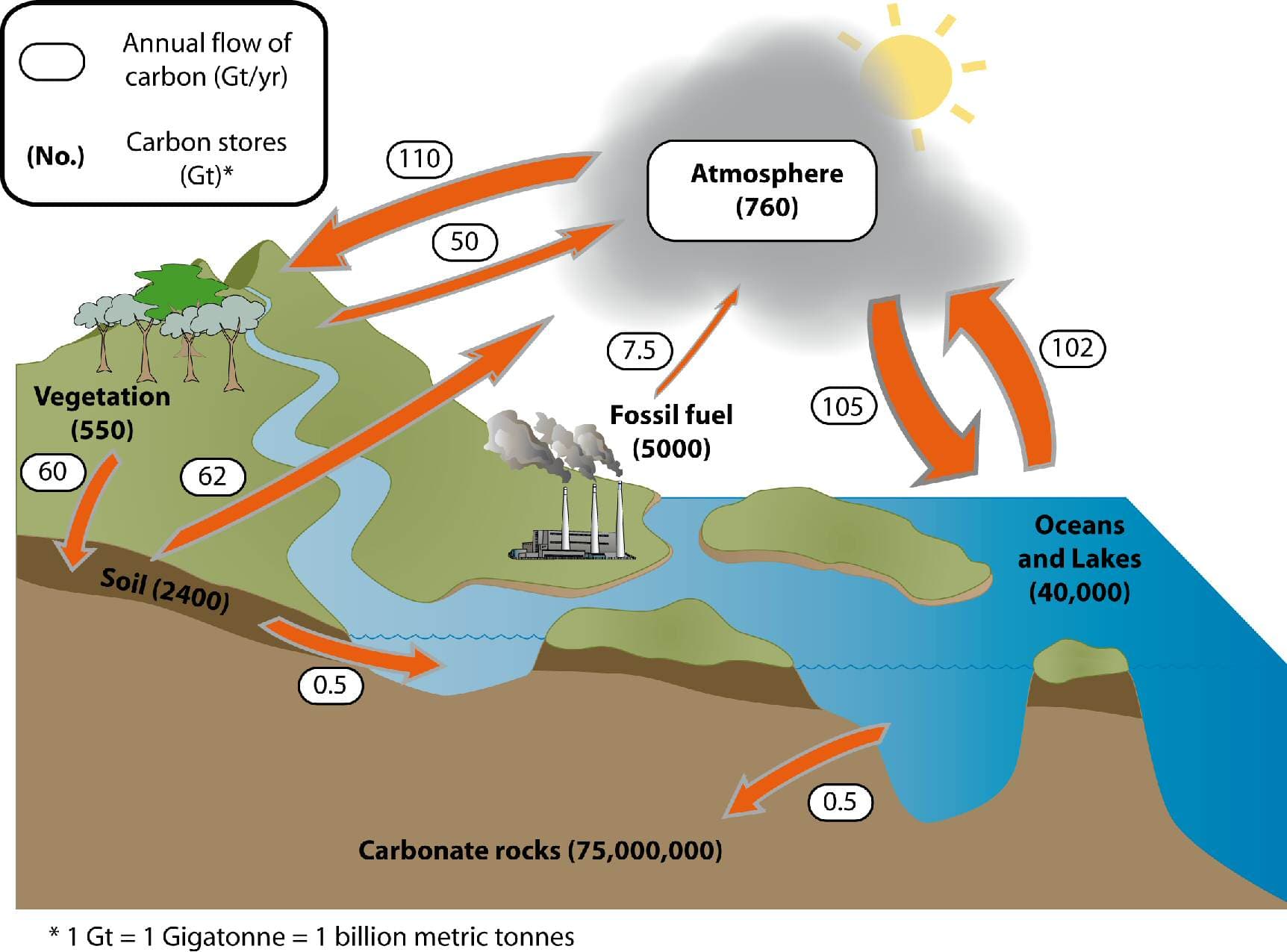
- Soils (pedosphere) hold roughly twice as much carbon as the atmosphere, stored in organic matter and humus
These natural sinks currently absorb about half of anthropogenic emissions each year, but they aren't enough on their own. That's where anthropogenic sequestration methods come in. These either enhance natural processes or create entirely new storage pathways:
- Enhanced weathering speeds up the natural reaction between and silicate or carbonate minerals
- Direct air capture (DAC) uses engineered systems to pull directly from ambient air
- Biochar production converts biomass into a stable, carbon-rich solid that resists decomposition when added to soil
Measuring and implementing carbon sequestration
Sequestration potential is typically measured in gigatons (Gt) of removed and stored over a defined time period. This metric allows direct comparison between very different approaches.
Carbon sequestration is a key strategy in meeting the targets set by the Paris Agreement, but it's meant to complement emissions reductions, not replace them. You still need to cut emissions at the source.
When evaluating any sequestration method, four factors matter most:
- Storage capacity: How much can the method hold?
- Permanence: How long does the carbon stay locked away? Decades? Centuries? Millennia?
- Energy requirements: How much energy does the process consume, and what's the source of that energy?
- Cost-effectiveness: Is the method economically viable at the scale needed?
A method with enormous capacity but poor permanence (or one that requires fossil-fuel energy to run) may not deliver the net climate benefit it promises.
Carbon sequestration methods: geological vs biological
Geological sequestration techniques
Geological sequestration injects captured into underground rock formations for long-term storage. The two primary targets are:
- Depleted oil and gas reservoirs, which already have well-characterized geology and existing infrastructure
- Deep saline aquifers, porous rock formations saturated with brine, which offer very large storage volumes globally
These formations can trap through structural trapping (impermeable cap rock), residual trapping ( caught in pore spaces), solubility trapping ( dissolving into formation water), and eventually mineral trapping ( reacting with rock to form carbonates). The result is large storage capacity and long-term stability, but careful site selection and ongoing monitoring are essential to prevent leakage back to the surface.
Mineral carbonation takes a different approach. It reacts with metal oxides (commonly magnesium or calcium silicates) to form thermodynamically stable carbonate minerals:
This provides essentially permanent storage since the carbon is locked into solid mineral form. The tradeoff is that the process is energy-intensive and currently not economically viable at large scales.

Biological sequestration approaches
Biological sequestration uses living systems to absorb and store . Plants fix carbon through photosynthesis, and that carbon can be retained in biomass, soils, and sediments.
Terrestrial approaches:
- Afforestation establishes new forests on land that was not previously forested
- Reforestation replants trees in areas that were deforested
- Soil carbon enhancement uses agricultural practices to increase the organic carbon content of soils. Key techniques include no-till farming (reduces soil disturbance that releases stored carbon), cover cropping (keeps living roots in the ground year-round), and crop rotation (maintains soil structure and microbial diversity)
Ocean-based approaches:
- Iron fertilization adds iron to nutrient-limited ocean regions to stimulate phytoplankton blooms, which draw down surface through photosynthesis
- Direct injection pumps into deep ocean waters below the thermocline
Ocean methods are controversial. Iron fertilization can trigger unpredictable ecological cascading effects, and direct injection lowers local pH, potentially harming deep-sea organisms. Long-term effectiveness for both remains uncertain.
Hybrid sequestration methods
Bioenergy with Carbon Capture and Storage (BECCS) combines two processes: growing biomass that absorbs , burning it for energy, then capturing the emissions and storing them geologically. In principle, this achieves negative emissions because the biomass already removed from the atmosphere during growth, and the combustion emissions never reach the atmosphere.
The challenges are significant: BECCS requires large areas of land for biomass cultivation (competing with food production), and the full technology chain has yet to be demonstrated at scale.
Enhanced weathering accelerates the natural chemical breakdown of silicate rocks by crushing them and spreading the powder over agricultural land or coastlines. As the minerals dissolve, they react with dissolved in water:
This shows promise for large-scale sequestration and can also improve soil fertility, but research on environmental impacts and accurate measurement of sequestration rates is still ongoing.
Carbon mitigation strategy effectiveness
Evaluation criteria for mitigation strategies
Not all mitigation strategies are equal. Comparing them requires a consistent set of criteria:
- removal capacity: The total volume of carbon dioxide a strategy can sequester, usually expressed in Gt per year
- Cost-effectiveness: The economic feasibility of deployment and ongoing operation (often quoted as dollars per ton of removed)
- Technological readiness: How mature and scalable the approach is right now
- Environmental impacts: Ecological consequences, both positive and negative
- Life cycle emissions: The total carbon footprint of the method itself, including energy inputs, transportation, and construction. A method that consumes large amounts of fossil energy may have a much smaller net removal than its gross numbers suggest
- Unintended consequences: Effects on ecosystems, water resources, land use, or human communities that weren't part of the original design

Comparison of specific mitigation strategies
| Strategy | Strengths | Limitations |
|---|---|---|
| Direct Air Capture (DAC) | Can be sited anywhere; significant removal potential if powered by renewables | Very energy-intensive; current costs are high (~– per ton ) |
| Afforestation / Reforestation | Relatively low cost; readily implementable; co-benefits like biodiversity and soil conservation | Limited by available land; vulnerable to wildfires, droughts, and pest outbreaks that release stored carbon |
| Industrial CCS | Targets large point sources (cement, steel, power plants); can significantly cut emissions from hard-to-abate sectors | Requires pipeline infrastructure for transport; depends on suitable nearby geological storage sites |
| Soil carbon sequestration | Low cost; widely applicable; co-benefits for soil health and food security | Storage may saturate over time; permanence depends on continued management practices |
The key takeaway: no single strategy is sufficient. Effective climate mitigation requires a portfolio approach, combining multiple methods that complement each other's strengths and weaknesses.
Policy and technology for carbon sequestration
International agreements and national policies
The Paris Agreement provides the overarching framework for national commitments to reduce emissions and implement sequestration. Countries submit Nationally Determined Contributions (NDCs) that increasingly include carbon removal targets alongside emissions cuts.
Carbon pricing mechanisms create economic incentives for sequestration:
- Carbon taxes impose a direct fee per ton of emitted, making it financially attractive to capture rather than release carbon
- Cap-and-trade systems set an overall emissions limit and let companies buy and sell emission allowances, driving investment toward the cheapest abatement options, including sequestration
Government funding for R&D plays a direct role in bringing down costs and improving efficiency. Early-stage technologies like DAC and enhanced weathering depend heavily on public investment before they become commercially competitive.
Regulatory frameworks are especially critical for geological storage and ocean-based approaches, where safety risks (leakage, ecological disruption) require established monitoring, reporting, and verification (MRV) protocols.
Technology development and implementation
Scaling carbon sequestration globally depends on more than just inventing better technology:
- Technology transfer shares knowledge and expertise between countries, adapting proven methods to local geological, ecological, and economic conditions
- Capacity building develops the skilled workforce and infrastructure needed to run sequestration projects, particularly in developing countries that may have large sequestration potential but limited technical resources
Cross-sectoral collaboration ties sequestration into broader sustainable development. For example, enhanced weathering on farmland can improve crop yields while sequestering carbon, and BECCS facilities can be integrated with renewable energy grids.
Policy measures that specifically promote biological sequestration include:
- Land-use regulations that protect existing forests and wetlands (which are already functioning as carbon sinks) and designate areas for afforestation
- Agricultural subsidies that reward farmers for adopting practices like no-till farming, cover cropping, and agroforestry that build soil carbon
See Fiveable more often in Google
Mark Fiveable as a preferred source and Google is more likely to show you our guides in Top Stories, with a "preferred" badge in AI Mode and AI Overviews.