
Memory Types and Processes
Stages of Memory
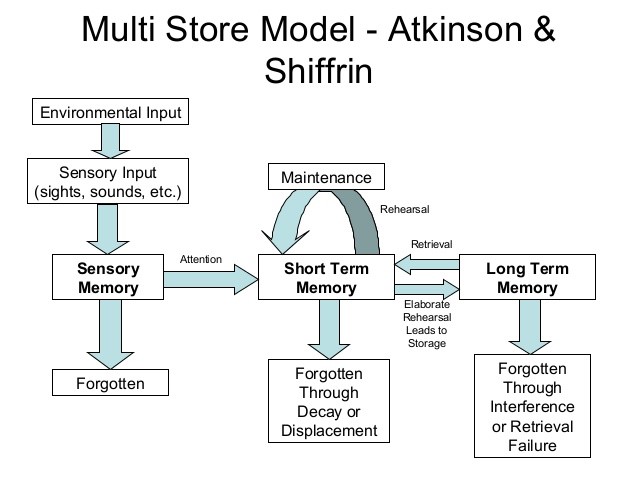
Think of memory as a three-stage pipeline. Information flows from the environment through each stage, but it can be lost at any point if it isn't processed further.
- Sensory memory briefly holds raw input from your senses (visual, auditory, tactile) for roughly 0.5–3 seconds. Most of it fades almost immediately unless you pay attention to it.
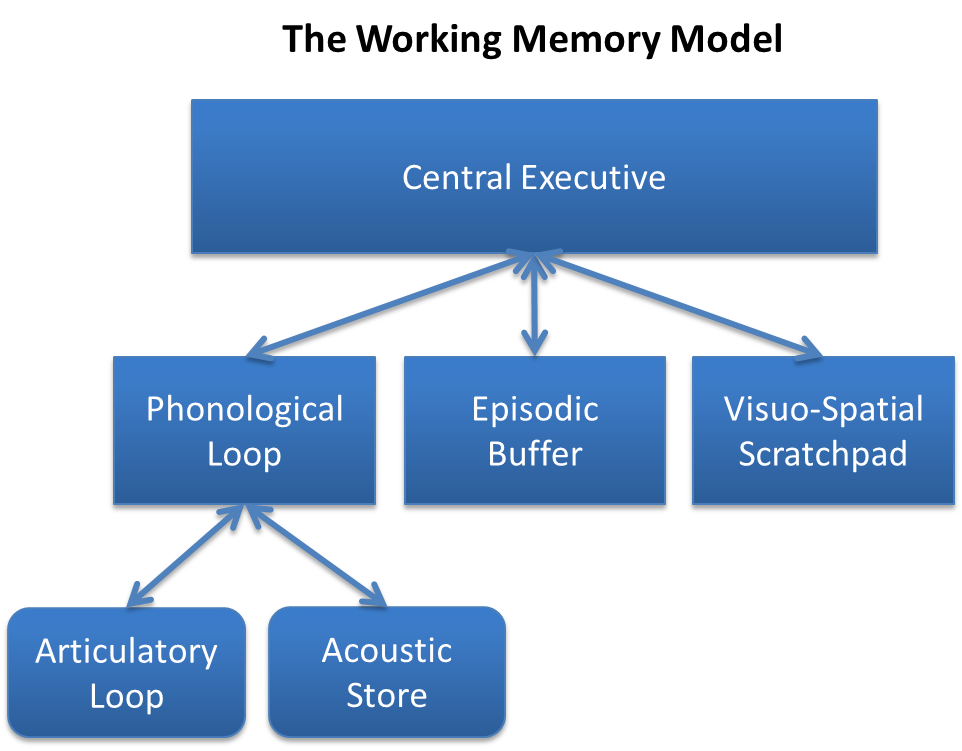
- Working memory is where you actively think about and manipulate information. It lasts less than a minute and holds only about 4–7 items at once. Baddeley's model breaks it into four components:
- Central executive – directs attention and coordinates the other components
- Phonological loop – handles verbal and auditory information (like repeating a phone number in your head)
- Visuospatial sketchpad – handles visual and spatial information (like picturing a map)
- Episodic buffer – integrates information from the other components and links it to long-term memory
- Long-term memory stores information for hours, years, or a lifetime, with virtually unlimited capacity. It splits into two broad types:
- Explicit (declarative) memory – facts you can consciously recall, like historical dates (semantic memory) or personal experiences (episodic memory)
- Implicit (non-declarative) memory – skills and habits you perform without conscious thought, like riding a bike (procedural memory)
Memory Processes
Three core processes move information through these stages:
- Encoding transforms incoming information into a storable format. It depends on attention, rehearsal, and connecting new material to what you already know. Encoding can be visual (picturing something), acoustic (repeating it aloud), or semantic (understanding its meaning). Semantic encoding tends to produce the strongest, most durable memories.
- Storage maintains encoded information over time through changes in neural connections. Each memory stage differs in how long and how much it can store: sensory memory is brief and large-capacity, working memory is brief and small-capacity, and long-term memory is lasting and essentially limitless.
- Retrieval pulls stored information back into conscious awareness. It happens through recall (generating information on your own, like an essay question) or recognition (identifying something you've seen before, like a multiple-choice question). Retrieval is easier when you have strong cues, when the context matches the original learning environment, and when the memory trace is well-established.
Cognitive Load Theory
Cognitive load theory, developed by John Sweller, starts from a simple premise: working memory is limited. If a learning task demands more processing than working memory can handle, learning breaks down. The theory identifies three types of load that compete for those limited resources.
Types of Cognitive Load
- Intrinsic load comes from the complexity of the material itself. It's determined by how many elements interact with each other and how much prior knowledge the learner already has. For example, learning vocabulary words has low intrinsic load because each word is relatively independent, while solving multi-step algebra problems has high intrinsic load because you must hold several relationships in mind at once. You can't eliminate intrinsic load through better design, but you can manage it (more on that below).
- Extraneous load is caused by how information is presented, not the content itself. Cluttered slides, irrelevant images, or instructions that force you to flip between a diagram and its explanation all add extraneous load. This is the type of load that good instructional design targets directly, because every bit of extraneous load wastes working memory capacity that could go toward actual learning.
- Germane load is the productive mental effort spent building and organizing schemas (mental frameworks for understanding). When a learner compares examples, self-explains a concept, or connects new material to prior knowledge, that's germane processing. Instructional design should actively promote this type of load.
Managing Cognitive Load
The goal is to keep total cognitive load within working memory's limits while maximizing the proportion devoted to germane processing. In practice, this means three things:
- Minimize extraneous load – Strip away unnecessary complexity in how material is presented. For example, integrate labels directly onto a diagram instead of placing them in a separate legend.
- Manage intrinsic load – You can't change the material's inherent complexity, but you can sequence it strategically. Break complex topics into smaller segments, teach component skills before combining them, and build on learners' prior knowledge so fewer elements feel new at once.
- Promote germane load – Encourage learners to actively process material. Use prompts for self-explanation, provide varied examples that highlight underlying structure, and ask learners to compare worked examples rather than passively reading them.
Strategies for Managing Cognitive Load
Chunking
Working memory can hold about 4–7 items, but chunking lets you pack more information into each "item" by grouping related pieces together. A 10-digit phone number is hard to remember as ten separate digits, but easy as three chunks: 555-123-4567.
Chunking works because it takes advantage of patterns and meaning:
- Group related items together – Categorize grocery items by department (produce, dairy, bakery) instead of memorizing a random list.
- Use meaningful labels or categories – In biology, grouping organelles by function (energy production, protein synthesis, transport) makes them easier to remember than memorizing an unstructured list.
- Present information hierarchically – Outlines and concept maps impose structure that helps learners see how pieces fit together, effectively reducing the number of independent items working memory has to juggle.
For instructional design, chunking means breaking lessons into focused segments and organizing content so that related ideas appear together rather than scattered across a presentation.
Automaticity
Automaticity is the ability to perform a task with little or no conscious effort. You experience it every time you read a word without sounding out each letter, or type on a keyboard without looking at the keys. Once a skill becomes automatic, it barely draws on working memory, freeing up capacity for higher-level thinking.
This matters enormously for learning. A student who has to consciously calculate during a word problem is using working memory on arithmetic instead of on the problem-solving strategy. A student who knows multiplication facts automatically can devote full attention to the harder reasoning.
Strategies for building automaticity:
- Provide ample practice with feedback – Repetition is necessary, but it should be deliberate. Spaced practice (spreading sessions over time) is more effective than massed practice (cramming).
- Use varied examples and contexts – Practicing the same skill in different situations promotes transfer, so the automaticity isn't limited to one narrow context.
- Gradually increase complexity – Start with simple, isolated tasks and progressively add challenge. This prevents cognitive overload during the early stages when the skill still requires conscious effort.
The connection between automaticity and cognitive load is direct: the more low-level processes you can automate, the more working memory you free up for complex, meaningful learning.