2.9 Parameters of Random Variables

📊AP Statistics Unit 2 Review
2.9 Parameters of Random Variables
📊 AP Statistics
Unit 2 Overview: Probability, Random Variables, and Probability Distributions
2.1
Tabular and Graphical Representations for the Distributions of Two Categorical Variables
2.2
Summary Statistics for Two Categorical Variables
2.3
Estimating Probabilities Using Simulation
2.4
Introduction to Probability
2.5
Mutually Exclusive Events
2.6
Conditional Probability
2.7
Independent Events and Unions of Events
2.8
Introduction to Random Variables and Probability Distributions
2.9
Parameters of Random Variables
2.10
The Binomial Distribution
2.11
The Normal Distribution
2.12
Sampling Distributions and the Central Limit Theorem
The parameters of a random variable describe its center and variability. In Topic 2.9, you calculate the mean (expected value) and standard deviation of a discrete random variable from its probability distribution, and you interpret both values in context.
Why This Matters for the AP Statistics Exam
This topic shows up whenever you are handed a probability distribution for a discrete random variable. On the AP Statistics exam, you may need to calculate the expected value and standard deviation from a table, then explain what those numbers mean for the situation described. Both formulas are on the formula sheet, so the points come from setting up the calculation correctly and interpreting the result.
Showing structure matters for full credit. Write the formula, substitute values carefully, and explain your answer in context instead of dropping a bare number.
Key Takeaways
- A parameter is a single, fixed value that describes a probability distribution or a population.
- The mean, or expected value, of a discrete random variable is a probability-weighted average of its possible values.
- The standard deviation measures how far the values of the random variable typically fall from the mean over the long run.
- The variance is the square of the standard deviation.
- Interpret both parameters in the context of the specific situation, with units.
Mean and Standard Deviation of a Discrete Random Variable

For a discrete random variable , the expected value is:
The variance is:
The standard deviation is the square root of the variance:
Here is a possible value of and is its probability. A discrete random variable takes on a countable or finite set of values.
Interpreting the Parameters
- Mean: The expected value is the long-run average outcome. If the random process were repeated many times, the average of the observed values would approach . It does not have to be a value that can actually take.
- Standard deviation: is the typical distance between the values of the random variable and its mean over the long run.
A complete interpretation names the random variable, the context, and the units.
How to Use This on the AP Statistics Exam
Problem Solving
- Confirm that each probability is between 0 and 1 and that the probabilities add to 1.
- Compute the mean using the weighted-average formula.
- For each value, find the squared distance from the mean and multiply it by its probability. Add these products to get the variance.
- Take the square root of the variance to get the standard deviation.
- Interpret both values with units and context.
Common Trap
Averaging the possible values without weighting them by their probabilities. The mean of a random variable is a weighted average, so a more likely value pulls the mean toward it.
Practice Example
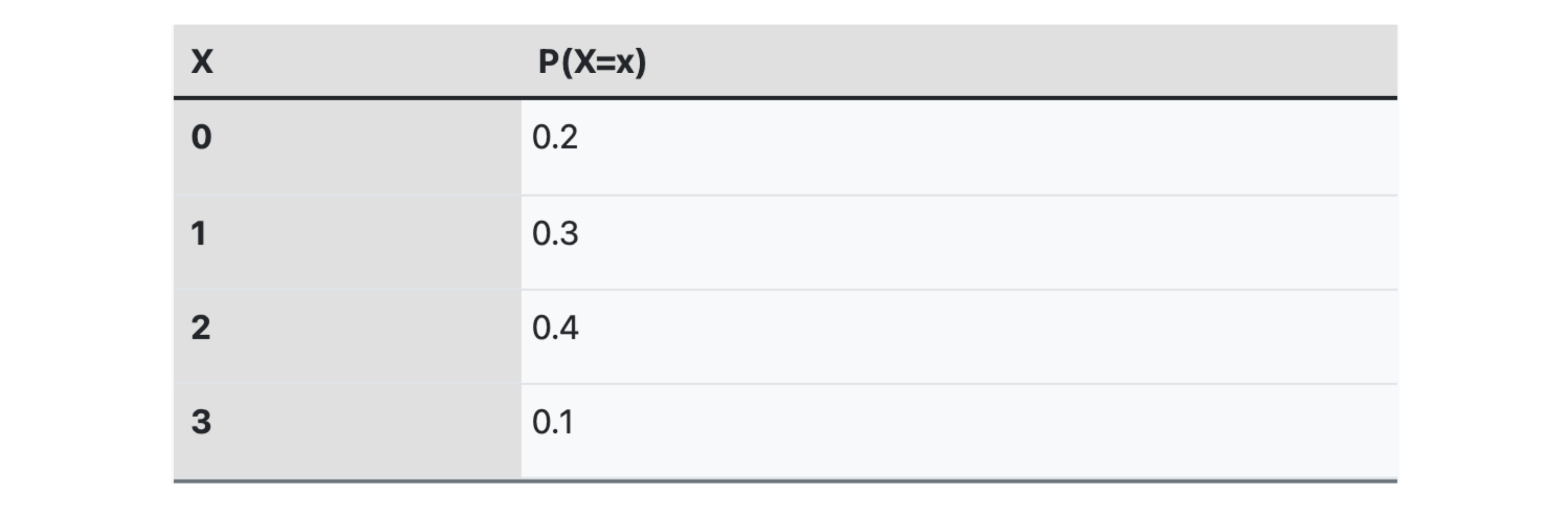
Suppose is the number of text messages a person receives in a day, with mean and standard deviation .
- Interpreting the mean: Over many days, the person receives an average of 1.4 text messages per day.
- Interpreting the standard deviation: The number of text messages the person receives on a given day typically varies from the mean of 1.4 by about 0.92 messages.
Common Misconceptions
- Misconception: Rounding the expected value to a whole number.Actually: The mean of a random variable is a long-run average and may be a decimal.
- Misconception: Forgetting to take the square root of the variance.Actually: Variance and standard deviation are not the same; the standard deviation is in the units of the variable.
- Misconception: Averaging the possible values without the probabilities.Actually: Each value is weighted by its probability.
- Misconception: Describing the standard deviation as the range of possible values.Actually: It measures the typical distance from the mean over the long run.
Related AP Statistics Guides
Practice Questions for 2.9
1 of 10
The bar chart above shows the relative frequency distribution for the number of broken eggs, , in a randomly selected carton.
Based on the distribution, which of the following is the best interpretation of the standard deviation of ?
A.
The number of broken eggs in a randomly selected carton typically varies from the mean of 0.8 by about 0.96 eggs.
B.
The average number of broken eggs in many randomly selected cartons typically varies from 0.8 by about 0.98 eggs.
C.
The number of broken eggs in a randomly selected carton typically varies from the mean of 0.98 by about 0.8 eggs.
D.
The number of broken eggs in a randomly selected carton typically varies from the mean of 0.8 by about 0.98 eggs.
Vocabulary
The following words are mentioned explicitly in the AP® course framework for this topic.Term | Definition |
|---|---|
discrete random variable | A random variable that takes on a countable number of distinct values, often representing counts or categorical outcomes. |
expected value | The long-run average outcome of a random variable, equivalent to the mean of a discrete random variable. |
independent random variables | Random variables where knowing the value or probability distribution of one does not change the probability distribution of the other. |
linear combinations | Expressions of the form aX + bY where X and Y are random variables and a and b are real number coefficients. |
linear transformations | Changes to a random variable of the form Y = a + bX, where a and b are constants that shift and scale the distribution. |
mean | The average value of a dataset, represented by μ in the context of a population. |
parameter | A numerical summary that describes a characteristic of an entire population. |
probability distribution | A function that describes the likelihood of all possible values of a random variable. |
random variable | A variable whose value is determined by the outcome of a random phenomenon and can take on different numerical values with associated probabilities. |
standard deviation | A measure of how spread out data values are from the mean, represented by σ in the context of a population. |
variance | A measure of the spread or dispersion of a probability distribution, denoted as σ², indicating how far values typically deviate from the mean. |
Frequently Asked Questions
What is AP Stats 2.9 about?
AP Stats 2.9 covers calculating and interpreting parameters for a discrete random variable, especially the mean or expected value and the standard deviation.
How do you find the mean of a discrete random variable?
Multiply each possible value by its probability and add the products. The formula is mu_X = sum of x_i times P(x_i).
How do you find standard deviation in AP Stats?
Find the mean, compute each squared distance from the mean, weight each squared distance by its probability, add those values to get variance, and take the square root.
How do you interpret standard deviation of a random variable?
The standard deviation describes how far values typically vary from the mean in context. It should be reported with appropriate units.
Why is expected value often a decimal?
Expected value is a long-run average, not a single required outcome. A value like 1.4 can be correct even if the random variable itself only takes whole-number values.
What is a common AP Stats 2.9 mistake?
A common mistake is averaging the x-values without probability weights or reporting a number without context. Use the probabilities and interpret the result with units.
See Fiveable more often in Google
Mark Fiveable as a preferred source and Google is more likely to show you our guides in Top Stories, with a "preferred" badge in AI Mode and AI Overviews.