AP Spanish Language Argumentative Essay Practice
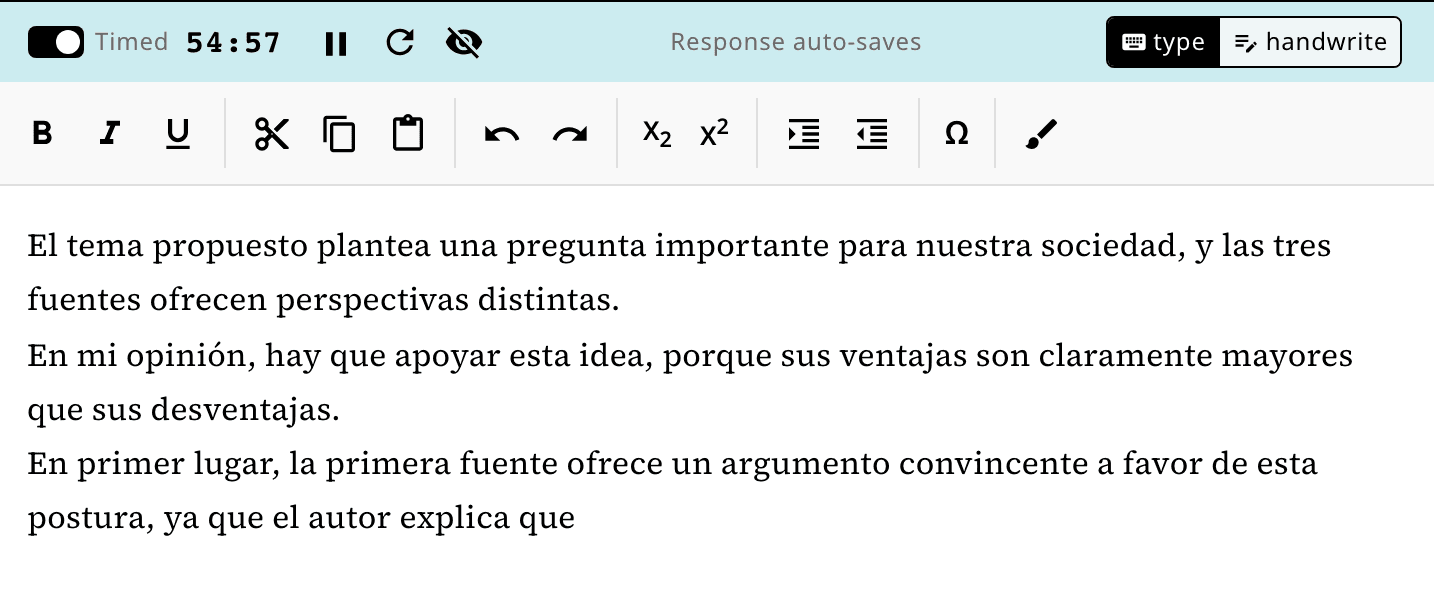
120 Argumentative Essays written in the AP format. Pick one, read the topic and all three sources, and write your essay in Spanish. Fiveable scores each Argumentative Essay response part by part on the AP rubric.
Your first scored response is included. A plan unlocks unlimited scoring.
120 questions
sorted by unit
Adult children living with parents: benefits and drawbacks
Unit 1: Families and Communities
¿Es beneficioso que los hijos adultos sigan viviendo en la casa de sus padres?
Source 1
En esta selección se trata el fenómeno de la permanencia de los hijos adultos en el hogar familiar.
La generación que no se va: entre la necesidad económica y la tradición cultural
Carlos Méndez Villa | Original Fiveable AP-style source simulation; not an authentic publication.
En las últimas décadas, se ha observado un cambio demográfico significativo en América Latina y España: los jóvenes permanecen en el hogar familiar mucho más tiempo que las generaciones anteriores. Este fenómeno, a menudo atribuido exclusivamente a crisis económicas y altas tasas de desempleo juvenil, tiene raíces más profundas que entrelazan la necesidad financiera con valores culturales arraigados.
Según sociólogos de la Universidad Nacional, el modelo de familia extendida sigue siendo un pilar fundamental en la sociedad hispana. A diferencia de culturas anglosajonas donde la independencia temprana es un rito de paso casi obligatorio, en nuestros países se valora la proximidad y el apoyo mutuo intergeneracional. "No es solo que no puedan irse", explica la Dra. Elena Restrepo, "es que muchas veces, ni los hijos ni los padres quieren que esa separación ocurra prematuramente".
Las ventajas económicas son innegables. Al compartir gastos, las familias pueden mantener un nivel de vida más alto, y los jóvenes tienen la oportunidad de ahorrar para un futuro más estable, como la compra de una vivienda propia o estudios de posgrado. Además, el apoyo emocional y logístico —desde el cuidado de nietos hasta la compañía para los adultos mayores— crea una red de seguridad vital en países con sistemas de bienestar limitados.
Sin embargo, la convivencia prolongada no está exenta de fricciones. La falta de privacidad y la dificultad para establecer límites entre padres e hijos adultos pueden generar conflictos domésticos. Los expertos advierten que, si bien la solidaridad familiar es positiva, es crucial que esta convivencia no frene el desarrollo de la autonomía individual y la responsabilidad personal de los jóvenes adultos.
Source 2
En esta selección se presentan datos sobre la emancipación juvenil en varios países.
Edad promedio de emancipación y porcentaje de ingresos destinados a vivienda (2023)
La tabla compara la edad promedio a la que los jóvenes dejan el hogar parental en diferentes países y el porcentaje del salario promedio juvenil que costaría alquilar una vivienda individual.
Label | Value |
|---|---|
Edad promedio de salida (España) | 30.3 años |
Edad promedio de salida (México) | 28.9 años |
Edad promedio de salida (Suecia) | 19.0 años |
Edad promedio de salida (Estados Unidos) | 24.6 años |
Costo de alquiler como % del salario juvenil (España) | 85% |
Costo de alquiler como % del salario juvenil (México) | 65% |
Data adapted for practice
Source 3
En esta selección se presenta una opinión crítica sobre la convivencia prolongada con los padres.
Cortar el cordón: la urgencia de la independencia
Lucía Fernández, columnista | Original Fiveable AP-style source simulation; not an authentic publication.
Audio stimulus
2 plays remaining
What the Argumentative Essay asks
The Argumentative Essay is FRQ 3 on the revised AP Spanish Language exam, starting in May 2027. You read two print sources, listen to an audio source, and write an essay in Spanish that takes a position and supports it with evidence from all three.
- 40 min
- to write, after 6 min of reading
- 10 points
- across rows A to E
- 3 sources
- two to read, one to listen to
Part A: Position
A clear position that answers the prompt directly
1 pt
Part B: Source use
Accurate evidence from all three sources, each one identified
2 pts
Part C: Argumentation
How the evidence supports your position, built into one argument
2 pts
Part D: Organization
Ideas in a clear order, with connections between them
2 pts
Part E: Language control
Vocabulary and grammar controlled well enough for the task
3 pts
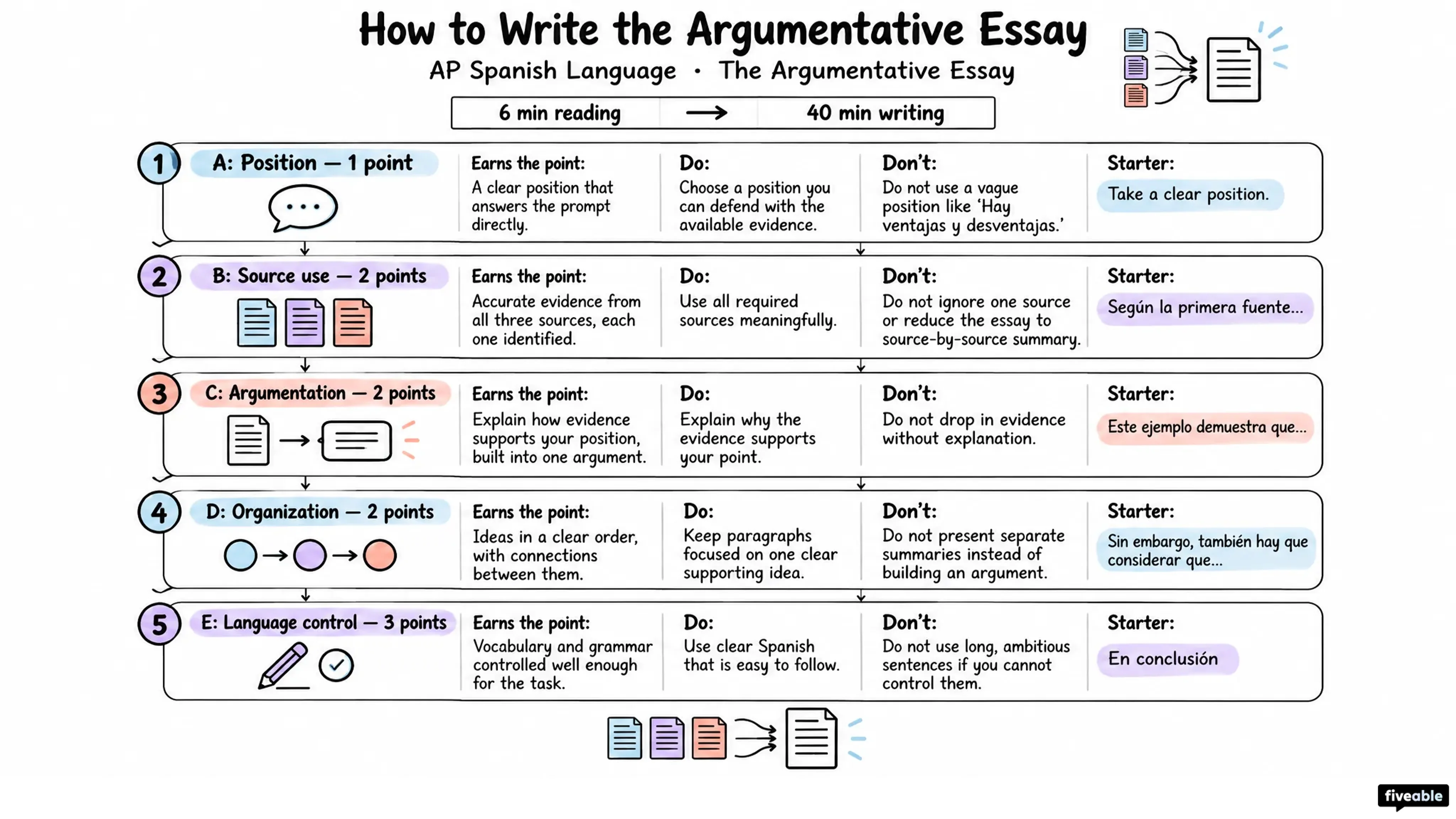
Argumentative Essay skill sheet
Every rubric point on one page: what earns it, what to do and what to avoid. Tap the sheet to see it full size.
How Argumentative Essay practice works
Each question follows the exam’s format, from the full prompt to a score on every part.
Read the topic and sources
The essay topic and all three sources. The audio source appears as a written transcript.
Write on a 55-minute timer
One timer covers the sources and your essay. Pause it or turn it off, and your response saves as you go.
Submit for a score out of 10
Your response is scored against the scoring guidelines written for that question. Your first score is included.
Feedback on every part
A summary at the top tells you what to work on next. Below it, each part shows whether you earned the point and what the scoring guidelines were looking for.
Detailed Feedback
Part A: 1/1 point
La tesis responde directamente: el arte urbano es legítimo pero la protección debe ser selectiva (murales sí, tags no). Es clara y matizada.
Questions about the Argumentative Essay
How many responses can I get scored?
You can read every question without a plan. Your first scored response is included. A plan unlocks unlimited scoring.
Do I have to write the essay in Spanish?
Yes. Write the whole essay in Spanish. Language control is its own row, worth 3 of the 10 points.
How does the audio source work here?
On the exam, one of the three sources is audio. Here it appears as a written transcript, so you can read it and cite it like the other two.
How do I type letters like á, é, ñ, and ü?
Use your keyboard’s accent shortcuts or a Spanish keyboard layout. You can also switch the editor to handwrite, write on paper, and add a photo of your page.
Are these real College Board questions?
No. We wrote them in the AP format, with an essay topic and three sources, and wrote scoring guidelines for each one.
More AP Spanish Language practice
AP Spanish Language FRQs
Every FRQ type for AP Spanish Language, with practice for each.
Write your first Argumentative Essay
Pick one from the list, or let us choose for you.
Teaching AP Spanish Language? Assign these Argumentative Essays to your class