AP Spanish Language Unit 2 Cheatsheet: Language and Culture

AP Spanish Language Unit 2 Cheatsheet: Language and Culture

Start with the first 3 sections of the Unit 2 one-page cheatsheet below. The full sheet is a PDF you can print.

Customs & Celebrations: Audience & Perspective

Determine intended audience:

  • Who is the text addressing? (formal/informal, age, education level, cultural background)
  • What clues signal audience? (tú vs. usted, register, cultural references)
  • How does audience shape tone and content choices?

Identify point of view, perspective, tone, attitude:

  • Whose viewpoint dominates? (first-person, third-person, collective)
  • What emotional stance does the author take? (celebratory, critical, nostalgic, ironic)
  • How do word choice and syntax reveal attitude toward the custom or celebration?

Common confusions: Tone ≠ topic. A text about a festival can have a critical or celebratory tone.
Written Language Conventions

Standard conventions to apply:

  • Capitalization: Proper nouns, sentence beginnings; Spanish does not capitalize days, months, or adjectives of nationality unless at sentence start
  • Orthography: Correct spelling, including accent marks (tilde, acute, diaeresis)
  • Accents: Distinguish meaning (sí/si, té/te, más/mas) and mark nondefault stress: words ending in a vowel, n, or s are normally stressed on the next-to-last syllable; words ending in another consonant are normally stressed on the last syllable.
  • Punctuation: Inverted question/exclamation marks at the start, standard ones at the end; semicolons for related clauses

Test tip: Accurate accents and capitalization can strengthen the overall language-use quality of written responses.

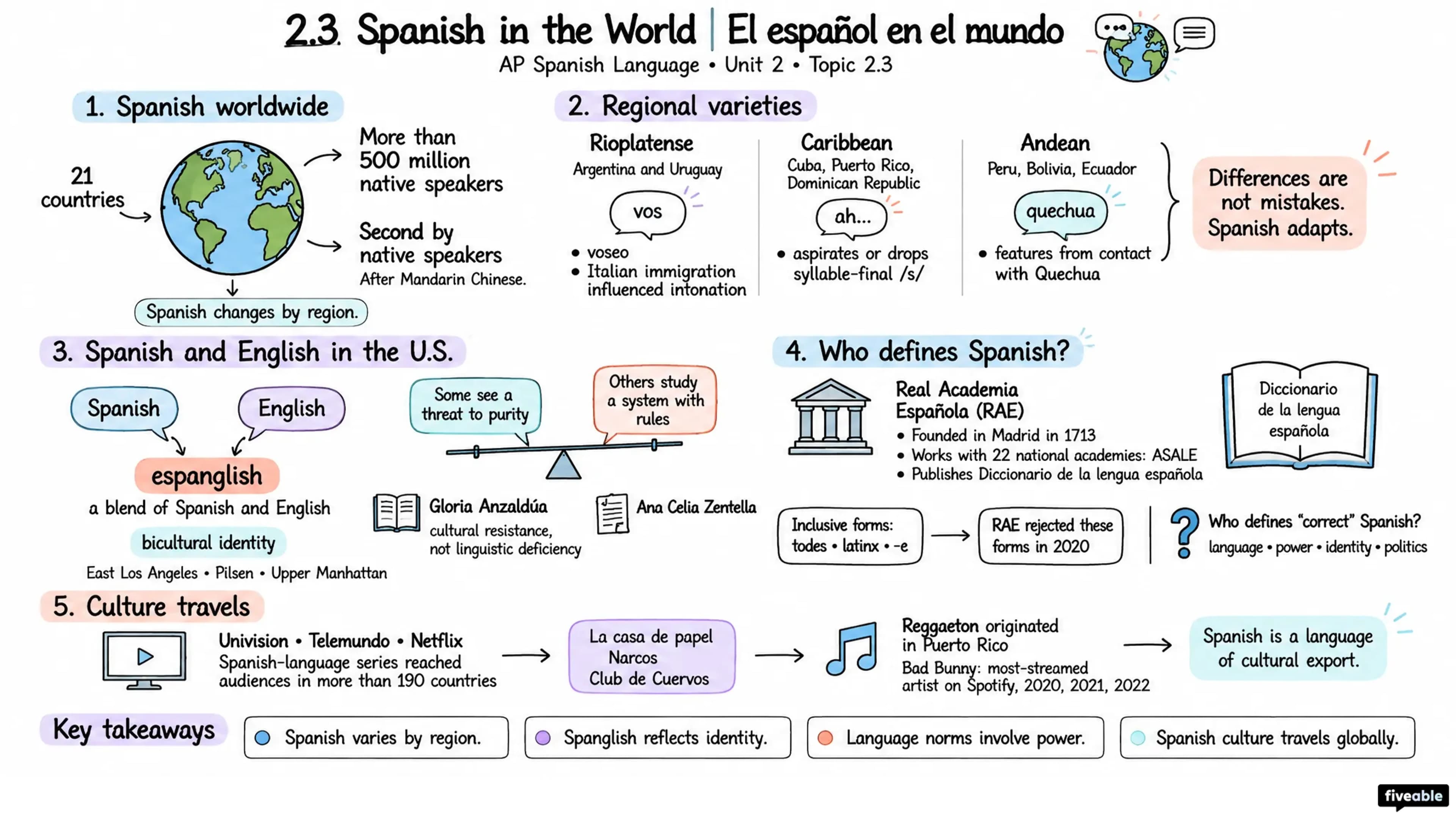
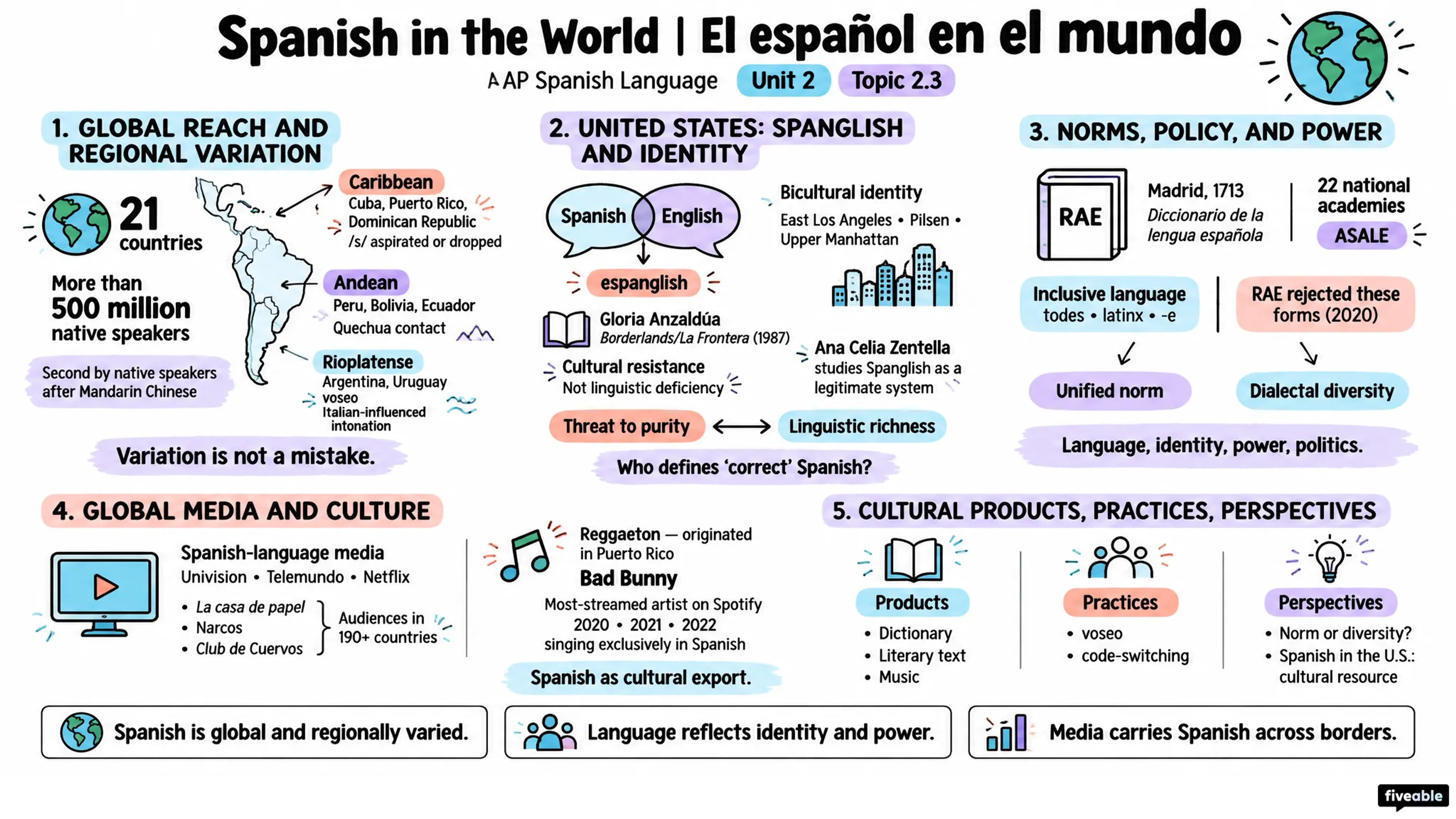
Spanish in the World: Global Context

Spanish as a global language:

  • Spoken across multiple continents; official or de facto national language in about 20 countries (21 if Puerto Rico is included)
  • Variations in vocabulary, pronunciation, grammar by region (Spain, Mexico, Caribbean, South America, Central America)
  • Influences from indigenous languages, English, and other contact languages

Cultural implications:

  • Regional identity and pride in language varieties
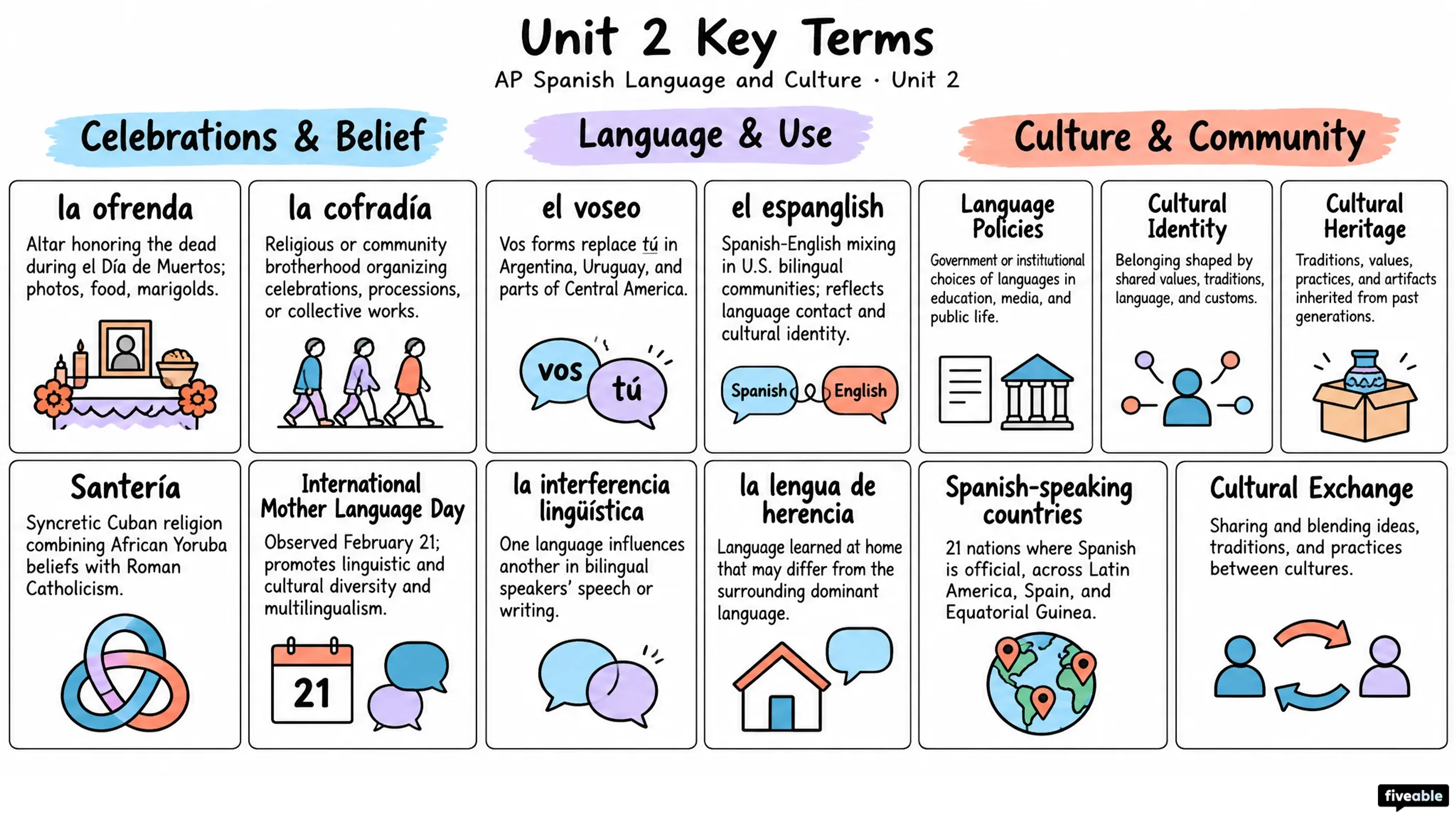
  • Code-switching and multilingualism in border/diaspora communities
  • Spanish language as vehicle for cultural values, traditions, and worldviews

For Unit 2 tasks: Recognize that Spanish-speaking cultures are diverse; avoid generalizing one region's customs to all Spanish speakers.

The rest of the Unit 2 sheet

6 more sections are on the one-page PDF:

  • Idiomatic & Culturally Relevant Expressions

  • Integrating Multiple Sources & Building Position

  • Organization & Rhetorical Strategies

  • Linguistic Variety: Grammar & Vocabulary

  • Communication Strategies: Circumlocution & Paraphrasing

  • Expressing Ideas, Preferences & Opinions

Made by you

Visual Cheatsheets

Pick a Unit 2 topic and a format: flowchart, comparison chart, vocab sheet, Cornell notes and more. Ready in about a minute.

Printable PDF · from the Fiveable shop

AP Spanish Language and Culture Unit 2 Cheatsheet

1 page · Language and Culture · PDF

Visual Cheatsheets

One topic, the format you pick, ready in about a minute

Format

Topic

Takes 30–60 seconds

Preview: Standard

Unit 2: Language and Culture, topic by topic

Each topic has a full study guide. See the whole unit.