AP Physics C: Mechanics Representations FRQ Practice
26 Translation Between Representations questions written in the AP format. Pick one, read the full question, and write your response. Fiveable scores each Representations FRQ response part by part on the AP rubric.
Your first scored response is included. A plan unlocks unlimited scoring.
26 questions
sorted by unit
Moving-platform launch at 53° relative to the student, with a second ball dropped
Unit 1: Kinematics
A student stands on a platform that moves horizontally at a constant velocity of 3.0 m/s to the right relative to the ground, as shown in Figure 1. At time t = 0, when the student is at position x = 0 relative to the ground, the student throws a ball upward with an initial velocity of 8.0 m/s at an angle of 53° above the horizontal, as measured in the reference frame of the platform. The ball is released from a height of 2.0 m above the ground. Take the +x direction to be to the right and the +y direction to be upward. Air resistance is negligible.
Figure 1: Student on a platform moving right at 3.0 m/s; ball released at height 2.0 m at t = 0 from ground position x = 0
Figure 2: Blank velocity-component axes for drawing the ground-frame initial velocity vector
On Figure 2, draw a vector arrow to represent the initial velocity of the ball as measured in the reference frame of the ground. The tail of the arrow should be placed at the origin. Use an appropriate scale so that the length and direction of the arrow accurately represent the magnitude and direction of the velocity components. The student observes the ball from the reference frame of the ground (Scenario 1).
Derive an expression for the horizontal displacement of the ball from its initial position when it reaches maximum height. Express your answer in terms of the platform velocity m/s, the initial speed of the ball relative to the platform m/s, the angle , the acceleration due to gravity , and physical constants, as appropriate. Begin your derivation by writing a fundamental physics principle or an equation from the reference information. The ball reaches its maximum height at time as measured from the ground reference frame.
Figure 3: Vertical position y versus time t for the thrown ball (ground frame), from release until it hits the ground
Figure 4: Axes for a_x versus t in the moving-platform frame (Scenario 2), from release until the ball hits the ground
On the axes in Figure 4, sketch a graph of the horizontal component of acceleration of the ball as a function of time t as measured in the reference frame of the moving platform (Scenario 2). The graph should begin at t = 0 and end when the ball hits the ground. Figure 3 shows the vertical position y of the ball as a function of time t in Scenario 1 (ground reference frame). In Scenario 2, an observer in the reference frame of the moving platform analyzes the horizontal motion of the ball.
Describe one kinematic quantity (position, velocity, or acceleration) that is the same for both balls throughout their motion, and one kinematic quantity that is different for the two balls throughout their motion. For each quantity you identify, briefly justify your answer with reference to the motion of the balls. In Scenario 3, a second identical ball is dropped from rest at the same instant and from the same height (2.0 m) as the thrown ball. Both balls are observed from the ground reference frame.
What the Representations FRQ asks
The Translation Between Representations (TBR) question is FRQ 2 on the AP Physics C: Mechanics exam. You represent one mechanics scenario as a diagram, a derived equation, and a sketched graph, then describe and justify a feature of the motion.
- 25–30 min
- suggested on the exam
- 12 points
- across parts A to D
- 95 min
- for all four FRQs
Part A: Diagram
Draw a bar chart, vector arrows, or a force diagram
3 pts
Part B: Derivation
Derive an expression for a key quantity, starting from a fundamental principle
4 pts
Part C: Graph
Sketch a graph of a related quantity, such as angular velocity versus time
3 pts
Part D: Reasoning
Describe a feature of the scenario, or how it would change, and justify it
2 pts
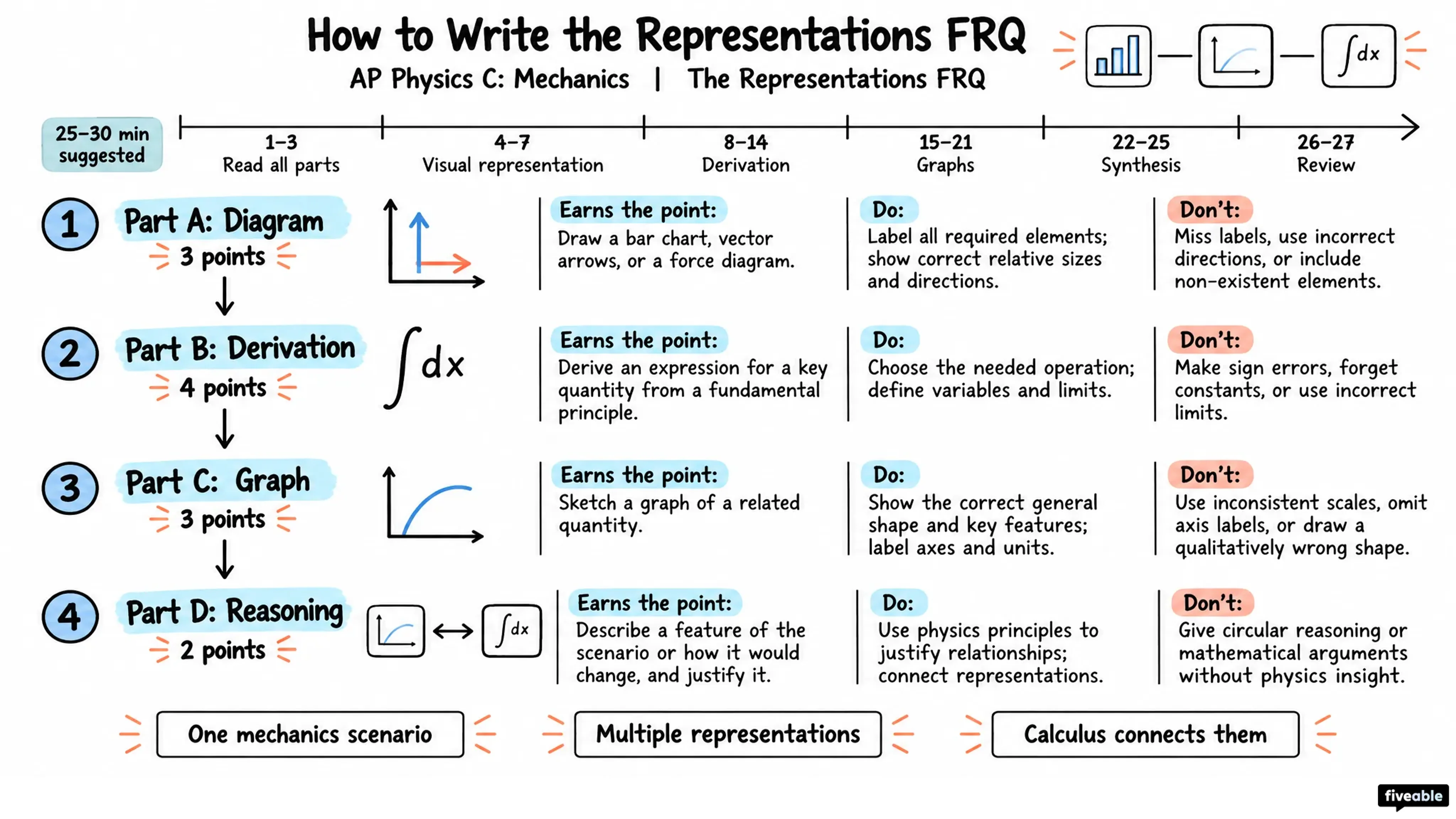
Representations FRQ skill sheet
Every rubric point on one page: what earns it, what to do and what to avoid. Tap the sheet to see it full size.
How Representations FRQ practice works
Each question follows the exam’s format, from the full prompt to a score on every part.
Read the full question
The scenario, its figures, and parts A through D, laid out the way the exam shows them.
Write on a 27-minute timer
Inside the 25 to 30 minutes the exam suggests for this question. Pause it or turn it off, and your response saves as you go.
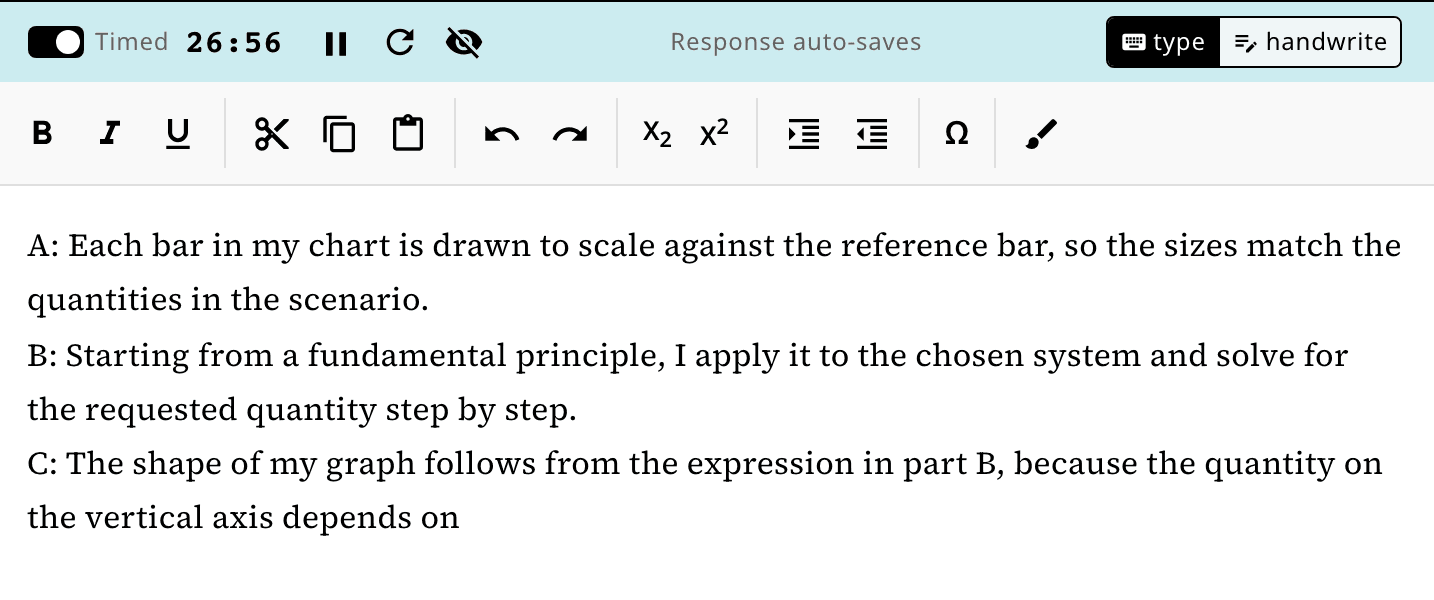
Submit for a score out of 12
Your response is scored against the scoring guidelines written for that question. Your first score is included.
Feedback on every part
A summary at the top tells you what to work on next. Below it, each part shows whether you earned the point and what the scoring guidelines were looking for.
Detailed Feedback
Part A: 1/1 point
Earned the point. You correctly drew and labeled the gravitational force pointing downward and the tension force pointing upward on the block.
Part A: 0/1 point
Did not earn the point. Your free-body diagram for the disk is missing the upward normal/axle force from the mount. The disk should have three forces: gravity (down), tension (down), and the axle force (up).
Part A: 1/1 point
Earned the point. You correctly drew the gravitational force vector longer than the tension vector on the block, indicating it accelerates downward, and you did not include any extraneous forces.
Questions about the Representations FRQ
How many responses can I get scored?
You can read every question without a plan. Your first scored response is included. A plan unlocks unlimited scoring.
What representations does the TBR ask for?
A diagram such as an energy bar chart, velocity vectors, or a force diagram, then a derivation, a graph of a related quantity, and a written description of a feature of the scenario.
How is the TBR different from the Mathematical Routines question?
Both include derivations. The TBR is built around linking a diagram, an equation, and a graph of the same scenario, and it is worth 12 points instead of 10.
How do I draw the bar chart or graph?
Use the drawing tool to draw on the question’s figure or on a blank graph. Your drawing is scored with the rest of your response. You can also switch to handwrite and add a photo of your page.
Are these real College Board questions?
No. We wrote them in the AP format, with the same four parts, and wrote scoring guidelines for each one.
More AP Physics C: Mechanics practice
Mathematical Routines FRQ practice
Mathematical Routines questions with the full scenario, figures, and both parts.
Experimental Design FRQ practice
Experimental Design questions with the lab setup, the data table, and all four parts.
Qualitative/Quantitative FRQ practice
Qualitative/Quantitative Translation questions with the full scenario and all three parts.
AP Physics C: Mechanics FRQs
Every FRQ type for AP Physics C: Mechanics, with practice for each.
Write your first Representations FRQ
Pick one from the list, or let us choose for you.
Teaching AP Physics C: Mechanics? Assign these Representations FRQs to your class