AP Latin Short Essay Practice
24 Short Essay questions written in the AP format. Pick one, read the Latin passage, and write both parts. Fiveable scores each Short Essay response part by part on the AP rubric.
Your first scored response is included. A plan unlocks unlimited scoring.
24 questions
sorted by unit
Volcanic hazards threatening Roman naval rescue operations
Unit 2: Unit 2 – Pliny's Letters: Eruption of Mt. Vesuvius
Source: Pliny the Younger, Epistulae 6.16.11-12
Iam navibus cinis incidebat, quo propius accederent, calidior
et densior; iam pumices etiam nigrique et ambusti
et fracti igne lapides; iam vadum subitum ruinaque
montis litora obstantia. Cunctatus paulum an retro flecteret,
mox gubernatori, ut ita faceret, monenti:
"Fortes" inquit "fortuna iuvat; Pomponianum pete."
Answer the following question(s) in English unless the question specifically asks you to provide Latin words.
The passage describes a series of dangerous physical obstacles that threaten the ships.
(i) Identify one specific physical danger that confronts the ships as they approach.
(ii) Provide the Latin word(s) from the passage that support your answer in part (i).
(iii) Translate in context the Latin word(s) you cited in part (ii).
Explain how the elder Pliny is characterized in this passage.
Your response should be 3 to 4 complete sentences in length.
In your response you should do the following:
- Respond to the prompt with an interpretation.
- Include at least one specific Latin citation from the passage. Provide the Latin and/or cite line numbers and translate or accurately paraphrase the Latin. Refer to more than a single word in your reference.
- Explain how the Latin citation(s) support(s) your response.
What the Short Essay asks
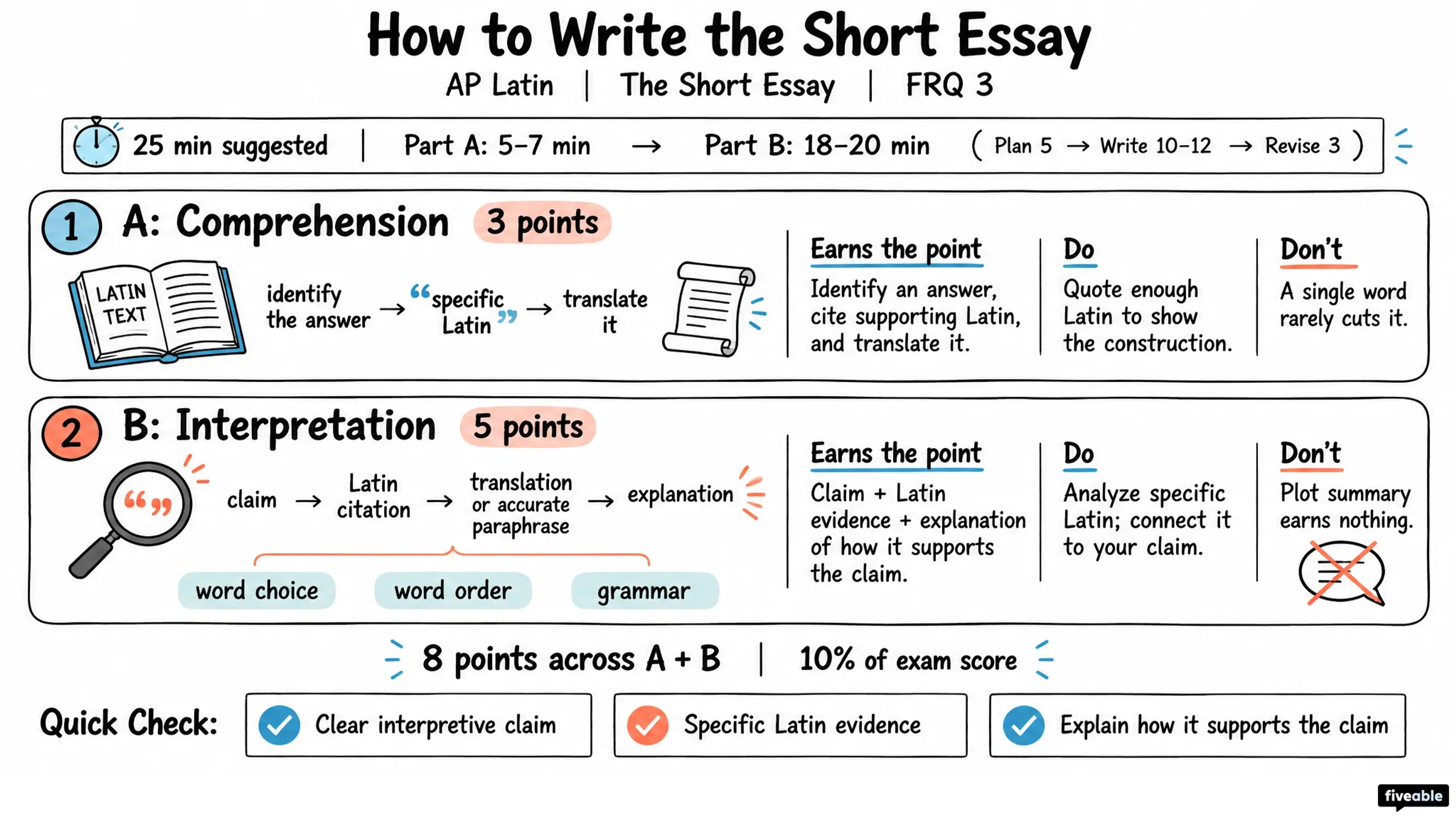
The Short Essay is FRQ 3 on the AP Latin exam. You read a passage of Vergil or Pliny, answer a comprehension question in Part A, and write a short interpretation in Part B supported by Latin from the passage.
- 25 min
- suggested time
- 8 points
- across parts A and B
- 10%
- of your exam score
Part A: Comprehension
Identify an answer, cite the Latin that supports it, and translate it
3 pts
Part B: Interpretation
A claim, a Latin citation, its translation, and how the Latin supports the claim
5 pts
Short Essay skill sheet
Every rubric point on one page: what earns it, what to do and what to avoid. Tap the sheet to see it full size.
How Short Essay practice works
Each question follows the exam’s format, from the full prompt to a score on every part.
Read the passage and both parts
The Latin passage, Part A, and the Part B prompt, laid out the way the exam shows them.
Write on a 25-minute timer
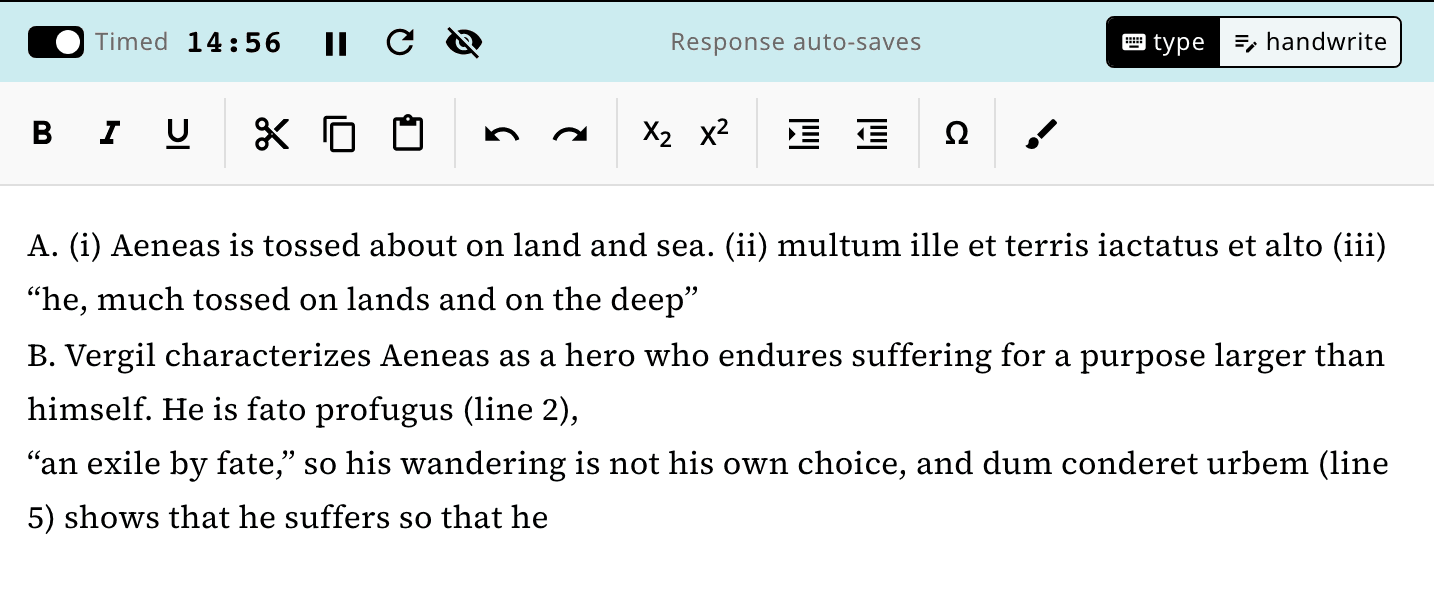
The time to plan for on exam day. Pause it or turn it off, and your response saves as you go.
Submit for a score out of 8
Your response is scored against the scoring guidelines written for that question. Your first score is included.
Feedback on every part
A summary at the top tells you what to work on next. Below it, each part shows whether you earned the point and what the scoring guidelines were looking for.
Detailed Feedback
Part A: 3/3 points
Full marks. You accurately identify multiple conditions Juno imposes — preserving the Latin name, language, and dress, and maintaining Latin political continuity — which satisfies A(i). You provide two Latin citations: 'nomen mutare Latinos' is substantive enough to earn the citation point (A(ii)), and both translations are accurate. 'Sit Latium, sint Albani per saecula reges' = 'let Latium remain, let there be Alban kings through the ages' is particularly well-rendered. One small note: 'nomen mutare Latinos' is a partial phrase (the 'ne vetus indigenas' context is dropped), but it still conveys a complete and accurate idea, so it clears the bar for A(ii) and A(iii).
Questions about the Short Essay
How many responses can I get scored?
You can read every question without a plan. Your first scored response is included. A plan unlocks unlimited scoring.
How long should Part B be?
Three to four complete sentences, as the prompt asks. Spend them on one interpretation, a specific Latin citation, and how that Latin supports your reading.
How much Latin should I cite?
More than a single word. Translate or accurately paraphrase what you cite, and add line numbers if they help.
How is the Short Essay different from the Short Answer Question?
The Short Answer Question asks several quick questions about a passage. The Short Essay asks for one interpretation argued from the Latin, and the exam suggests 25 minutes for it.
More AP Latin practice
Short Answer Question practice
Short Answer Questions with the full Latin passage and all seven parts.
Write your first Short Essay
Pick one from the list, or let us choose for you.
Teaching AP Latin? Assign these Short Essays to your class