AP Latin Short Answer Question Practice
25 Short Answer Questions written in the AP format. Pick one, read the Latin passage, and answer every part. Fiveable scores each Short Answer Question response part by part on the AP rubric.
Your first scored response is included. A plan unlocks unlimited scoring.
25 questions
sorted by unit
Vesuvius eruption, ash, and naval response
Unit 2: Unit 2 – Pliny's Letters: Eruption of Mt. Vesuvius
Answer the following questions in English unless the question specifically asks you to provide Latin words. Base your answers on the passage below.
Source: Pliny the Younger, Epistulae 6.16.11-12
Iam navibus cinis incidebat, quo propius accederent, calidior
et densior; iam pumices etiam nigrique et ambusti
et fracti igne lapides; iam vadum subitum ruinaque
montis litora obstantia. Cunctatus paulum an retro flecteret,
mox gubernatori, ut ita faceret, monenti:
"Fortes" inquit "fortuna iuvat; Pomponianum pete."
Stabiis erat diremptus sinu medio;
nam sensim circumactis curvatisque litoribus mare infunditur.
cinis, cineris, m.: ash
pumex, pumicis, m.: pumice stone
amburo, -ere: to burn around, scorch
vadum, -i, n.: shallow water
ruina, -ae, f.: collapse, fallen mass
obsto, obstare: blocking, standing in the way
cunctor, cunctari: to delay, hesitate
flecto, -ere: to turn, bend
gubernator, -oris, m.: pilot, helmsman
Pomponianus, -i, m.: Pomponianus, a friend of Pliny the Elder
Stabiae, -arum, f. pl.: Stabiae, a town near Vesuvius
dirimo, -ere: to separate, divide
(i) Translate in context the phrase quo propius accederent (line 1).
(ii) Identify the grammatical construction of accederent in this clause.
Identify the contextual meaning of the word subitum (line 3).
Identify what the phrase fracti igne lapides (lines 2–3) describes.
Identify the case and number of gubernatori (line 5).
Translate in context the sentence Fortes fortuna iuvat (line 6).
Identify or describe the grammatical use of the subjunctive verb faceret (line 5).
Identify the destination the speaker orders the helmsman to head for in line 6.
What the Short Answer Question asks
The Short Answer Question is FRQ 1 on the AP Latin exam. You get a passage of Vergil or Pliny from the required readings and answer a series of short questions on translation, grammar, scansion, style, and context.
- 15 min
- suggested time
- 8 points
- across parts A to G
- 10%
- of your exam score
Part A: Translate and identify
Translate a phrase in context, then identify a case, form, or construction in it
2 pts
Part B–G: Six short answers
Meaning in context, antecedents, grammar, content, and background from the readings
6 pts
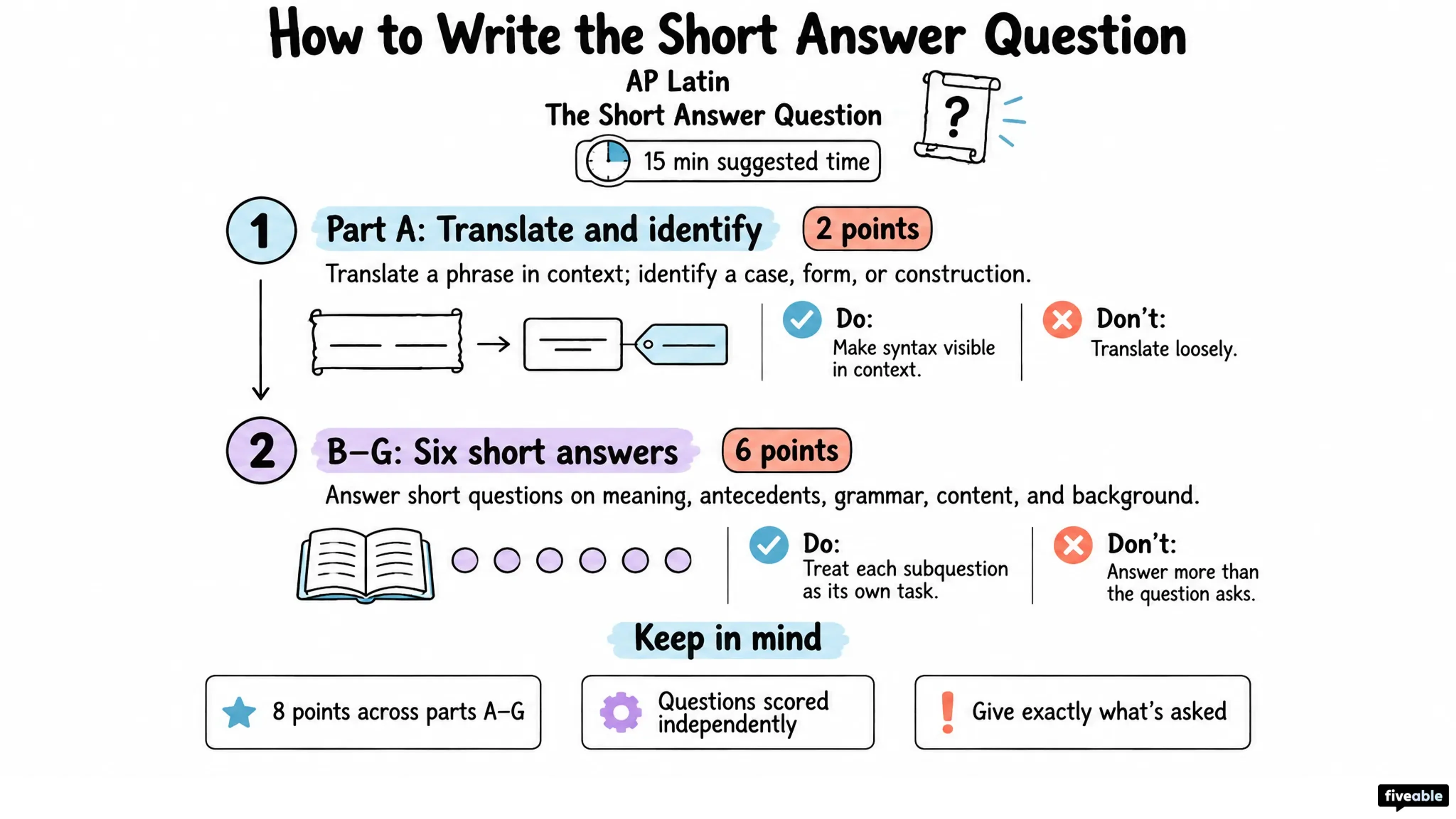
Short Answer Question skill sheet
Every rubric point on one page: what earns it, what to do and what to avoid. Tap the sheet to see it full size.
How Short Answer Question practice works
Each question follows the exam’s format, from the full prompt to a score on every part.
Read the passage and every part
The Latin passage and all seven parts, A through G, laid out the way the exam shows them.
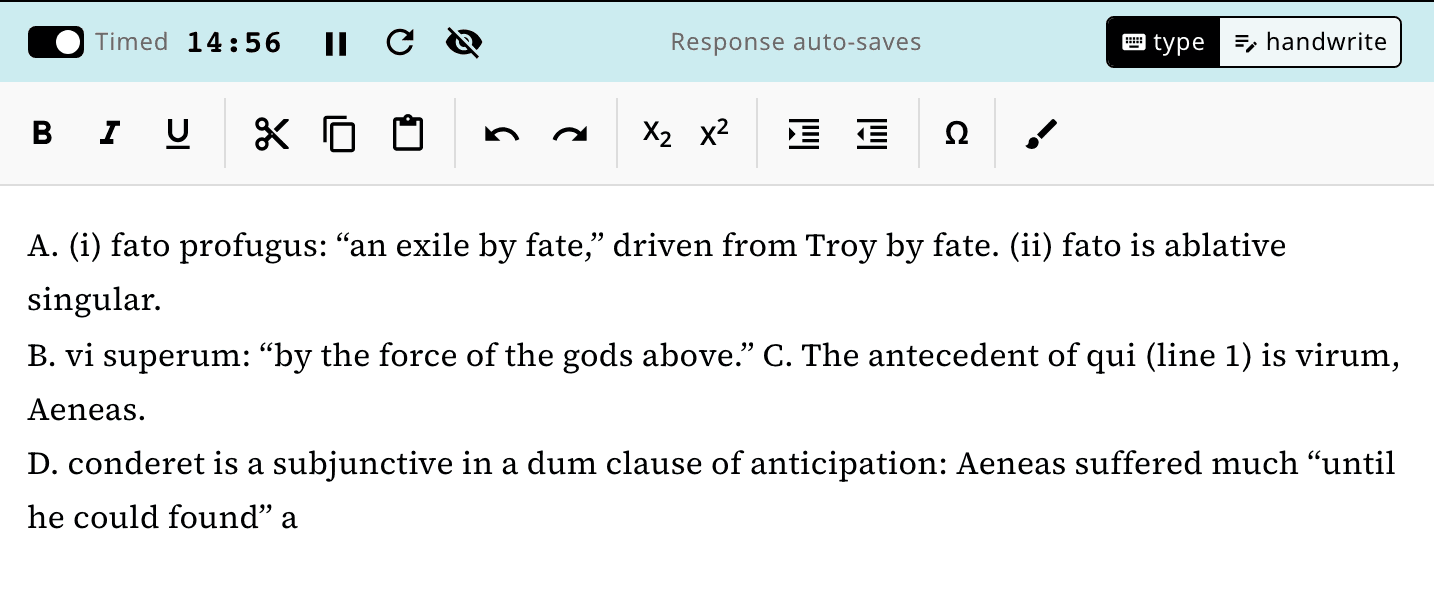
Write on a 15-minute timer
The time to plan for on exam day. Pause it or turn it off, and your response saves as you go.
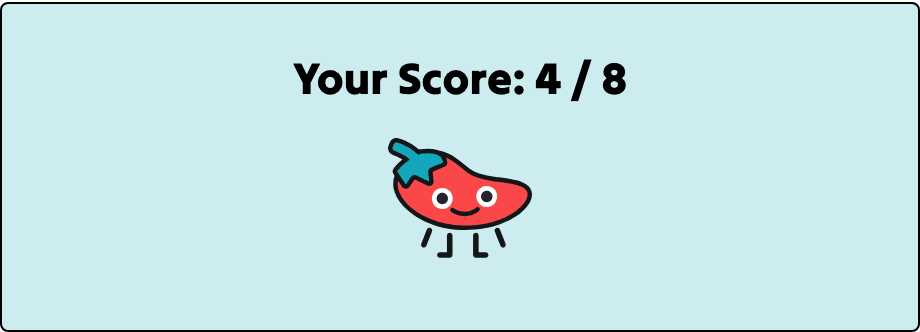
Submit for a score out of 8
Your response is scored against the scoring guidelines written for that question. Your first score is included.
Feedback on every part
A summary at the top tells you what to work on next. Below it, each part shows whether you earned the point and what the scoring guidelines were looking for.
Detailed Feedback
Part A(A(i)): 0/1 point
Did not earn the point. Your translation 'Having being untied from fear in the same manner' has two problems. First, 'adeo' means 'so' or 'to such a degree' — it's an intensifier, not 'in the same manner.' You needed something like 'so free from fear' or 'freed from fear to such a degree.' Second, 'untied' is a stretch for 'solutus' — while it technically comes from 'solvo,' the contextual meaning here is 'free' or 'released.' The intensifier 'adeo' is the key word you missed.
Part A(A(ii)): 1/1 point
Earned the point. You correctly identified 'metu' as ablative.
Part B: 1/1 point
Earned the point. You identified 'maximo' as meaning 'maximum' or 'to the fullest extent,' which captures the superlative sense required. To make this even stronger, you could note that it contrasts with 'studioso animo' to show the scale of Pliny's spirit in undertaking the mission.
Questions about the Short Answer Question
How many responses can I get scored?
You can read every question without a plan. Your first scored response is included. A plan unlocks unlimited scoring.
How do I mark scansion?
Pick one notation and keep to it: D and S for dactyls and spondees, or - and u for long and short syllables. You can also switch to handwrite and add a photo of your marked lines.
How much should I write for each part?
Only what the part asks. If it asks for one action, give one. A translate-in-context part needs English that shows the Latin syntax, like “in order to” for a purpose clause.
Which authors are on it?
Vergil’s Aeneid and Pliny the Younger’s Letters, from the required readings. Each question uses one passage from one of them.
Are these real College Board questions?
No. We wrote them in the AP format, with passages from the required readings, and wrote scoring guidelines for each one.
More AP Latin practice
Write your first Short Answer Question
Pick one from the list, or let us choose for you.
Teaching AP Latin? Assign these Short Answer Questions to your class