AP Latin Unit 4 Cheatsheet: Required - Vergil's Aeneid: Excerpts From Books 1 and 2

AP Latin Unit 4 Cheatsheet: Required - Vergil's Aeneid: Excerpts From Books 1 and 2

Start with the first 3 sections of the Unit 4 one-page cheatsheet below. The full sheet is a PDF you can print.

Dactylic Hexameter & Meter

Greek and Roman epic poetry, including the Aeneid, is typically composed in dactylic hexameter, with six metrical feet per line.

  • Dactyl: — ∪ ∪ (long + 2 short)
  • Spondee: — — (2 long)
  • Trochee: — ∪ (long + short)

Vergilian pattern:

  • Feet 1–4: dactyl OR spondee
  • Foot 5: usually dactyl
  • Foot 6: spondee OR trochee

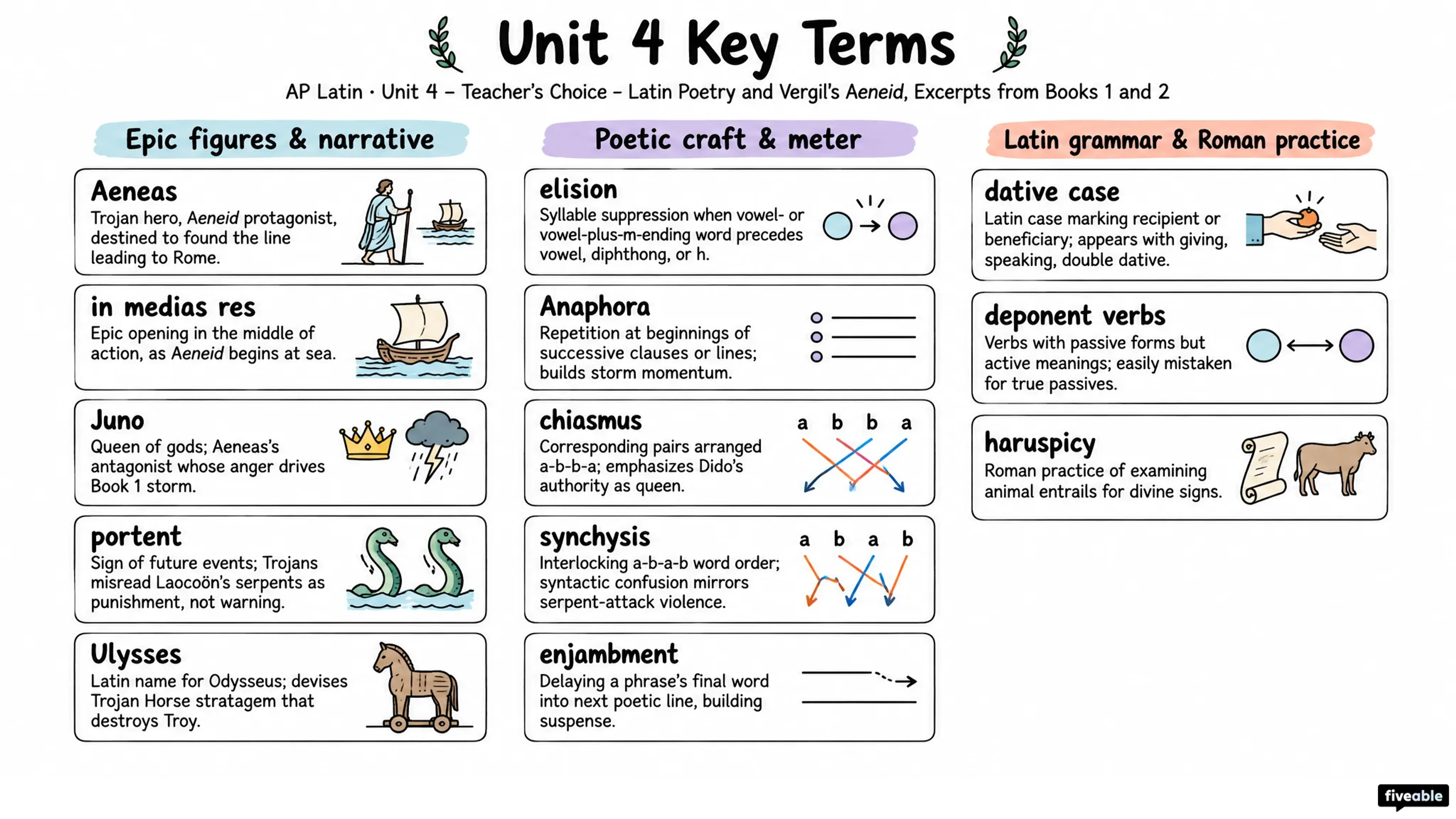
Elision: Partial suppression of a word's end when it ends in a vowel, vowel + m, or diphthong AND the next word begins with a vowel, diphthong, or h. Read through the elided syllable without pause.
Epic Genre & Conventions

Epic poetry is a highly stylized, long-established genre. Poets claimed their place in tradition by using established elements while adding personal contribution.

Key structural elements:

  • Proem: preface or prologue
  • Invocation to the Muses: request for divine inspiration
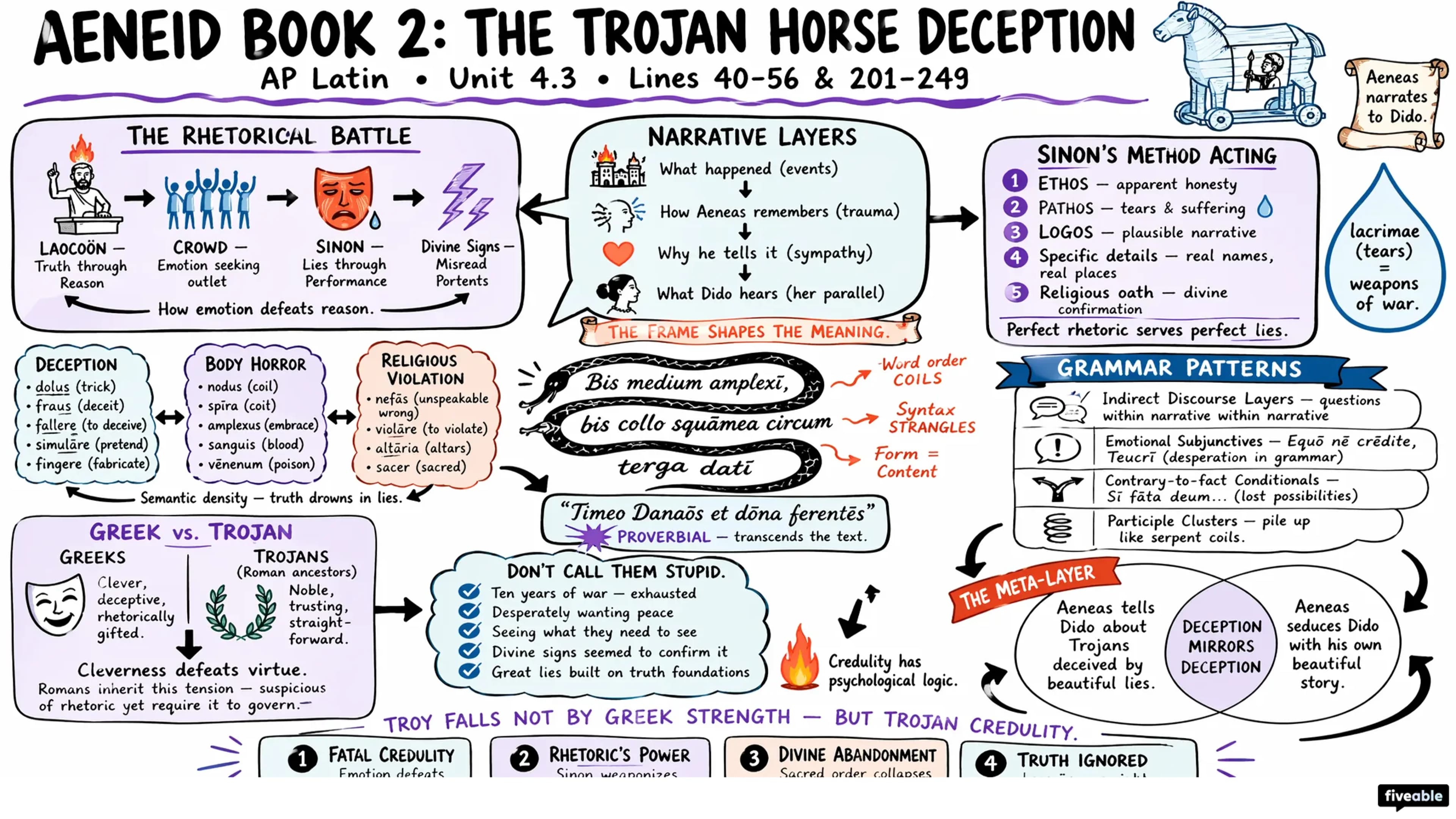
  • In medias res: narrative begins in the middle of action, not at the start

Vergil's sources: Drew inspiration from Homer's Odyssey and Iliad.

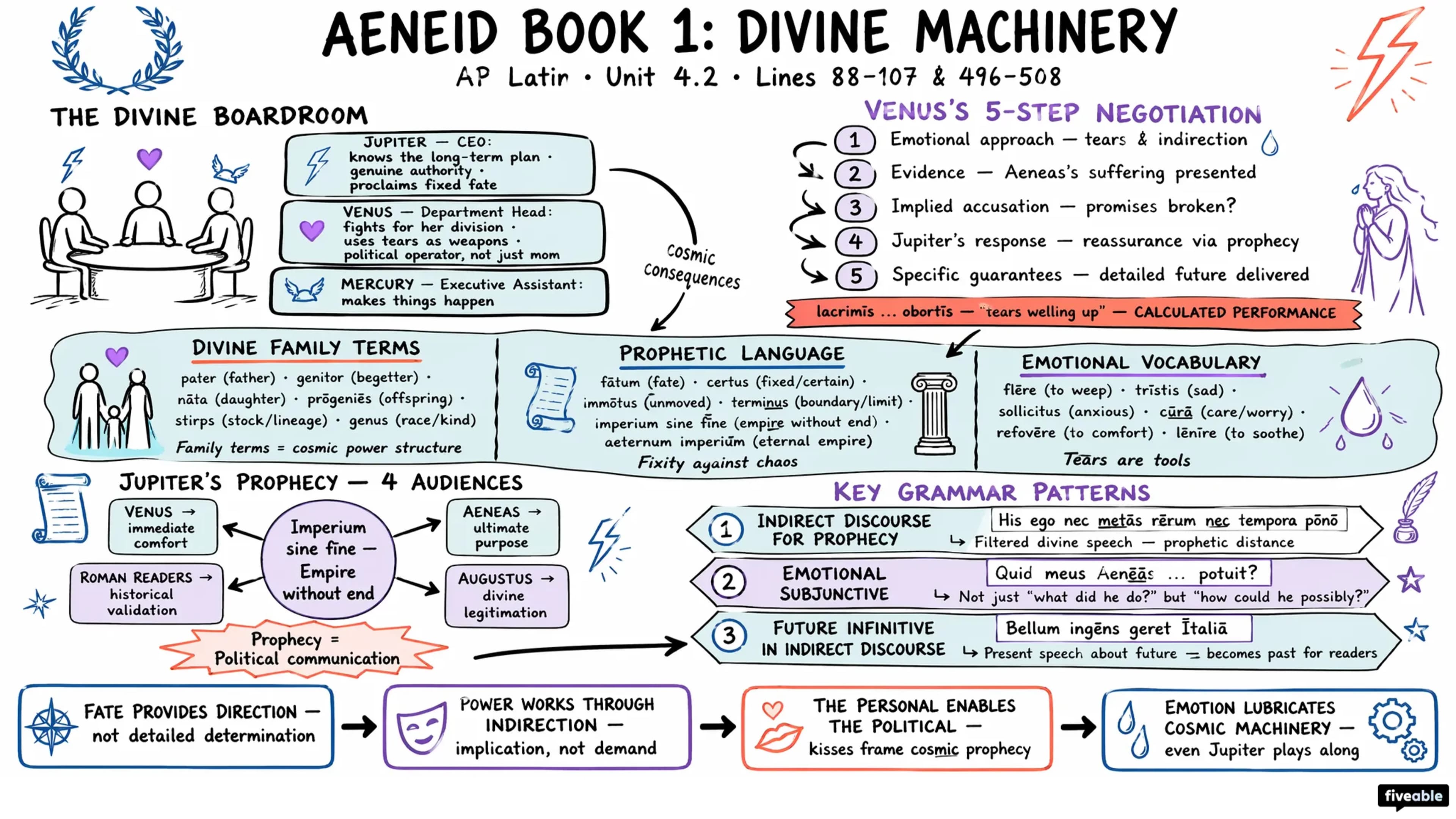
Purpose of the Aeneid: Created a foundation legend establishing Augustus's divine ancestry (descendant of Aeneas, son of Venus) and preordained status as ruler; presented Romans as fated to rule the world.

Key Mythological Figures & Allusions

Gods & Goddesses:

  • Jupiter: King of gods; married to Juno
  • Juno: Queen of gods; goddess of marriage
  • Venus: Goddess of love, beauty, desire, victory; Aeneas's mother; married to Vulcan
  • Minerva, Mars, Apollo, Mercury: Jupiter's children; respectively gods of crafts, war, music/prophecy, and commerce
  • Neptune, Pluto (Dis): Saturn's sons; gods of seas and underworld
  • The Fates: Three goddesses controlling human destiny, lifespan, accomplishment, suffering

Legendary Figures:

  • Dido (Elissa): Legendary founder of Carthage; fled Tyre after brother Pygmalion murdered her husband Sychaeus; rejected Iarbas's marriage proposal
  • Paris: Trojan prince; judged the beauty contest between Hera, Athena, Aphrodite; chose Aphrodite, causing Helen to fall in love with him

The rest of the Unit 4 sheet

6 more sections are on the one-page PDF:

  • Stylistic Devices: Repetition & Word Order

  • Historical Context: Augustus & Civil Wars

  • Grammar: Adjectives, Participles & Conditions

  • The Trojan War & Trojan Horse

  • Grammar: Cases & Verb Tenses

  • Similes, Metaphors & Interpretation

Made by Fiveable

Text-Based Cheatsheet

Unit 4: Required - Vergil's Aeneid: Excerpts From Books 1 and 2 on one page, aligned to the 2026-2027 course. Made and checked by the Fiveable Content Team.

Or get the whole course

Made by you

Visual Cheatsheets

Pick a Unit 4 topic and a format: flowchart, comparison chart, vocab sheet, Cornell notes and more. Ready in about a minute.

Printable PDF · from the Fiveable shop

AP Latin Unit 4 Cheatsheet

1 page · Required - Vergil's Aeneid: Excerpts From Books 1 and 2 · PDF

Visual Cheatsheets

One topic, the format you pick, ready in about a minute

Format

Topic

Takes 30–60 seconds

Preview: Standard

Unit 4: Teacher's Choice – Latin Poetry and Vergil's Aeneid, Excerpts from Books 1 and 2, topic by topic

Each topic has a full study guide. See the whole unit.